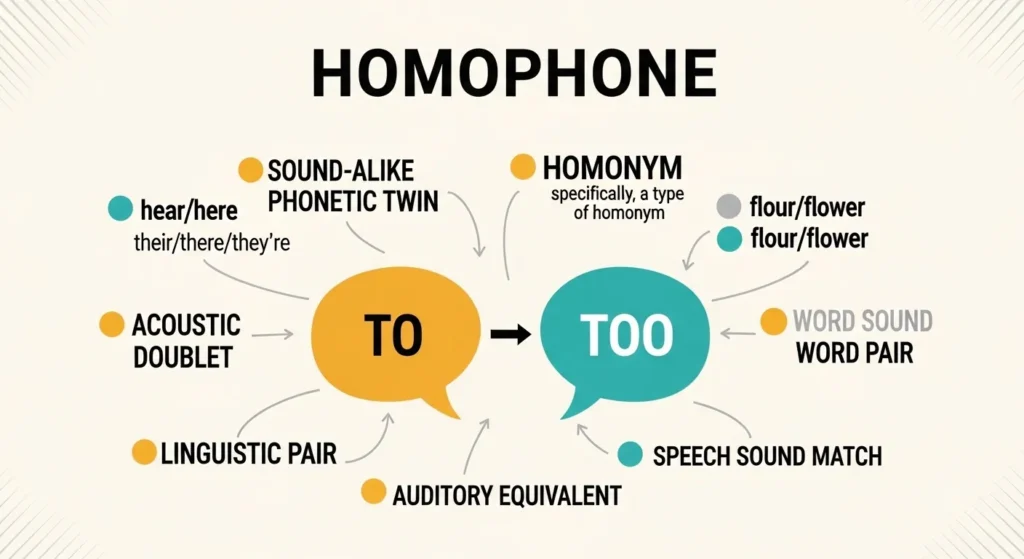
Have you ever heard two words that sound exactly the same but mean completely different things? For example, “flower” and “flour.”
This is where the idea of homophones comes in. A homophone is a word that sounds like another word but has a different meaning and often a different spelling.
Many learners search for synonyms of homophone, similar words for homophone, or another word for homophone because they want to understand this concept better.
However, finding exact synonyms can be tricky since “homophone” is a specific linguistic term.Still, there are easy synonyms for homophone and related terms that can help you expand your vocabulary and communicate more clearly.
For instance, when writing or speaking, understanding these similar words helps avoid confusion and improves accuracy.
Imagine texting someone, “I’ll meet you at the write place,” instead of “right place.” It can completely change the meaning! Therefore, learning homophones and their related terms can make your English much stronger and more confident.
In this guide, you’ll discover clear meanings, practical examples, and useful alternatives to help you fully understand and use these terms in daily communication.
Featured Snippet
A homophone is a word that sounds the same as another word but has a different meaning and often a different spelling.
While exact synonyms are limited, related terms like homonym and homograph are often used in similar contexts to describe word similarities.
Why Learning Synonyms of Homophone Matters
Understanding synonyms for homophone helps you grasp subtle differences in language. Although “homophone” has a specific meaning, related terms improve your vocabulary and clarity.
Moreover, learning these words helps avoid confusion in writing and speaking. For example, using the wrong word can change meaning completely. Therefore, knowing similar words for homophones makes your communication more precise.
In addition, it boosts your confidence in English, especially in exams, writing tasks, and conversations.
Synonyms of Homophone
Here are similar words for homophone and closely related terms used in English:
Homonym
Meaning: A word that shares either the same spelling, pronunciation, or both with another word but has a different meaning.
Examples:
- “Bat” can mean an animal or sports equipment.
- She saw a bat flying at night.
Homograph
Meaning: Words that are spelled the same but may have different meanings and pronunciations.
Examples:
- “Lead” (to guide) and “lead” (a metal).
- He will lead the team tomorrow.
Same-sounding word
Meaning: A simple term for words that sound alike.
Examples:
- “Sea” and “see” are same-sounding words.
- These same-sounding words confuse beginners.
Sound-alike word
Meaning: Words that sound similar or identical.
Examples:
- “Break” and “brake” are sound-alike words.
- Sound-alike words often cause spelling mistakes.
Identical pronunciation words
Meaning: Words pronounced exactly the same.
Examples:
- “Pair” and “pear” have identical pronunciation.
- Students struggle with identical pronunciation words.
Phonetic match
Meaning: Words that share the same pronunciation pattern.
Examples:
- “Knight” and “night” are phonetic matches.
- This is a clear phonetic match example.
Pronunciation pair
Meaning: Two words with the same sound but different meanings.
Examples:
- “Right” and “write” form a pronunciation pair.
- Learn each pronunciation pair carefully.
Word twin (informal)
Meaning: Informal term for words that sound alike.
Examples:
- “Sun” and “son” are word twins.
- Kids enjoy learning word twins.
Audio twin
Meaning: Words that sound identical when spoken.
Examples:
- “Buy” and “by” are audio twins.
- Audio twins are common in English.
Speech-alike word
Meaning: Words that sound the same in spoken language.
Examples:
- “Allowed” and “aloud” are speech-alike words.
- Speech-alike words can confuse listeners.
Phonological twin
Meaning: Words identical in sound structure.
Examples:
- “Meet” and “meat” are phonological twins.
- Linguists study phonological twins.
Similar-sounding word
Meaning: Words that sound very close or identical.
Examples:
- “Accept” and “except” are similar-sounding.
- These words are often mixed up.
Sound match
Meaning: Words that share the same sound.
Examples:
- “Sale” and “sail” are a sound match.
- Practice each sound match daily.
Pronunciation duplicate
Meaning: Words that share identical pronunciation.
Examples:
- “Plain” and “plane” are duplicates.
- These pronunciation duplicates are tricky.
Phonetic twin
Meaning: Words with the same spoken form.
Examples:
- “Hole” and “whole” are phonetic twins.
- Phonetic twins need careful attention.
Acoustic match
Meaning: Words that sound the same acoustically.
Examples:
- “Hour” and “our” are acoustic matches.
- Acoustic matches are common in speech.
Verbal twin
Meaning: Words identical in spoken language.
Examples:
- “One” and “won” are verbal twins.
- Verbal twins confuse learners.
Sound pair
Meaning: A pair of words with the same pronunciation.
Examples:
- “Two” and “too” are a sound pair.
- Memorize each sound pair.
Phonetic equivalent
Meaning: Words that share the same sound.
Examples:
- “No” and “know” are equivalents.
- This is a phonetic equivalent case.
Speech twin
Meaning: Words identical in spoken form.
Examples:
- “Hear” and “here” are speech twins.
- Practice speech twins regularly.
Audio equivalent
Meaning: Words that sound the same when heard.
Examples:
- “Weak” and “week” are audio equivalents.
- Audio equivalents improve listening skills.
Same pronunciation pair
Meaning: Words pronounced the same way.
Examples:
- “Stair” and “stare” are such pairs.
- These pairs appear in exams.
Sound duplicate
Meaning: Words with identical sound patterns.
Examples:
- “Blue” and “blew” are sound duplicates.
- Sound duplicates are tricky.
Phonetic match pair
Meaning: Words sharing exact pronunciation.
Examples:
- “Dear” and “deer” are a match pair.
- Learn each phonetic match pair.
Identical sound word
Meaning: Words that sound exactly alike.
Examples:
- “Buy” and “bye” are identical sound words.
- Practice identical sound words daily.
Quick Synonyms Table
| Word | Meaning | Example |
| Homonym | Same spelling or sound, different meaning | “Bat” has multiple meanings |
| Homograph | Same spelling, different meaning | “Lead” varies in meaning |
| Sound-alike word | Words that sound the same | “Brake” and “break” |
| Phonetic twin | Same pronunciation | “Meet” and “meat” |
| Audio twin | Identical sound | “Buy” and “by” |
| Speech-alike word | Same spoken form | “Aloud” and “allowed” |
How to Choose the Right Synonym
Choosing the right synonyms for homophone depends on context.
For example, if you are writing academically, use “homonym” or “homograph.” However, in casual conversation, “sound-alike word” is easier to understand.
Moreover, if you want clarity for beginners, use simple phrases like “same-sounding words.” On the other hand, in linguistic discussions, terms like “phonetic equivalent” are more accurate.
Real-life examples:
- In school: “These are homophones like ‘their’ and ‘there.’”
- In casual talk: “These are sound-alike words.”
- In research: “These words are phonological twins.”
Therefore, always match the word to your audience and purpose.
Frequently Asked Questions
What is another word for homophone?
Another word for homophone includes related terms like homonym or sound-alike word. These are often used as similar words for homophones.
Are homonyms and homophones the same?
Not exactly. A homophone focuses on sound, while a homonym may share spelling or sound. However, they are often listed among synonyms for homophone.
Why are homophones confusing?
Homophones sound identical but have different meanings. Therefore, without context, understanding them can be difficult.
What are easy synonyms for homophone?
Easy synonyms for homophone include “same-sounding words” and “sound-alike words,” which are simple and beginner-friendly.
How can I learn homophones easily?
Practice with examples and use them in sentences. Moreover, learning similar words for homophones helps you understand differences faster.
Conclusion
In summary, while “homophone” is a specific term, there are many synonyms for homophone and related expressions that help explain it clearly. Words like “homonym,” “sound-alike word,” and “phonetic twin” can make learning easier.
Moreover, choosing the right term depends on your audience and purpose. For example, simple phrases work best in daily conversation, while technical terms suit formal writing.
Therefore, keep practicing these words in real-life situations. As a result, your vocabulary will grow, and your communication will become clearer and more confident.

James Parker is a writer who creates clear and helpful content for readers. I am James Parker, and I am a synonyms writer who focuses on explaining word meanings and differences in simple language to help students and learners understand concepts easily.