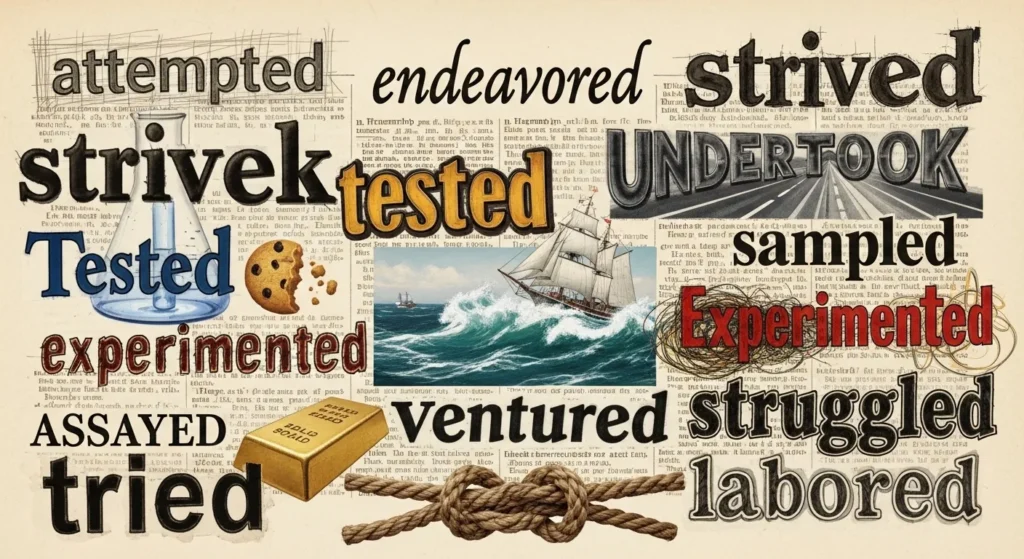
I’ll be honest, “tried” is one of those words I catch myself overusing in almost every first draft I write. It’s short, it’s easy, and it fits almost any sentence. But that’s exactly the problem. When a word is that flexible, it also becomes vague. If you’ve ever re-read something you wrote and felt like every third sentence started with “I tried to…” or “She tried…” you already know the feeling I’m talking about.
In this guide, I want to walk you through the word “tried” the way I’d explain it to a student: not just a list to skim, but an actual understanding of when and why to use each alternative. Because a synonym search shouldn’t just be “another word for tried” it should be about picking the right word for what you actually mean.
What Does “Tried” Actually Mean?
Quick answer: “Tried” is the past tense of “try.” It has two very different jobs in English:
- As a verb, it means you made an effort, attempted something, or tested it out (“She tried the new recipe”).
- As an adjective, it means something has been proven reliable through use or experience (“a tried and trusted method”).
Most people searching for a tried synonym are looking for the verb sense but if you’ve ever seen the phrase “tried and true” and wondered what makes it different, that’s the adjective sense. I’ll cover both, because mixing them up is where a lot of writers (and a lot of other synonym lists, honestly) go wrong.
There’s also a third, narrower use worth knowing: in a legal context, “tried” means a case was heard and judged in court as in, “the case was tried in a federal court.” I’ll touch on this too, since it’s a common search (tried synonym court) that most guides skip entirely.
Why Bother Learning Synonyms for “Tried” at All?
Think of it this way: if a doctor only knew the word “sick,” they couldn’t tell you whether you had a headache, a fracture, or a fever. Precision matters. The same logic applies to writing.
- “Attempted” signals formality good for reports, resumes, or academic writing.
- “Experimented” signals curiosity or a process good for science, cooking, or design writing.
- “Gave it a shot” signals casualness good for texts, blogs, or conversational tone.
- “Tried and true” signals trust built over time, good for recommendations and reviews.
Once you see synonyms this way as tools with different jobs, not just interchangeable words your writing naturally gets sharper. That’s really the whole point of this article.
Sense 1: “Tried” as an Adjective (Reliable, Proven, Tested)
This is the sense most articles on this topic skip, but it’s genuinely common. Think of phrases like “a tried method” or “tried and true.”
| Synonym | Meaning | Example |
| Tried and true | Proven reliable over time | This is a tried and true recipe passed down for generations. |
| Proven | Shown to work through evidence | They used a proven strategy to grow the business. |
| Reliable | Consistently trustworthy | He’s a reliable partner for any project. |
| Time-tested | Verified through long use | It’s a time-tested technique used by professionals. |
| Dependable | Can be counted on | She’s known for being dependable under pressure. |
| Trustworthy | Deserving of confidence | A trustworthy source confirmed the report. |
| Well-tried | Frequently tested and confirmed | This is a well-tried approach in classrooms worldwide. |
| Verified | Officially confirmed as accurate | The results were verified by an independent lab. |
| Established | Long accepted as valid | It follows an established process. |
Note on “tried and true”: If you’ve searched “what’s another way to say tried and true?” the closest natural alternatives are “time-tested,” “tried and tested,” or simply “proven.” These carry the same weight of long-standing reliability without repeating the original phrase.
Sense 2: “Tried” as a Verb (Attempted, Tested, Made an Effort)
This is the sense most people mean when they ask, “what can I say instead of tried?” Here’s a breakdown by tone, so you can actually pick the right one instead of guessing.
Formal / Professional Alternatives
Useful for reports, cover letters, academic writing, or anywhere you want to sound polished. This answers a common search tried synonym formal.
- Attempted She attempted to resolve the dispute before it escalated.
- Endeavored The team endeavored to meet the tight deadline.
- Undertook He undertook a thorough review of the contract.
- Sought They sought a solution that satisfied both parties.
- Pursued She pursued every possible option before giving up.
- Strived He strived for accuracy in every report he filed.
Everyday / Conversational Alternatives
Better for blogs, social captions, or casual writing.
- Gave it a shot I gave it a shot even though I wasn’t sure it would work.
- Had a go She had a go at fixing the leak herself.
- Took a chance He took a chance on the new job offer.
- Made an effort They made an effort to arrive on time.
- Went for it I just went for it without overthinking.
Testing / Experimenting Alternatives
Good for science, cooking, product reviews, or process-driven writing. This is often what people mean by another word for tried out.
- Tested The scientist tested three different formulas.
- Tried out I tried out the new app before recommending it.
- Experimented (with) She experimented with different spice ratios.
- Sampled We sampled a few brands before choosing one.
- Trialed The company trialed the software with a small team first.
Dealing With / Handling Alternatives
Used when “tried” describes tackling a problem or task.
- Tackled He tackled the issue head-on.
- Addressed The manager addressed the customer’s concern.
- Grappled with She grappled with the decision for weeks.
- Worked at He worked at improving his pronunciation daily.
The Legal Sense: “Tried” in Court
If you’ve landed here searching for a tried synonym court, this is for you. When “tried” refers to a legal case:
- The case was heard before a jury.
- Adjudicated The dispute was adjudicated in civil court.
- The defendant was prosecuted for fraud.
- Judged The matter was judged based on the evidence presented.
This sense is completely separate from “I tried to call you” so if you’re writing legal or news content, make sure you’re not mixing the two.
Antonyms of “Tried” (The Opposite Words)
A lot of writers forget antonyms even matter but knowing the opposite of a word often sharpens how you use the word itself. Here’s the answer to tried antonyms:
- For the “attempted” sense: gave up, abandoned, quit, dropped, ignored
- For the “reliable/proven” sense: untried, unproven, untested, unreliable, unverified, uncertain
For example: “an untried method” means one that hasn’t been tested yet the direct opposite of “a tried and true method.”
Quick Reference Table
| Context | Best Word Choice | Example |
| Formal writing | Attempted, Undertook | He attempted the exam despite illness. |
| Casual speech | Gave it a shot, Had a go | I had a go at painting last weekend. |
| Science/testing | Tested, Experimented | They tested the new formula twice. |
| Reliability/trust | Tried and true, Proven | This is a proven method for saving time. |
| Legal writing | Heard, Adjudicated | The case was heard in district court. |
| Dealing with a problem | Tackled, Addressed | She tackled the issue immediately. |
How to Actually Choose the Right Synonym
Here’s the quick mental check I use, and I’d suggest you use it too:
- Am I talking about an effort or attempt? → Use attempted, endeavored, or gave it a shot (depending on tone).
- Am I talking about testing something? → Use tested, tried out, or experimented.
- Am I talking about something proven reliable? → Use tried and true, proven, or time-tested.
- Am I writing about a legal case? → Use heard, adjudicated, or prosecuted.
- What’s my tone, formal or casual? → Let that decide the final word.
That’s really it. Context first, tone second, word last.
Frequently Asked Questions
What can I say instead of “tried”? It depends on the meaning. If you mean “made an effort,” use attempted, endeavored, or gave it a shot. If you mean “tested,” use tested, tried out, or experimented. You mean “proven reliable,” use tried and true or time-tested.
What is a better word for “attempt”? Attempted, endeavored, undertook, and ventured are all strong alternatives, depending on how formal you want to sound.
What’s another way to say “tried and true”? Time-tested, tried and tested, or proven are the closest natural alternatives; they all describe something reliable because it’s been used successfully before.
What is another word for “tried to”? “Attempted to,” “sought to,” “endeavored to,” and “made an effort to” all work as direct replacements for “tried to.”
What is another word for “tried out”? “Tested,” “sampled,” or “trialed” are commonly used instead of “tried out,” especially in product reviews or professional writing.
Is there a synonym for “tries” (the plural/present form)? Yes attempts, efforts, endeavors, or trials, depending on context. For example, “three tries” can become “three attempts.”
Are “tried” and “tested” the same thing? Not exactly. “Tried” usually means an effort was made, while “tested” specifically implies checking something’s performance or accuracy. They overlap in the phrase “tried and tested,” which combines both meanings.
What are the antonyms of “tried”? For the effort sense: gave up, abandoned, quit. For the reliability sense: untried, unproven, untested, unreliable.
Is “tried” ever used in a legal sense? Yes, “tried” can mean a case was heard and judged in court, as in “the case was tried in front of a jury.” This is a different meaning entirely from “I tried to help.”
Final Thoughts
“Tried” isn’t a bad word, it’s just an overused one. The goal isn’t to avoid it completely; it’s to know when a more precise word will say what you actually mean.
Next time you’re writing and “tried” shows up for the third time in a paragraph, ask yourself: am I talking about effort, testing, or reliability? Once you know the answer, the right synonym usually picks itself.

I am Aiden, a passionate writer at Synonyms who specializes in vocabulary, synonyms, and word meanings. I create clear, helpful content that makes language easier to understand for readers worldwide.Aiden is an English language expert with over
5 years of experience in vocabulary and
linguistics. He specializes in helping
learners improve their writing skills through
simple and practical word guides.