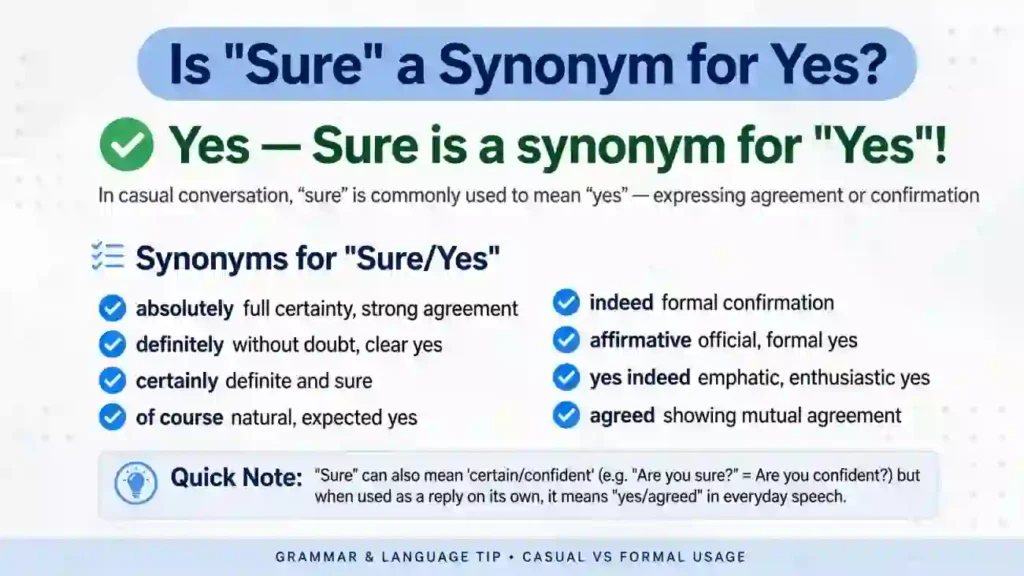
Yes, “sure” is a synonym for “yes” in many informal conversations, especially when agreeing to a request, accepting an offer, or giving permission. However, the words are not always interchangeable. “Yes” directly confirms something, while “sure” often expresses willingness, agreement, or a relaxed acceptance. The correct choice depends on the question and context.
Key Takeaways
- “Sure” can mean “yes,” “certainly,” or “of course” in casual American English.
- “Yes” is usually the clearest answer to a direct factual question.
- “Sure” often shows willingness to help, accept an offer, or grant permission.
- “Sure” is common in everyday conversation but may sound too casual in some formal situations.
- Tone matters because “sure” can sometimes sound hesitant, indifferent, or sarcastic.
What Does “Sure” Mean?
The word “sure” has several meanings, depending on how someone uses it. As an adjective, it commonly means certain or confident about something. As an informal response, it can mean “yes,” “certainly,” or “all right.”
For example:
- “Are you sure about the answer?” means, “Are you certain?”
- “Can you help me with this?” — “Sure!” means, “Yes, I can help.”
- “Would you like some coffee?” — “Sure!” means, “Yes, I’d like some.”
The Oxford Advanced Learner’s Dictionary identifies “sure” as an informal response used to say yes, particularly in North American English.
Oxford Learner’s Dictionaries
+1
Sure as an affirmative response
When someone answers with “sure,” they usually accept a suggestion, agree to a request, or indicate that something is fine with them.
For example:
Friend: Can I borrow your notebook?
You: Sure, just give it back tomorrow.
Here, “sure” means “yes.” It also communicates that you are willing to let your friend borrow the notebook.
Other examples include:
- “Can we meet after lunch?” — “Sure!”
- “Would you mind opening the window?” — “Sure, no problem.”
- “Can you send me the address?” — “Sure, I’ll send it now.”
In these situations, “sure” sounds natural, friendly, and relaxed.
Sure as a word expressing certainty
“Sure” does not always mean “yes.” It can also describe how certain someone feels about a fact, decision, or situation.
For example:
- “I’m sure she’s at home.” This expresses confidence.
- “Are you sure you locked the door?” This asks whether someone is certain.
- “I’m not sure what he meant.” This expresses uncertainty.
In these sentences, replacing “sure” with “yes” would change the meaning or make the sentence incorrect.
Therefore, when someone asks whether sure is a synonym for yes, the answer is yes in certain contexts, but not in every use of the word.
What Is the Difference Between Sure and Yes?
“Sure” and “yes” can communicate the same general message, but they often serve slightly different purposes.
“Yes” is a direct affirmative answer. “Sure” usually emphasizes willingness or acceptance, particularly when someone makes a request or suggestion.
| Situation | Using “yes” | Using “sure” |
| Factual question | “Yes, I live here.” | “Sure, I live here.” May sound unusual or context-dependent. |
| Request for help | “Yes, I can help.” | “Sure, I can help.” Sounds relaxed and friendly. |
| Accepting an offer | “Yes, thank you.” | “Sure, thanks.” Sounds casual. |
| Giving permission | “Yes, you may use it.” | “Sure, go ahead.” Sounds conversational. |
| Formal confirmation | “Yes, I confirm the appointment.” | “Sure.” May sound too casual or incomplete. |
The key distinction is that “yes” often confirms the content of a question, while “sure” frequently responds to the intention behind a request. English-usage discussions also highlight this difference, especially with questions involving permission.
English Language Learners Stack Exchange
+1
When to use yes
Use “yes” when you want to give a clear answer, confirm information, or avoid ambiguity.
Examples:
Question: Did you finish your homework?
Answer: Yes, I finished it.
Question: Are you available on Friday?
Answer: Yes, I’m available on Friday.
Question: Do you understand the instructions?
Answer: Yes, I understand them.
In these examples, “yes” directly confirms the information being requested.
It is also useful in professional writing, interviews, official conversations, and situations where a precise answer matters.
When to use sure
Use “sure” when you want to sound approachable, cooperative, or comfortable accepting a request.
Examples:
Question: Could you help me carry these boxes?
Answer: Sure, I’ll help you.
Question: Would you like to join us for dinner?
Answer: Sure, that sounds great.
Question: Can I borrow your pen?
Answer: Sure, here you go.
“Sure” works especially well in casual conversations with friends, family members, classmates, and coworkers.
However, it is not always an enthusiastic response. Depending on the speaker’s tone, it may simply communicate acceptance without showing much excitement.
Examples of Sure and Yes in Everyday Conversations
The easiest way to understand these words is to see how people use them in real-life situations.
1. In a conversation with a friend
Friend: Want to watch a movie tonight?
You: Sure! What do you want to watch?
Here, “sure” expresses agreement with a suggestion. It sounds natural and informal.
You could also say, “Yes! What do you want to watch?” Both responses work, although the tone may differ slightly.
2. When someone asks for help
Coworker: Can you review this document for me?
You: Sure, send it over.
“Sure” shows that you are willing to help. It is a common response in everyday workplace conversations.
A more formal alternative would be, “Certainly. Please send me the document.”
3. When answering a factual question
Friend: Did you call the restaurant?
You: Yes, I called them this morning.
Here, “yes” is the most direct answer because the question asks whether a specific action happened.
Responding with “sure” would sound unusual without additional context.
4. When granting permission
Sibling: Can I use your headphones?
You: Sure, just be careful with them.
In this example, “sure” means that you permit your sibling to use the headphones.
“Yes, you can use them” is also correct, but “sure” sounds more relaxed.
5. When the answer sounds uncertain
Friend: Are you definitely coming tomorrow?
You: Sure, I think so.
This answer sounds less definite because “I think so” introduces uncertainty. Depending on the tone, the listener might wonder whether you have fully committed.
If you want to communicate a definite commitment, say, “Yes, I’ll be there tomorrow.”
These examples show why context matters more than simply memorizing “sure” as another word for “yes.”
Is Sure a Polite or Formal Way to Say Yes?
Yes, “sure” can be polite. It often sounds friendly and cooperative when someone asks for help, offers something, or requests permission.
For example, “Sure, I’d be happy to help” is a warm and polite response. However, a single-word “Sure” may sound too casual in certain professional or formal settings.
Consider these alternatives:
| Situation | Recommended response |
| Talking with friends | “Sure!” |
| Accepting a casual invitation | “Sure, sounds good.” |
| Responding to a customer | “Certainly, I’d be happy to help.” |
| Confirming a business appointment | “Yes, I confirm the appointment.” |
| Agreeing to a manager’s request | “Of course. I’ll take care of it.” |
| Responding to an official request | “Yes, I can confirm that.” |
The best choice depends on the relationship, situation, and tone of the conversation.
In American English, “sure” is widely understood and commonly used in informal speech. For formal emails, official confirmations, and sensitive discussions, a more specific response can communicate your meaning more clearly.
Other Synonyms and Alternatives for Yes
If you want to avoid repeating “yes,” several alternatives can help you express agreement, enthusiasm, certainty, or willingness.
However, not every alternative fits every situation.
| Alternative | Meaning or tone | Example |
| Certainly | Polite and confident | “Certainly, I can help you.” |
| Of course | Willing agreement | “Of course, you can come along.” |
| Absolutely | Strong agreement | “Absolutely! That’s a great idea.” |
| Definitely | Clear commitment or certainty | “Definitely, I’ll be there.” |
| Okay | Acceptance or acknowledgment | “Okay, let’s get started.” |
| No problem | Willingness to help | “No problem, I’ll send it over.” |
| For sure | Informal, confident agreement | “For sure, I’ll join you.” |
| Sure thing | Friendly acceptance | “Sure thing, I’ll take care of it.” |
| Yep | Casual version of yes | “Yep, I’m ready.” |
| Affirmative | Formal or technical confirmation | “Affirmative, the system is ready.” |
Which alternative should you choose?
- For casual conversations: Use “sure,” “yep,” “okay,” or “sure thing.”
- For enthusiastic agreement: Use “absolutely” or “definitely.”
- For polite professional communication: Use “certainly” or “of course.”
- For a clear factual answer: Use “yes.”
- For formal or technical confirmation: Use “affirmative” when it suits the situation.
Remember that “okay” can mean acceptance without necessarily showing agreement, while “absolutely” usually expresses stronger agreement than a simple “yes.”
Common Mistakes When Using Sure
Although “sure” is a useful alternative to “yes,” a few common mistakes can make your meaning unclear.
1. Using sure for every question
Not every question can be answered naturally with “sure.”
Question: Have you submitted the application?
Clear answer: Yes, I submitted it.
“Sure” is less appropriate because the question asks whether an action has already happened, rather than whether you are willing to do something.
2. Assuming sure always expresses enthusiasm
A person who says “sure” may be happy to help, but the word alone does not guarantee excitement.
For example, “Sure, whatever you want” might sound neutral, reluctant, or dismissive depending on the speaker’s tone.
If you want to sound enthusiastic, try “Absolutely!” or “That sounds great!”
3. Using sure in formal writing without enough detail
A one-word reply may be acceptable in a quick workplace chat, but it may not provide enough information in an important email.
Instead of writing:
“Sure.”
You could write:
“Certainly. I’ll send the completed report by Friday.”
The longer response confirms both your agreement and the action you intend to take.
4. Confusing sure with surely
“Sure” and “surely” are related, but they do not always work in the same way.
- “Sure, I’ll help you.” — An informal acceptance.
- “I’m sure she’ll arrive soon.” — Confidence about something.
- “Surely, there’s another option.” — An expression of expectation or belief.
Choose the word that matches the meaning you want to communicate.
Frequently Asked Questions
Is sure a synonym for yes?
Yes. “Sure” is an informal synonym for “yes” when someone accepts a request, agrees to a suggestion, or grants permission. However, “sure” also means certain or confident, so it cannot replace “yes” in every sentence.
What does sure mean in a text message?
In a text message, “sure” usually means yes, okay, or that something is acceptable. For example, if a friend texts, “Want to meet at 6?” and you reply, “Sure,” you are agreeing to the plan. The tone depends on the conversation and any additional words or punctuation.
Is sure the same as absolutely?
Not exactly. Both words can express agreement, but “absolutely” often communicates stronger enthusiasm or certainty. “Sure” is generally more relaxed.
For example, “Sure, I’ll come” sounds casual, while “Absolutely, I’ll be there!” can sound more enthusiastic and definite.
Is sure a positive or negative response?
“Sure” is generally an affirmative response, meaning it indicates acceptance or agreement. However, the speaker’s tone and surrounding words can make it sound hesitant, reluctant, or sarcastic. If you need to express a clear, confident commitment, use a direct answer such as “Yes, definitely.”
What is a more formal synonym for sure?
“Certainly” is a useful formal or professional alternative when “sure” means willingness or agreement. Depending on the context, “of course,” “I agree,” and “yes, I can confirm that” may also work.
For example, instead of saying “Sure, I’ll help,” you could say, “Certainly, I’d be happy to assist.”
Can I say sure instead of yes in an email?
Yes, especially in informal emails and everyday workplace messages. For example, “Sure, I’ll send the file this afternoon” sounds natural. For formal correspondence, customer communication, or official confirmations, “Certainly” or a specific affirmative response may be more appropriate.
Conclusion
So, is sure a synonym for yes? Yes, in many everyday situations. In American English, “sure” is a common, informal way to accept a request, agree to a suggestion, or give permission.
The main difference is that “yes” directly confirms an answer, while “sure” often communicates willingness or acceptance. Use “sure” for relaxed conversations, “yes” for clear confirmation, and “certainly” for a more formal tone.
Understanding this small difference will help you choose more natural words and communicate clearly in conversations, text messages, and professional writing.

I am Aiden, a passionate writer at Synonyms who specializes in vocabulary, synonyms, and word meanings. I create clear, helpful content that makes language easier to understand for readers worldwide.Aiden is an English language expert with over
5 years of experience in vocabulary and
linguistics. He specializes in helping
learners improve their writing skills through
simple and practical word guides.