Have you ever wanted to say “unfortunately” but felt it sounded too repetitive? You’re not alone. Many people use this word often, especially when sharing bad news or expressing regret. However, using the same word again and again can make your writing feel dull. That’s why learning synonyms of unfortunately is so helpful.
In simple terms, “unfortunately” is used when something negative happens or when a situation does not go as expected. For example, you might say, “Unfortunately, I missed the bus.” This shows disappointment or regret in a polite way.
However, there are many other ways to express the same idea. By learning different words, you can improve your communication skills and sound more natural. Moreover, using a variety of expressions makes your writing more engaging and easier to read.
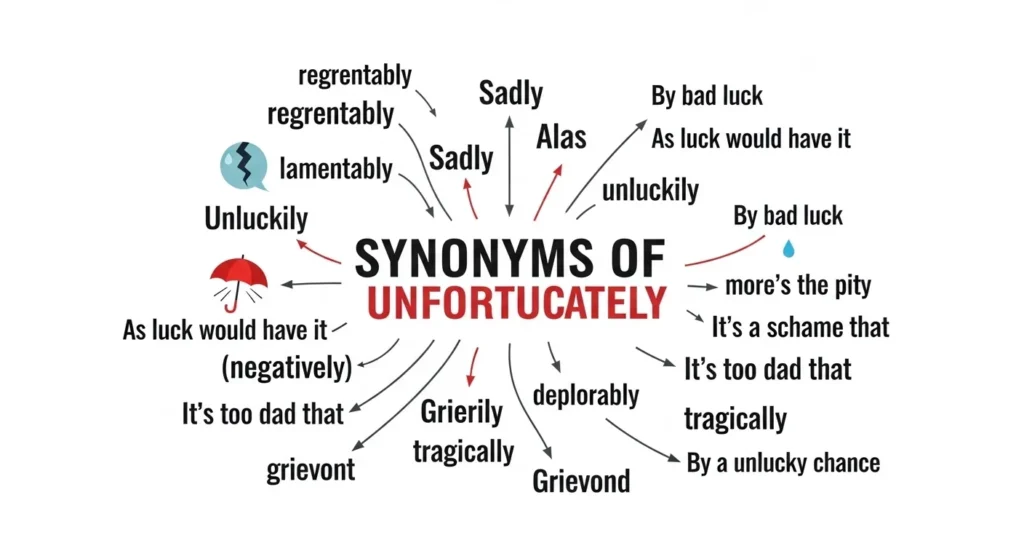
For instance, instead of repeating “unfortunately,” you could say “sadly” or “regrettably.” As a result, your message feels fresh and more interesting. In this guide, you’ll explore simple and useful synonyms of unfortunately that you can use in daily life.
Featured Snippet
“Unfortunately” means something bad or disappointing has happened. It is used to express regret, sadness, or an unwanted outcome.
Common synonyms include “sadly,” “regrettably,” and “unluckily,” which all help convey negative situations in a clear and polite way.
Why Learning Synonyms of Unfortunately Matters
Learning synonyms of unfortunately can improve both your speaking and writing. First, it helps you avoid repetition, which makes your sentences sound more natural.
Moreover, different situations need different tones. For example, “sadly” sounds softer, while “regrettably” feels more formal. Therefore, choosing the right word can make your message clearer.
In addition, using a variety of words shows strong vocabulary skills. As a result, your communication becomes more professional and engaging.
Synonyms of Unfortunately
Here are useful synonyms of unfortunately and similar words you can use in everyday communication.
Common Everyday Synonyms
Sadly
Meaning: used to show sadness about a situation
Examples:
- Sadly, we had to cancel the trip.
- She sadly said goodbye to her friend.
Regrettably
Meaning: used to express regret in a formal way
Examples:
- Regrettably, the event was postponed.
- He regrettably declined the offer.
Unluckily
Meaning: something happened due to bad luck
Examples:
- Unluckily, it started raining.
- She unluckily missed her flight.
Unfortunately enough
Meaning: emphasizes a negative outcome
Examples:
- Unfortunately enough, the plan failed.
- The shop was closed, unfortunately enough.
Formal and Professional Synonyms
Alas
Meaning: expresses sorrow or disappointment (often formal)
Examples:
- Alas, the project did not succeed.
- The team lost, alas, after a tough match.
Regretfully
Meaning: showing regret politely
Examples:
- Regretfully, we cannot accept your request.
- She regretfully left early.
Disappointingly
Meaning: something did not meet expectations
Examples:
- Disappointingly, the results were poor.
- The movie ended disappointingly.
Strong Negative Tone Synonyms
Tragically
Meaning: used for very serious or sad events
Examples:
- Tragically, the accident took many lives.
- He tragically lost his family.
Sadly enough
Meaning: emphasizes sadness in a situation
Examples:
- Sadly enough, no one helped him.
- The plan failed, sadly enough.
Unhappily
Meaning: indicates an unhappy outcome
Examples:
- Unhappily, the deal fell through.
- She unhappily accepted the news.
Additional Useful Synonyms
Badly
Meaning: something turned out poorly
Examples:
- Badly, the plan didn’t work.
- The event ended badly.
Inconveniently
Meaning: something caused trouble or difficulty
Examples:
- Inconveniently, the system crashed.
- The delay came inconveniently.
Sadly so
Meaning: confirms something negative
Examples:
- It is sad that he left.
- The truth is sadly so.
Quick Synonyms Table
| Word | Meaning | Example |
| Sadly | Feeling sorrow | Sadly, we lost the game. |
| Regrettably | Showing regret | Regrettably, it was canceled. |
| Unluckily | Due to bad luck | Unluckily, he missed the bus. |
| Alas | Formal sadness | Alas, the plan failed. |
| Disappointingly | Not meeting expectations | Disappointingly, it rained. |
| Tragically | Very serious negative event | Tragically, many were injured. |
How to Choose the Right Synonym
Choosing the best synonym depends on the situation. First, think about the tone you need. For example, “sadly” works well in casual conversations, while “regrettably” is better for formal writing.
Moreover, consider how strong the situation is. If something is very serious, you might use “tragically.” On the other hand, for small problems, “unluckily” is more suitable.
For example:
- “Sadly, I can’t attend the meeting.” (casual)
- “Regrettably, we must cancel the event.” (formal)
- “Tragically, the accident caused damage.” (serious)
Therefore, always match the word with the context. As a result, your message will sound clear and appropriate.
Frequently Asked Questions
1. What are the most common synonyms of unfortunately?
The most common synonyms of “unfortunately include “sadly,” “regrettably,” and “unluckily.” These are easy to use and fit most situations.
2. Can I use “sadly” instead of unfortunately?
Yes, “sadly” is a simple and natural alternative. In many cases, it works as another word for unfortunately in everyday speech.
3. Is “alas” still used today?
“Alas” is less common in daily speech but still used in formal or literary writing. It is one of the more traditional similar words unfortunately.
4. Which synonym is best for formal writing?
“Regrettably” and “regretfully” are best for formal writing. They sound polite and professional compared to casual options.
Conclusion
Learning synonyms of unfortunately can greatly improve your communication. Instead of repeating one word, you can choose from many alternatives like “sadly,” “regrettably,” or “unluckily.”
Moreover, each word has a slightly different tone, so using the right one makes your message clearer. For example, formal writing needs polite words, while casual speech allows simpler choices.
Therefore, practice using these synonyms in your daily conversations and writing. As a result, your language will become more natural, engaging, and effective.

I am Alexander, a passionate writer and language enthusiast at Synonyms. I specialize in creating clear, helpful content about synonyms, word meanings, and language differences to make English easier for everyone.