If you’ve ever written a resume, a research proposal, or a course description, chances are you’ve typed the word “multidisciplinary” at least once and then immediately used it again three sentences later because nothing else quite fits.
It’s one of those words that shows up constantly in academic and professional writing, but repeating it makes even the strongest CV or proposal start to feel stiff and repetitive.
The tricky part is that “multidisciplinary” isn’t just a fancy way of saying “varied” or “diverse.” It specifically means drawing on multiple fields, disciplines, or areas of expertise usually to solve a problem or build something that no single field could handle alone. A multidisciplinary team isn’t just a group of different people; it’s a group where each person brings a distinct kind of expertise to the table.
For example:
The hospital assembled a multidisciplinary team of surgeons, nutritionists, and physical therapists to manage the patient’s recovery.
That sentence works because each professional represents a separate discipline. Swap “multidisciplinary” for a word like “diverse” and you lose that precision: diverse could just as easily describe a team that’s varied in age or background, not necessarily in professional expertise.
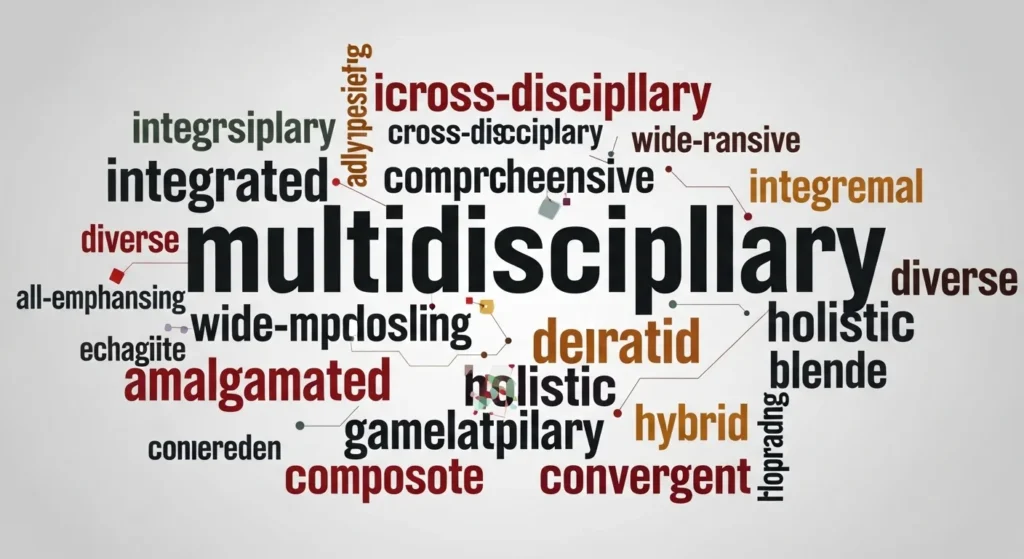
This guide walks through the closest synonyms for multidisciplinary, groups the rest by context (academic, workplace, general writing), and clears up the confusion between multidisciplinary, interdisciplinary, and transdisciplinary three words people mix up constantly, even though they mean genuinely different things.
What Does Multidisciplinary Mean?
Multidisciplinary describes something that involves, combines, or draws from more than one academic discipline, field of study, or area of professional expertise. It’s most often used to describe teams, research projects, courses, or approaches that bring together specialists from different backgrounds to work on a shared goal while each specialist largely stays within their own area of expertise.
The word breaks down simply: “multi” (many) plus “disciplinary” (relating to a field of study or discipline). So at its core, it just means “many fields,” but in practice it carries a specific connotation of collaboration and combined expertise rather than just variety for its own sake.
A genuinely multidisciplinary situation usually involves:
- Professionals or scholars from at least two distinct fields
- A shared goal or project that benefits from combining those fields
- Each contributor largely working within their own discipline’s methods and knowledge
A few examples to illustrate the idea:
The university launched a multidisciplinary program combining computer science, psychology, and design. Three separate fields, one shared academic goal.
Her multidisciplinary background in law and public health made her the ideal candidate for the policy role. Two distinct areas of expertise, both relevant to the job.
The design studio takes a multidisciplinary approach, pairing engineers with artists on every project. Different disciplines, working together but staying distinct.
Notice that none of these examples describe someone who is simply “flexible” or “adaptable” in a general sense; the word always points back to specific, separate fields of knowledge being combined.
The Closest Synonyms for Multidisciplinary
Some of the words below are near-perfect substitutes. Others only capture part of the meaning, so it’s worth knowing exactly where each one fits.
1. Interdisciplinary
Interdisciplinary is the word people confuse with multidisciplinary most often, and honestly, in casual writing they’re used almost interchangeably.
Technically, though, there’s a real distinction: multidisciplinary means different fields work side by side on a shared problem, each staying within its own methods, while interdisciplinary means those fields actually blend their methods and knowledge together to create something new.
The research team took an interdisciplinary approach, merging techniques from biology and computer science into a single new methodology.
Use interdisciplinary when the fields aren’t just cooperating, they’re genuinely merging their approaches.
2. Cross-disciplinary
Cross-disciplinary is close in meaning to interdisciplinary, often used when knowledge or methods from one field are applied within another.
Her cross-disciplinary training in economics and environmental science shaped how she approached climate policy.
Difference: Cross-disciplinary tends to describe an individual’s skill set more than a team, though it can apply to both.
3. Transdisciplinary
Transdisciplinary goes a step further than interdisciplinary. It describes work that transcends individual disciplines entirely, often involving non-academic stakeholders (like communities or industry partners) alongside researchers.
The transdisciplinary project brought together scientists, local farmers, and policymakers to redesign the region’s water systems.
Use it when the collaboration crosses not just academic boundaries, but the line between academic and non-academic expertise altogether.
4. Cross-functional
Cross-functional is the workplace equivalent of multidisciplinary, used almost exclusively in business and corporate settings rather than academia.
The product launch required a cross-functional team of marketers, engineers, and designers.
Use cross-functional when you’re writing about business teams rather than research or academic work; it’s the more natural, expected term in that context.
5. Versatile
Versatile shifts the focus from teams and projects to individuals. It describes someone capable of doing many different kinds of tasks well, without necessarily implying formal expertise in separate disciplines.
He’s a versatile employee, equally comfortable handling client calls and analyzing spreadsheets.
Difference: Versatile = broadly capable. Multidisciplinary = specifically trained or experienced across multiple defined fields.
6. Multifaceted
Multifaceted describes something with many different aspects or dimensions, which can overlap with multidisciplinary but isn’t limited to academic or professional fields.
The multifaceted problem required input from engineers, sociologists, and city planners.
Use it when you want to emphasize complexity and many angles, not just the number of fields involved.
7. Wide-ranging
Wide-ranging suggests breadth without necessarily implying formal disciplinary structure.
Her wide-ranging expertise covers everything from finance to graphic design.
This word works well in resumes and bios, though it’s less precise academically than multidisciplinary.
8. Eclectic
Eclectic implies a mix drawn from many different sources or styles, often with a slightly artistic or unconventional connotation.
His eclectic approach to teaching borrows freely from psychology, storytelling, and game design.
Difference: Eclectic often carries a personal, stylistic flavor; it’s less formal-sounding than multidisciplinary.
9. Well-rounded
Well-rounded describes someone with broad knowledge or skills across different areas, often used to describe education or personal development rather than professional teams.
The program aims to produce well-rounded graduates with skills in both the humanities and sciences.
10. Polymathic
Polymathic is a more literary, less common word describing a person whose knowledge spans an unusually wide range of subjects closer to “Renaissance person” than to a typical team description.
Da Vinci is often cited as the ultimate polymathic figure, moving fluidly between art, anatomy, and engineering.
Use it sparingly; it’s a strong, somewhat formal word best reserved for describing individuals with genuinely exceptional range, not everyday teams or projects.
More Synonyms for Multidisciplinary, Grouped by Context
Where you’re using the word changes which synonym actually fits. A resume needs a different flavor of “multidisciplinary” than a grant proposal or a course catalog. Here’s the rest of the list, organized so you can find the right one fast.
Academic and Research Alternatives
These fit naturally in papers, proposals, and university settings.
11. Integrative combining different elements or approaches into a unified whole. The integrative curriculum blends literature, history, and philosophy.
12. Pluralistic recognizing and combining multiple perspectives or approaches, often used in academic or philosophical writing. A pluralistic approach to education values input from multiple teaching traditions.
13. Holistic considering the whole rather than individual parts, often implying multiple fields contribute to a fuller picture. The clinic takes a holistic approach, treating physical, mental, and social health together.
14. Comparative analyzing across multiple fields or systems side by side. The comparative study drew from linguistics, anthropology, and history.
15. Synthesized describing knowledge or methods combined from multiple sources into something new. Her synthesized approach merged neuroscience with education theory.
Workplace and Resume Alternatives
Good for CVs, job descriptions, and professional bios where “multidisciplinary” might start to feel overused.
16. Cross-functional already covered above, but worth repeating here since it’s the single most natural swap for workplace writing.
17. Multi-skilled someone capable across multiple distinct skill areas. We’re looking for a multi-skilled candidate comfortable with both design and copywriting.
18. Broad-based describes experience or a team spanning many areas. The company built a broad-based leadership team with backgrounds in finance, tech, and law.
19. Diversified is often used to describe a career, portfolio, or skill set spanning multiple areas. Her diversified experience in both nonprofit and corporate sectors made her stand out.
20. Adaptable flexible across different roles or tasks, though without the formal “multiple fields” implication. He’s an adaptable team player who moves easily between departments.
General and Everyday Alternatives
Useful outside academic or corporate writing, in general prose or casual descriptions.
21. Varied, simple, broad, works almost anywhere. She has a varied background in teaching, writing, and consulting.
22. Diverse commonly used, though slightly less precise than multidisciplinary since it can refer to more than just fields of expertise. The panel featured a diverse group of specialists.
23. All-around casual, implies general competence across many areas. He’s an all-around talent, equally skilled at writing and coding.
24. Wide-reaching, similar to wide-ranging, emphasizes scope. The initiative had wide-reaching effects across health, education, and housing.
25. Combined simple and direct, useful when describing the merging of expertise without needing a more formal word. The project used combined expertise from urban planning and public health.
Multidisciplinary vs. Similar Words: The Differences That Actually Matter
These words get used almost interchangeably in casual writing, but in academic and professional contexts, the differences matter more than people realize.
Multidisciplinary vs. Interdisciplinary
Multidisciplinary:
- Multiple fields contribute
- Each field largely stays within its own methods
- Contributors work side by side, not necessarily blended together
Interdisciplinary:
- Multiple fields contribute
- Methods and knowledge genuinely blend together
- Often produces new approaches that don’t belong fully to any single original field
Example to see the difference: A multidisciplinary team might include a doctor, a nutritionist, and a psychologist all treating the same patient, each working within their own specialty.
An interdisciplinary team would have those same experts developing an entirely new treatment framework that combines medical, nutritional, and psychological principles into one integrated method.
Multidisciplinary vs. Transdisciplinary
Transdisciplinary goes further still, often crossing the line between academic and non-academic knowledge entirely, bringing in community members, industry professionals, or policymakers alongside researchers, and aiming to produce knowledge that transcends any single discipline’s boundaries.
Simple way to remember the scale: Multidisciplinary = side by side. Interdisciplinary = blended together. Transdisciplinary = beyond disciplines altogether.
Multidisciplinary vs. Cross-functional
These two mean almost the same thing, but the context differs. Multidisciplinary is the academic and research-oriented term; cross-functional is what the same concept is called in business and workplace settings.
The university’s multidisciplinary research center vs. the company’s cross-functional product team, same underlying idea, different professional worlds.
How Writers and Professionals Use Multidisciplinary Effectively
The word earns its place in a sentence because it signals precision. Compare these two versions:
The team included people from different backgrounds.
The team was multidisciplinary, combining expertise in engineering, design, and psychology.
The second version tells the reader exactly what kind of variety is being described, not age, not culture, not personality, but professional and academic expertise.
That precision is exactly why the word shows up so often in research papers, grant applications, and job postings, and exactly why it starts to feel repetitive if it’s the only tool being used throughout a long document.
Common Mistakes When Using Multidisciplinary (or Its Synonyms)
Using it as a stand-in for “diverse” in general. Multidisciplinary specifically refers to fields of expertise, not general diversity of background, age, or identity. If you mean general variety, “diverse” is usually the more accurate word.
Treating multidisciplinary and interdisciplinary as identical. They’re close, but not the same. Multidisciplinary keeps fields separate and cooperating; interdisciplinary blends them into something new. Using the wrong one in a formal proposal can actually misrepresent your project’s methodology.
Overusing it in resumes without specifics. Simply writing “multidisciplinary professional” without naming the actual fields involved weakens the word’s impact. It’s far stronger to say “multidisciplinary background in finance, UX design, and data analysis” than to leave it vague.
Frequently Asked Questions About Multidisciplinary
What is another word for multidisciplinary? Common alternatives include interdisciplinary, cross-disciplinary, cross-functional, integrative, and versatile. The best choice depends on whether you’re describing an academic project, a workplace team, or an individual’s broad skill set.
What does multidisciplinary mean? Multidisciplinary means involving or combining multiple academic disciplines or areas of professional expertise, usually to address a shared problem or project, with each field largely contributing through its own methods and knowledge.
What is the difference between multidisciplinary and interdisciplinary? Multidisciplinary describes different fields working side by side on a shared goal, each staying within its own methods. Interdisciplinary describes those fields genuinely blending their methods and knowledge together to create a new, combined approach.
What is a multidisciplinary team? A multidisciplinary team is a group of professionals from different fields such as medicine, engineering, or law working together on a shared project or case, with each member contributing expertise from their own specific discipline.
What is the antonym of multidisciplinary? Words like specialized, single-discipline, or narrow best capture the opposite of multidisciplinary describing something limited to one field or area of expertise rather than combining several.
How do you use multidisciplinary in a sentence? A few examples:
- The clinic uses a multidisciplinary approach, combining input from doctors, therapists, and dietitians.
- She built a multidisciplinary career spanning law, journalism, and public policy.
- The university offers a multidisciplinary degree that blends computer science with design.
What is a good synonym for multidisciplinary on a resume? Cross-functional, multi-skilled, versatile, and broad-based all work well on a resume, since they sound natural in a workplace context rather than a strictly academic one.
Is multidisciplinary the same as cross-functional? They’re very similar in meaning, but multidisciplinary is more common in academic and research contexts, while cross-functional is the standard term in business and workplace settings.
Final Thoughts
There’s no single word that replaces multidisciplinary perfectly in every context. The right choice depends on whether you’re writing about academic research, a professional team, or an individual’s background.
For research and academic writing, interdisciplinary, integrative, or transdisciplinary tend to fit best, depending on how deeply the fields actually blend together. For resumes and workplace writing, cross-functional, multi-skilled, or broad-based feel far more natural.
Understanding these small distinctions doesn’t just help you avoid repeating the same word, it helps you describe exactly the kind of collaboration or expertise you’re talking about, which is usually the whole point of choosing a precise word in the first place.

James Parker is a writer who creates clear and helpful content for readers. I am James Parker, and I am a synonyms writer who focuses on explaining word meanings and differences in simple language to help students and learners understand concepts easily.