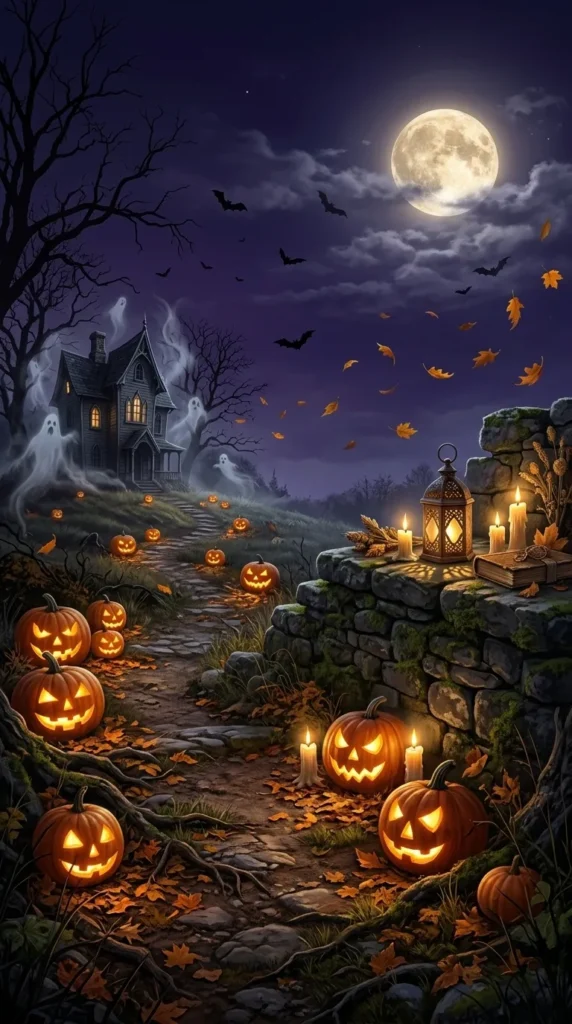
Dictionaries recognize only two strict synonyms for Halloween, Allhallows Eve and Hallowe’en. Everything else is a spelling variant, a nickname, or a related word. This article sorts them out, explains where each comes from, and shows when to use which.
What Halloween Means
Halloween is a noun for the evening of October 31, the night before All Saints’ Day, often marked by costumes and pranks. It is a proper noun, so English usage normally drops the article: people say “on Halloween,” not “on Halloween.”
Vocabulary.com gives the US pronunciation as roughly hal-oh-WEEN, with a slightly shorter middle vowel in the UK.
In Urdu the word is borrowed from English and written ہالووین. The Rekhta dictionary defines it as the eve of All Saints’ Day on October 31, when people dress in disguise and children wear scary faces and play pranks. A verified Sindhi dictionary entry could not be found, so no Sindhi equivalent is given here.
Why Halloween Is Celebrated, and Its Symbols
Halloween exists because two older observances merged. The Celtic festival of Samhain marked the turn from harvest to winter and a time when the dead were thought to return, while the Christian All Saints Day on November 1 gave the night before it a name. Costumes and bonfires began as protection against wandering spirits. Today it is largely a secular holiday of costumes, sweets, and parties in many Western countries.
The main symbols trace back to those roots or to the modern celebration:
- Pumpkins and jack-o’-lanterns, carved with faces and lit as decoration
- Costumes and masks, once worn to scare spirits away
- Bonfires and candles, from the Samhain tradition of fire
- Ghosts, skeletons, and graveyards, which stand for the returning dead
- Witches, brooms, cauldrons, bats, owls, and black cats, which belong to spooky folklore
- Candy, the reward for trick-or-treating
True Synonyms and Spelling Variants
Vocabulary.com lists Allhallows Eve (one word, no apostrophe) and Hallowe’en as the two dictionary synonyms, and RhymeBook, which draws on Princeton WordNet, gives the same pair. The name itself is a contraction of All Hallows’ Eve.
The word “hallow” is now obsolete in everyday English and means “saint,” so the phrase means the evening before All Saints’ Day.
Vocabulary.com traces the stages: from the 8th century, Christians observed All Saints Day on November 1 and borrowed some customs from Samhain. The phrase later shrank to Allhallowe’en and then to Halloween.
The apostrophe in Hallowe’en marks the missing letters of “evening,” and you still see it in older books and some British publications.
Looser variants include All Saints’ Eve and the formal All Hallows’ Evening, which appear mostly in religious and historical writing. The wider season is Allhallowtide (or Hallowtide), which covers All Hallows’ Eve, All Saints’ Day on November 1, and All Souls’ Day on November 2.
Samhain
Samhain (pronounced roughly “SOW-in”) is an ancient Celtic festival marking the end of the harvest and the start of winter. Vocabulary.com says it was the day the souls of the dead were believed to return home, with costumes and bonfires meant to scare the spirits away.
Many Halloween customs trace back to it. Modern Pagans and Wiccans still celebrate Samhain, so it is both a historical root and a living tradition rather than a plain synonym.
Nicknames and Regional Names
Spooky Season is a lighthearted nickname for the whole autumn run-up to October 31, used online and in shops for decorations, horror films, and costume planning.
The night itself is often called Trick-or-Treat Night, and children say Treat Night or Candy Night. Witches’ Night and Ghost Night are informal labels from stories and songs.
In parts of England and the United States, October 30 is Mischief Night, and in some areas such as Detroit it is Devil’s Night. Both names describe the pranks played the evening before, not Halloween itself.
Descriptive Words: Spooky, Scary, Ghoulish
Besides names for the night itself, writers need words that describe it. Merriam-Webster’s related-words list includes spooky, scary, ghoulish, gothic, festive, boisterous, and convivial, which cover both the frightening and the party side of the holiday. Vocabulary.com’s Halloween word list suggests rarer choices such as eldritch (strange and unearthly) to avoid overusing “spooky” and “creepy.” A playful coinage, spooktacular, also appears on children’s vocabulary lists.
For spooky itself, common synonyms are eerie, creepy, ghostly, uncanny, haunting, and chilling, and its antonyms include cheerful, comforting, and reassuring. Halloween as a named holiday has no true antonym, because a holiday has no opposite.
Related Words by Theme
Merriam-Webster’s list of 154 related words is generated automatically from published text, so it shows words that appear near “Halloween” rather than true synonyms. Grouped by theme, the most useful ones are:
Theme
Related words
Creatures and characters
ghost, witch, zombie, Dracula, Frankenstein, scarecrow
Costumes and decorations
costume, mask, pumpkin, decorations
Treats and activities
candy, apples, treats, parties, films
Time and season
October, autumn, fall, harvest, harvest moon, nightfall, midnight, eve
Other holidays and festivals
Christmas, Thanksgiving, Easter, Purim, carnival, fiesta
Synonyms for Costume, Decorations, and Party
Three Halloween nouns come up often enough to need their own alternatives:
Word
Alternatives
Costume
outfit, getup, disguise, fancy dress, garb, attire
Decorations
ornaments, trimmings, adornments, props, embellishments
Party
gathering, bash, get-together, celebration, masquerade, costume ball, soirée
These come from general thesaurus usage rather than the Halloween pages above, so choose by tone: getup and bash are casual, while attire and soirée sound formal.
Other Ways to Say Trick or Treat and Happy Halloween
The trick-or-treat custom has several relatives. Trunk-or-treat has children collect candy from decorated car trunks in a parking lot, guising is the Scottish custom of dressing up and performing for treats, and souling is the old English practice of asking for soul cakes around All Souls’ Day.
Instead of “Happy Halloween,” people say Have a spooky night, Stay spooky, Have a fang-tastic night, or Boo to you. Those who observe the older festival may say Happy Samhain.
Halloween Words for Dogs
Dog owners have their own vocabulary, built from puns rather than dictionary words. Howl-o-ween replaces Halloween, a paw-ty is a party, and trick-or-treat becomes bark or treat, pup or treat, or lick or treat. Costume captions play on fur-ocious, pup-kin, and fang-tastic. If you decorate with candle-lit pumpkins, keep them out of a lively dog’s reach or use a battery light, as Nylabone advises.
Halloween in Other Languages
ConceptNet lists Portuguese Dia das Bruxas (“Day of the Witches”) and Catalan vigília de Tots els Sants (“vigil of All Saints”), which echoes the religious name. Babel Free adds Welsh Nos Galan Gaeaf, Irish Oíche Shamhna (“Samhain night”), Icelandic hrekkjavaka, Turkish Cadılar Bayramı (“Witches’ Festival”), and Latin Pervigilium Omnium Sanctorum. Indonesian and Malay keep the English word, as do Urdu (ہالووین) and Hindi (हैलोवीन).
Several cultures also hold separate remembrance festivals around the same time. Mexico’s Día de los Muertos (Day of the Dead) honors departed loved ones, and Ireland and Scotland preserve many Samhain-inspired customs. They are not synonyms, but they share Halloween’s themes of memory and the thin line between the living and the dead.
Look-Alike Words: Haunts, Hallway, and Hollered
Some searches land on words that only resemble Halloween vocabulary. Haunts as a verb means frequents, visits, or lingers around, and as a noun means favorite hangouts; the ghostly sense is a spirit that keeps returning to a place. Hallway is not related to “hallow”; its synonyms are corridor, passage, and passageway. Hollered means shouted, with synonyms yelled, bellowed, and called out.
Caution: Not Every Listed Word Is a Synonym
Automated thesaurus lists mix real synonyms with noise. Merriam-Webster’s list includes Christmas, Xmas, Friday, and Purim because they appear in similar text, not because they mean Halloween.
Nicknames such as Witches’ Night and Ghost Night are descriptive labels and are not recorded as synonyms in the dictionaries checked. Treat only Allhallows Eve and Hallowe’en as strict synonyms, and everything else as variants or related vocabulary.
Conclusion
From the formal All Hallows’ Eve to the playful Spooky Season, the names for Halloween reflect its layers: Celtic roots in Samhain, a Christian calendar name, regional pranks, and modern party culture.
Knowing which terms are true synonyms and which are nicknames or related words lets you choose the right one for formal writing, a party invitation, or a dog’s costume caption.

I am Alexander, a passionate writer and language enthusiast at Synonyms. I specialize in creating clear, helpful content about synonyms, word meanings, and language differences to make English easier for everyone.