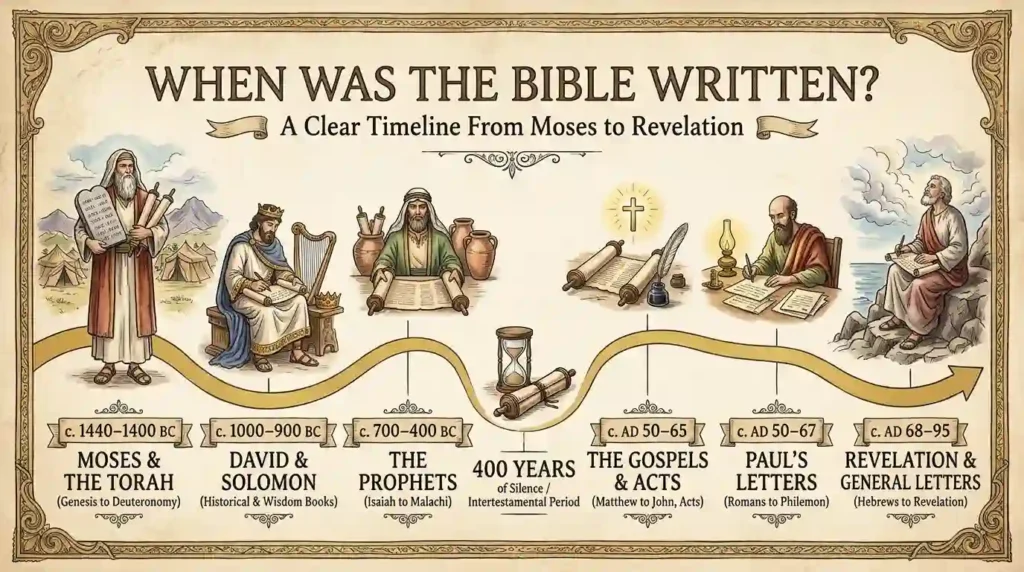

The Bible was written over about 1,500 years, from around 1400 BC to around AD 95. It was not written in one year, in one place, or by one person. Moses wrote in the desert, David wrote songs as a king, Jeremiah wrote in a time of crisis, and Paul wrote letters from prison. The book of Hebrews sums it up well: God spoke to our ancestors at many times and in many ways through the prophets, and in these last days through his Son (Hebrews 1:1-2).
This guide gives you a clear, step-by-step timeline. You will see when each part of the Bible was written, who wrote it, in which languages, and how the books were gathered into the Bible we hold today. Every point is tied to a Scripture reference so you can check it yourself.
The Short Answer: When Was the Bible Written?
- Old Testament: about 1400 BC to about 400 BC, roughly 1,000 years.
- The gap between the testaments: about 400 years with no new Bible book.
- New Testament: about AD 45 to about AD 95, roughly 50 years.
- Whole Bible: about 1,500 years from the first writing to the last.
| Part of the Bible | Approximate dates | Length of time |
|---|---|---|
| Old Testament | 1400 BC to 400 BC | About 1,000 years |
| Gap between the testaments | 400 BC to the time of John the Baptist | About 400 years |
| New Testament | AD 45 to AD 95 | About 50 years |
| Whole Bible | 1400 BC to AD 95 | About 1,500 years |
These are the dates most traditional readers use. Scholars do not agree on every date, and we will look at why later in this article.
What the Bible Says About Its Own Writing
The Bible itself tells us that its words were written down by real people at real moments. Here are some clear examples:
- God told Moses to write a record of a battle on a scroll (Exodus 17:14).
- Moses wrote down all the words of the Lord (Exodus 24:4) and later finished writing the law in a book (Deuteronomy 31:24).
- Joshua added words to the Book of the Law of God (Joshua 24:26).
- God told Jeremiah to take a scroll and write all his words on it, and Baruch wrote them down as Jeremiah spoke (Jeremiah 36:2, 36:4).
- God told Habakkuk to write the vision down clearly (Habakkuk 2:2).
- Jesus told John to write what he saw in a book (Revelation 1:11).
The early church also copied and shared these writings. Paul asked that his letter to Colossae be read in Laodicea too (Colossians 4:16), and he asked that his letter to the Thessalonians be read to all the believers (1 Thessalonians 5:27).
When was the Bible written Timeline PDF
The Bible was written over many centuries, with its books composed by different authors in different historical periods. The Old Testament developed over a long period, with writings traditionally dated from around 1400 BC to 400 BC, although some dates remain debated. The New Testament was written approximately between AD 45 and 100. A Bible timeline PDF can help readers understand when important books were written, how biblical history unfolded, and how the Old and New Testaments connect. Bible Gateway News & Knowledge+2
When were the books of the Bible written timeline
The books of the Bible were written across a period of more than a thousand years, rather than all at once. The Old Testament includes ancient historical accounts, poetry, wisdom literature, and prophetic writings. The New Testament books were composed mainly during the first century AD, beginning with early Christian letters and followed by the Gospels and other writings. Their writing dates are not always certain, but a chronological timeline helps readers explore their historical background. United Church of God+2
What was the last book of the Bible written chronologically
The Book of Revelation is commonly considered one of the last books written in the Bible. Many scholars date its composition to approximately AD 95–96, during the reign of Emperor Domitian. However, some scholars support an earlier date around AD 64–65. The Gospel of John and its letters also belong to the later period of New Testament writing. Therefore, Revelation is widely regarded as the final biblical book, although its exact date remains debated. Bible Gateway News & Knowledge+2
When was the first book of the New Testament written
The first New Testament book was written during the middle of the first century AD, but scholars do not completely agree about which book came first. James is sometimes considered the earliest, with proposed dates in the 40s or early 50s. First Thessalonians, written around AD 50–51, is often identified as one of the earliest securely dated New Testament writings. These early letters helped guide Christian communities before the four Gospels were completed. Bible Gateway News & Knowledge+2
Full Bible Timeline Chart
A full Bible timeline chart provides a clear overview of major biblical events, historical periods, and the writing of Scripture. It can begin with creation and the patriarchs, followed by the Exodus, the kingdoms of Israel and Judah, the Babylonian exile, and the life of Jesus. It also includes the early Christian church and the writing of New Testament books. Such a chart makes it easier to connect biblical stories with their historical settings. Bible Gateway News & Knowledge+1
Simple Bible Timeline chart
A simple Bible timeline chart helps beginners understand the main events of Scripture without getting lost in complicated historical details. It can highlight important periods such as creation, Abraham’s journey, Moses and the Exodus, King David’s reign, the birth of Jesus, and the early church. Arranging these events in chronological order makes biblical history easier to follow. It also helps readers see how God’s promises, important people, and major events connect throughout the Bible. Bible Gateway News & Knowledge+1
Was Revelation the last book written in the Bible
Revelation is widely believed to be the last book written in the Bible, with many scholars placing its composition around AD 95–96. It was traditionally associated with John while he was on the island of Patmos. However, some scholars suggest an earlier date during Nero’s reign. The Gospel of John and the letters of John also have late first-century dates. Although the exact chronology remains debated, Revelation is commonly placed at the end of biblical writing. Bible Gateway News & Knowledge+2
When was the Bible written New Testament
The New Testament was written during the first century AD, approximately between AD 45 and 100. Its 27 books include four Gospels, the Acts of the Apostles, letters written to early Christian communities, and the Book of Revelation. Paul’s letters are among the earliest surviving Christian writings, while the Gospels share accounts of Jesus’ life, teachings, death, and resurrection. Together, these books explain the beginnings of Christianity and the message of the early church. Bible Gateway News & Knowledge+2
When Was the Old Testament Written?
The Old Testament has 39 books in the Protestant Bible. They were written over about 1,000 years, in four main stages.
The Law (about 1400 BC)
The first five books are Genesis, Exodus, Leviticus, Numbers, and Deuteronomy. They are called the Law, the Torah, or the Pentateuch. Tradition says Moses wrote them, and the Bible shows Moses writing the law (Exodus 24:4; Deuteronomy 31:9). Moses was well prepared for this task, since he was trained in all the wisdom of Egypt (Acts 7:22).
Most traditional dates place Moses around 1400 BC. Some scholars date the final form of these books later, and see them as shaped over time by scribes. Genesis itself names no author, which is one reason for these different views.
Many of the events in Genesis happened long before Moses was born. Early readers believed these stories were passed down carefully by families before they were written. Paul showed that the church also valued both spoken and written teaching (2 Thessalonians 2:15).
The Historical Books (about 1000 BC to 400 BC)
Joshua, Judges, Samuel, Kings, Chronicles, Ezra, Nehemiah, and Esther tell Israel’s story from the promised land to the return from exile. They were written and gathered over many centuries. For example, the Book of the Law was found in the temple in the days of King Josiah (2 Kings 22:8), and Ezra was a teacher who knew the law of Moses well (Ezra 7:6).
The Poetry and Wisdom Books (about 1000 BC to 400 BC)
This group includes Job, Psalms, Proverbs, Ecclesiastes, and Song of Solomon. David is known as the sweet psalmist of Israel (2 Samuel 23:1). Solomon spoke three thousand proverbs and wrote over a thousand songs (1 Kings 4:32), and men of King Hezekiah later copied more of his proverbs (Proverbs 25:1). One psalm is even titled a prayer of Moses (Psalm 90), and another remembers the sorrow of exile in Babylon (Psalm 137:1).
Many readers think Job is one of the oldest books, because it is set in the world of the early patriarchs (Job 1:1). Scholars still debate this.
The Prophets (about 750 BC to 400 BC)
The prophets wrote during times of crisis, warning, and hope:
- Isaiah wrote in the days of King Uzziah and later kings (Isaiah 1:1).
- Jeremiah served from the days of Josiah until Jerusalem fell (Jeremiah 1:1-3).
- Ezekiel wrote among the exiles in Babylon (Ezekiel 1:1-3).
- Daniel was taken to Babylon as a young man (Daniel 1:1-6).
- Haggai and Zechariah wrote after the return from exile (Haggai 1:1; Zechariah 1:1).
- Malachi wrote the last Old Testament book, around 450 to 400 BC (Malachi 1:1).
Even in the Old Testament, people were already gathering and studying earlier writings. Daniel read the Scriptures and understood the number of years given to Jeremiah (Daniel 9:2). In Nehemiah’s day, Ezra read the Book of the Law to the people (Nehemiah 8:1-3).
The 400 Years Between the Testaments
After Malachi, no new book was added to the Bible for about 400 years. Malachi ended with a promise that God would send Elijah before the great day of the Lord (Malachi 4:5-6). The New Testament shows this promise being fulfilled in John the Baptist, who came with the spirit and power of Elijah (Luke 1:17).
Those years were quiet in Scripture, but not empty. During this time the Jewish people lived under Persian, Greek, and then Roman rule. The Greek translation of the Old Testament, called the Septuagint, was also made in this period. When the time was right, God sent his Son (Galatians 4:4), and the word of God came to John the Baptist in the wilderness (Luke 3:2).
When Was the New Testament Written?
The New Testament has 27 books, written within about 50 years. It was written within the lifetime of many who saw Jesus. Paul wrote that after Jesus rose, he appeared to more than 500 people at once, and most of them were still alive when Paul wrote (1 Corinthians 15:6).
Paul’s Letters (about AD 48 to AD 67)
Most scholars think Galatians or 1 Thessalonians was among the earliest New Testament writings. Paul wrote to churches he had planted (Galatians 1:1-2; 1 Thessalonians 1:1) and to the church in Rome (Romans 1:1). He wrote some letters from prison (Philippians 1:13), and near the end of his life he wrote to Timothy about his coming death (2 Timothy 4:6-8).
The Gospels (about AD 55 to AD 95)
Matthew, Mark, Luke, and John tell the story of Jesus. Many scholars think Mark was first, and some place it in the late 50s or the 60s. Peter calls Mark his son, which shows the link between Mark and Peter (1 Peter 5:13). Luke wrote an orderly account after careful research (Luke 1:1-4), and Luke was Paul’s doctor and companion (Colossians 4:14). John’s Gospel is usually dated last, around AD 85 to 95, and it says it was written so that readers would believe that Jesus is the Christ (John 20:30-31; John 21:24).
Acts (about AD 60 to AD 85)
Acts is the second book written by Luke, and it continues his Gospel (Acts 1:1). It ends with Paul under house arrest in Rome, preaching for two years (Acts 28:30-31). Dates for Acts range from about AD 60 to the 80s.
The General Letters (about AD 45 to AD 95)
James, 1 and 2 Peter, 1, 2, and 3 John, Jude, and Hebrews were written to believers facing trials and false teaching (James 1:1; 1 Peter 1:1; 1 John 1:1-3; Jude 1:3). Some of these, like James, may be very early.
Revelation (about AD 95)
Revelation is usually seen as the last book written. John wrote it while on the island of Patmos (Revelation 1:9), and Jesus told him to write what he saw (Revelation 1:11). Some scholars date it earlier, but the AD 95 date is the most common.
Chronological Order of the Bible: A Quick Timeline
| Approximate date | Writing | Scripture connection |
|---|---|---|
| About 1400 BC | The Law of Moses | Exodus 24:4; Deuteronomy 31:24 |
| About 1000 BC | Many psalms and proverbs | 2 Samuel 23:1; 1 Kings 4:32 |
| About 750 BC to 550 BC | Isaiah, Jeremiah, Ezekiel | Isaiah 1:1; Jeremiah 1:1-3; Ezekiel 1:1-3 |
| About 520 BC to 400 BC | Haggai, Zechariah, Malachi | Haggai 1:1; Zechariah 1:1; Malachi 1:1 |
| About AD 48 to 67 | Paul’s letters | Galatians 1:1-2; 2 Timothy 4:6-8 |
| About AD 55 to 95 | The Gospels and Acts | Luke 1:1-4; Acts 1:1; John 20:30-31 |
| About AD 95 | Revelation | Revelation 1:9-11 |
Who Wrote the Bible?
About 40 authors wrote the Bible, and they came from very different walks of life:
- Moses was a leader trained in Egypt (Acts 7:22).
- David was a shepherd who became king (1 Samuel 16:11-13).
- Amos was a shepherd from Tekoa (Amos 1:1).
- Nehemiah was a royal cupbearer (Nehemiah 1:11).
- Peter, Andrew, James, and John were fishermen (Matthew 4:18-21).
- Matthew was a tax collector (Matthew 9:9).
- Luke was a doctor (Colossians 4:14).
- Paul was a trained scholar who became an apostle (Philippians 3:5-6).
Each author wrote in his own style, yet Christians believe God guided the whole work. Scripture says that all Scripture is God-breathed (2 Timothy 3:16), and that men spoke from God as they were carried along by the Holy Spirit (2 Peter 1:20-21). That is why the Bible sounds human in each part, yet speaks with one voice.
What Languages Was the Bible Written In?
The Bible was written in three languages:
- Hebrew for most of the Old Testament.
- Aramaic for some parts of the Old Testament, such as parts of Ezra (Ezra 4:8 to 6:18; 7:12-26), Daniel (Daniel 2:4 to 7:28), and one verse in Jeremiah (Jeremiah 10:11).
- Greek for the whole New Testament.
The mix of languages fits the story. Three languages were even used on the sign over Jesus on the cross (John 19:20).
When Was the Bible Put Together? (How the Canon Formed)
Writing the books and gathering them into one Bible were two different steps. The list of accepted books is called the canon.
The Old Testament Canon
The Law was treated as Scripture very early (Joshua 1:8; 2 Kings 22:8-13). By the time of Jesus, the Jewish Scriptures were recognized in three groups. Jesus himself spoke of the Law of Moses, the Prophets, and the Psalms, and said they all spoke about him (Luke 24:44; Matthew 5:17).
The New Testament Canon
The church began to treat apostolic writings as Scripture very early. Peter placed Paul’s letters alongside the other Scriptures (2 Peter 3:15-16), and churches shared letters with each other (Colossians 4:16). The church later tested books by whether they came from an apostle or an apostle’s close companion, whether they matched the teaching handed down once for all (Jude 1:3), and whether churches widely accepted them.
These two historical events are not found in the Bible, so they have no verse reference: Athanasius listed all 27 New Testament books in AD 367, and the Council of Carthage confirmed the list in AD 397.
The Bible closes with a warning not to add to or take away from its words (Revelation 22:18-19), echoing an earlier warning in Deuteronomy 4:2.
Why Do Dates and Book Counts Differ?
The books of the Bible do not carry dates, so scholars weigh different clues. Traditional dating follows the authors named in the books, such as Moses for the Law and Paul for his letters. Critical dating looks at language, style, and events, and may place some books later. Both approaches use evidence, but they start from different views of how the Bible came to be.
Book counts differ too. Protestant Bibles contain 66 books, while Catholic Bibles contain 73. The difference is seven extra Old Testament books, which Catholics call deuterocanonical and Protestants call the Apocrypha. Eastern Orthodox Bibles include a few more. Both Catholic and Protestant Bibles share the same 27 New Testament books.
These differences do not change the main story. The central events and teachings are the same in every tradition.
How Do We Know the Bible Text Was Kept Safe?
The Bible promises that God’s word will last (Isaiah 40:8; Matthew 24:35), and Paul says the Jews were entrusted with the words of God (Romans 3:1-2). History gives strong support for careful copying. These facts come from manuscript history, not from the Bible itself, so they have no verse reference:
- The Dead Sea Scrolls, found near Qumran in 1947, contain Hebrew copies from before the time of Christ, and they closely match later copies.
- The Septuagint, a Greek Old Testament, was made in the third and second centuries BC.
- The Codex Sinaiticus and Codex Vaticanus are major Greek Bibles from the fourth century.
- Thousands of Greek New Testament manuscripts allow scholars to compare copies and spot scribal slips.
The early believers also checked what they heard against Scripture. The people of Berea examined the Scriptures daily to see if what Paul taught was true (Acts 17:11). That is a good model for us.
How Did the Bible Reach Us in Our Own Language?
The Bible was meant for all nations (Revelation 7:9). Here is a simple timeline of how it spread. These are historical dates with no verse reference:
- The Septuagint gave Greek-speaking Jews the Old Testament.
- Jerome made the Latin Vulgate around AD 405.
- John Wycliffe’s followers made the first complete English Bible in the late 1300s.
- Gutenberg printed the Bible on a printing press around 1455.
- The King James Version was published in 1611.
Why Did It Take 1,500 Years to Write the Bible?
The Bible took so long because God spoke to real people in real times, not through one single act (Hebrews 1:1-2). Each book met a need in its own day: law for a new nation, songs for worship, warnings for a drifting people, and letters for young churches. Paul says that whatever was written in earlier days was written for our learning, so that we might have hope (Romans 15:4).
The writers came from many places and eras, yet the message holds together. Jesus said that all the Scriptures point to him (Luke 24:27), and John said his Gospel was written so people might believe and have life (John 20:31).
How to Read the Bible With Its Timeline in Mind
You do not need to memorize dates. Try this simple path:
- Start with a short book from each stage. Read a section of Genesis for the beginning, a psalm for worship, a prophet for crisis, and a Gospel for Jesus.
- Ask when and why it was written. A law for Israel in the desert sounds different from a letter to a church in a Greek city.
- Check what you read against the text. Like the Bereans, test what you hear against Scripture (Acts 17:11).
- Look for Jesus. He is the centre of the whole story, from the Law to the Prophets and the Psalms (Luke 24:27, 24:44).
Frequently Asked Questions
When was the Bible written?
The Bible was written from about 1400 BC to about AD 95, a span of about 1,500 years. The Old Testament took about 1,000 years and the New Testament about 50 years, with a gap of about 400 years between them. Moses is shown writing the Law in Exodus 24:4, and John is told to write in Revelation 1:11.
Who wrote the first book of the Bible?
Tradition says Moses wrote Genesis, along with the rest of the Law (Exodus 24:4; Deuteronomy 31:9). Genesis does not name its author, and some scholars think the books reached their final form over time. The traditional view names Moses, while honest study notes the other views.
What was the last book of the Bible written?
Revelation is usually seen as the last book written, around AD 95, by John on Patmos (Revelation 1:9-11). It is also the last book in the Bible’s order.
How many authors wrote the Bible?
About 40 authors, including kings, shepherds, fishermen, a doctor, and a tax collector (2 Samuel 23:1; Amos 1:1; Matthew 4:18-21; Colossians 4:14; Matthew 9:9). The count is approximate, since some books do not name their authors.
What is the oldest book in the Bible?
Many scholars point to Job or the books of Moses. Job is set in the age of the patriarchs (Job 1:1), and Moses wrote the Law (Exodus 24:4). The Bible does not state which was first, so the answer rests on scholarly opinion.
In what languages was the Bible written?
Hebrew, Aramaic, and Greek. Parts of Ezra, Daniel, and Jeremiah are in Aramaic (Ezra 4:8 to 6:18; Daniel 2:4 to 7:28; Jeremiah 10:11).
Why is there a 400-year gap between the testaments?
No new Bible book was written between Malachi and the time of John the Baptist. It was a time of waiting. The Bible says God sent his Son when the time was right (Galatians 4:4), and the word of God came to John in the wilderness (Luke 3:2).
When was the Bible canonized?
The canon formed over time. The Law was treated as Scripture very early (Joshua 1:8), Jesus affirmed the Law, the Prophets, and the Psalms (Luke 24:44), and the early church recognized apostolic writings (2 Peter 3:15-16). The final list of 27 New Testament books was confirmed in the fourth century.
Was the Bible written by God or by men?
Christians believe both. People wrote the words, and God inspired them (2 Timothy 3:16; 2 Peter 1:20-21).
Conclusion
The Bible was written over about 1,500 years, from Moses around 1400 BC to John around AD 95. The Old Testament took about 1,000 years, the New Testament about 50 years, and about 400 quiet years sit between them. Around 40 authors wrote in Hebrew, Aramaic, and Greek, and the books were gathered into the canon we know today.
You do not need to master every date to read the Bible well. Start with one short book, ask what need it met in its own day, and let the whole story lead you to Jesus (Luke 24:27).