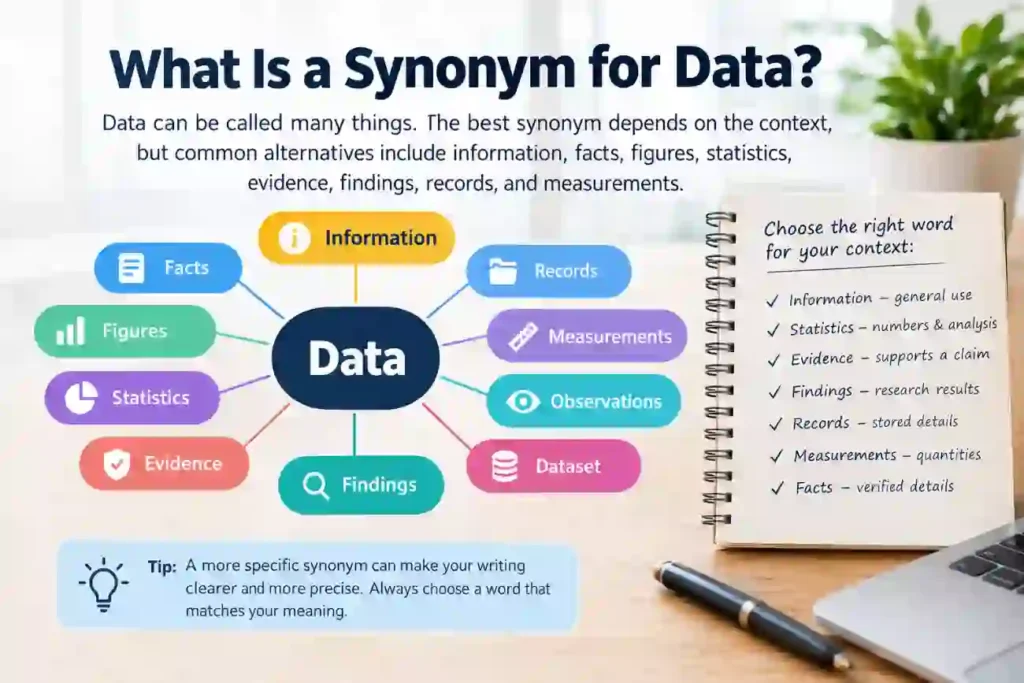
A common synonym for data is information. Other alternatives include facts, figures, statistics, evidence, findings, records, and measurements.
The best word depends on your context. Use information for general knowledge, statistics for numerical summaries, evidence to support a claim, and findings to describe the results of research.
Key Takeaways
- Information is the best general alternative to data in many everyday sentences.
- Facts, figures, and statistics work well when discussing specific details or numbers.
- Evidence and findings are useful in research, academic writing, and analysis.
- Records and documentation are better when referring to stored or organized information.
- Choose a synonym that preserves your original meaning instead of replacing data automatically.
What Is the Best Synonym for Data?
The best synonym for data is usually information. Both words refer to details that help people understand a subject, answer a question, or make a decision.
However, other words may be more accurate in specific situations. For example, statistics refers to numerical information or its analysis, while evidence refers to information that supports a conclusion.
Consider these examples:
- Original: The data shows a change in customer behavior.
- Alternative: The information shows a change in customer behavior.
- More specific: The statistics show a change in customer behavior.
The first alternative is suitable for general writing. The second is more specific if the data consists of numerical results.
When choosing another word for data, think about what the information represents and how the reader will understand it.
15 Useful Synonyms for Data
Here are 15 alternatives to data, along with their meanings and the situations in which they work best.
1. Information
Meaning: Facts or details about a person, subject, event, or situation.
Information is the most versatile synonym for data. It works in everyday conversations, business communication, educational materials, and general writing.
Example: The company collected information about customer preferences.
2. Facts
Meaning: Details that can be verified or shown to be true.
Use facts when you want to emphasize accuracy or established details rather than a broad collection of raw data.
Example: The report presents facts about changing market conditions.
3. Figures
Meaning: Numerical values, amounts, or statistics.
Figures is especially useful in financial reports, sales summaries, budgets, and business discussions.
Example: The latest sales figures show an increase in revenue.
4. Statistics
Meaning: Numerical summaries or information analyzed using statistical methods.
This word is appropriate when discussing percentages, averages, rates, trends, or other numerical measures.
Example: The statistics reveal a rise in website traffic.
5. Evidence
Meaning: Information that supports or challenges a claim, explanation, or conclusion.
Use evidence when the purpose of the data is to help establish whether an idea or claim is supported.
Example: The research provides evidence of a relationship between the two variables.
6. Findings
Meaning: Results or conclusions discovered through research, investigation, or analysis.
Findings is a strong choice for academic papers, surveys, scientific studies, and professional reports.
Example: The study’s findings highlight several important patterns.
7. Records
Meaning: Stored details about events, activities, transactions, or individuals.
Use records when the information is preserved for reference, tracking, or documentation.
Example: The office reviewed its financial records before preparing the annual report.
8. Measurements
Meaning: Values obtained by measuring something.
This synonym works well in science, engineering, healthcare research, and experiments where quantities are measured.
Example: The measurements indicate a difference in temperature.
9. Observations
Meaning: Details noticed or recorded during monitoring, examination, or research.
Use observations when information comes from watching, examining, or studying something.
Example: The researchers documented their observations during the experiment.
10. Results
Meaning: Outcomes produced by a test, process, experiment, or analysis.
Results is appropriate when you want to emphasize what an activity produced rather than the original information collected.
Example: The test results helped the team identify the problem.
11. Details
Meaning: Individual pieces of information about a subject.
This word is useful in simple, conversational writing when technical language is unnecessary.
Example: Please provide the details needed to complete the report.
12. Research
Meaning: A systematic process of investigating a subject to develop knowledge or answer questions.
Research is related to data but is not an exact synonym. It describes the investigation itself, not necessarily the information collected.
Example: The team used research to understand customer needs.
13. Documentation
Meaning: Written or recorded material that explains, supports, or describes something.
Use this term when referring to organized reports, supporting files, procedures, or documented information.
Example: The developer updated the documentation for the software project.
14. Metrics
Meaning: Measures used to evaluate performance, progress, or results.
Metrics is particularly useful in marketing, business analytics, website performance, and project management.
Example: The marketing team reviewed key performance metrics each week.
15. Dataset
Meaning: An organized collection of related data.
Use dataset when referring to a specific collection of information prepared for analysis, research, or computer processing.
Example: The analyst cleaned the dataset before running the model.
Which Synonym for Data Should You Use?
The right alternative depends on your subject, audience, and purpose. Some words are suitable for almost any situation, while others are best for specialized writing.
| Context | Best synonym | Example |
|---|---|---|
| Everyday writing | Information | We need more information. |
| Business reports | Figures | The figures show higher sales. |
| Academic writing | Findings | The findings support the argument. |
| Scientific studies | Measurements | The measurements were recorded. |
| Research conclusions | Evidence | The evidence supports the theory. |
| Website analytics | Metrics | The metrics improved this month. |
| Financial documents | Records | The records show each payment. |
| Computer science | Dataset | The dataset contains customer entries. |
| Surveys | Responses | The responses reveal customer preferences. |
| Experiments | Results | The results were reviewed carefully. |
How to Choose the Most Accurate Word
Follow these three simple steps when selecting a synonym for data.
- Identify what the data contains. If it contains numbers, figures or statistics might fit. If it contains written responses, responses or comments may be more precise.
- Consider its purpose. Use evidence when supporting a claim and findings when describing what an investigation discovered.
- Check the sentence. Replace data with your preferred alternative and confirm that the meaning remains accurate.
For example, saying “the data supports the argument” may work in a research paper. Saying “the evidence supports the argument” emphasizes its role in supporting a claim.
Choosing a precise word makes your writing clearer without changing the original meaning.
Data vs. Information: What Is the Difference?
Although data and information are often used interchangeably, they can have slightly different meanings.
Data commonly refers to recorded facts, values, observations, or measurements. Information often refers to details that are meaningful or useful for understanding a question or situation.
Consider a store that records the following daily sales:
- Monday: $500
- Tuesday: $650
- Wednesday: $700
These individual values are data. When a manager examines them and recognizes that sales increased each day, that pattern becomes useful information.
In practice, the distinction is not always strict. Raw data can already be meaningful, and information may contain data in many forms.
For everyday writing, information is usually a safe alternative. In technical writing, however, retaining the word data may be more accurate.
Examples of Data Synonyms in Sentences
The following examples show how to replace data naturally in different situations.
| Original sentence | Alternative sentence |
|---|---|
| We collected data from customers. | We collected information from customers. |
| The data shows a sales increase. | The sales figures show an increase. |
| The data supports the hypothesis. | The evidence supports the hypothesis. |
| The data from the study was useful. | The study’s findings were useful. |
| The data was stored securely. | The records were stored securely. |
| The data measures website performance. | The metrics measure website performance. |
| The data was collected during testing. | The measurements were collected during testing. |
| The data revealed a problem. | The results revealed a problem. |
Notice that some replacements require a small sentence change. This is normal because synonyms do not always have identical meanings or grammatical uses.
Common Mistakes When Using Data Synonyms
Avoid these mistakes to keep your writing accurate.
- Using statistics for every type of data: Statistics usually refers to numerical summaries or statistical analysis, not every kind of recorded information.
- Using findings when you mean raw data: Findings generally describe what research or analysis has revealed.
- Treating research and data as identical: Research is an investigative process, while data is material that may be collected or examined during that process.
- Replacing data with evidence automatically: Data can serve as evidence, but not all data necessarily supports a particular claim.
- Choosing a technical word for simple writing: In an everyday sentence, information may sound more natural than metrics or dataset.
One additional point concerns grammar. In traditional formal usage, data is the plural of datum. For example, “The data are consistent.” In modern American English, data is also widely treated as a mass noun, particularly in business and technology: “The data is available.” Follow the style guide and conventions used by your organization or publication.
Frequently Asked Questions
What is another word for data?
Another word for data is information. Depending on the context, you can also use facts, figures, statistics, evidence, findings, records, or measurements. Choose information for general writing and a more specific alternative when you want to explain exactly what the data represents.
What is the closest synonym for data?
Information is generally the closest everyday synonym for data. Both terms can describe details used to understand a subject or make decisions. However, data may refer more specifically to raw measurements, observations, or recorded values, especially in scientific and technical settings.
What is a formal word for data?
Information, evidence, findings, and statistical results can work in formal writing, depending on the meaning. Academic writers often use findings for research outcomes and evidence when discussing support for an argument. In technical documents, data itself may be the clearest and most professional choice.
What is a synonym for data in research?
In research, useful alternatives include findings, observations, measurements, evidence, and results. These words describe different things. Observations are recorded details, measurements are quantified values, findings are discoveries from analysis, and evidence is information used to support or challenge a conclusion.
What is another word for data in business?
In business, common alternatives include information, figures, metrics, records, and statistics. Use figures for numerical amounts, metrics for performance measures, and records for stored transactions or historical details. The best choice depends on whether you are discussing performance, finances, customers, or operations.
Is information the same as data?
The terms overlap, but they are not always identical. Data refers to recorded facts, values, or observations, while information often describes details that are meaningful in a particular context. For example, individual sales amounts are data, while the trend revealed by analyzing those amounts is useful information.
What is the plural of data?
Data is traditionally the plural form of datum. In modern American English, it is also commonly used as a mass noun, so both “the data are” and “the data is” can be acceptable depending on context and style. For professional writing, follow the relevant publication’s grammar guidelines.
Conclusion
The best answer to “what is a synonym for data” is usually information. Other useful alternatives include facts, figures, statistics, evidence, findings, records, measurements, and metrics.
The key is to choose a word that matches your intended meaning. Use information for general communication, statistics for numerical analysis, evidence for supporting a claim, and findings for research outcomes.
By selecting the right synonym, you can make your writing more precise, natural, and easier to understand.

I am Aiden, a passionate writer at Synonyms who specializes in vocabulary, synonyms, and word meanings. I create clear, helpful content that makes language easier to understand for readers worldwide.Aiden is an English language expert with over
5 years of experience in vocabulary and
linguistics. He specializes in helping
learners improve their writing skills through
simple and practical word guides.