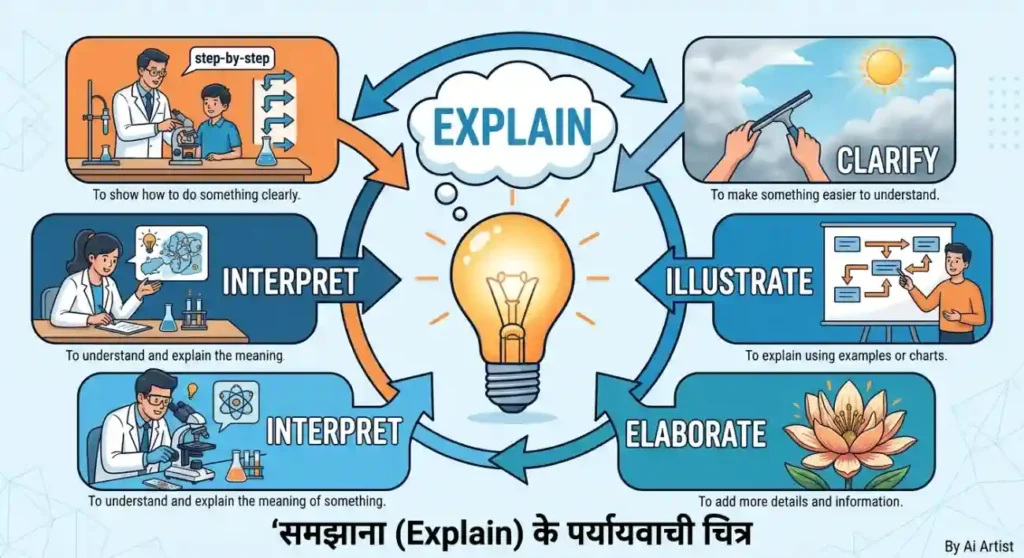
A synonym for explain is clarify, describe, illustrate, interpret, or elaborate, depending on the context. These words help communicate information in different ways.
For example, clarify means to make something easier to understand, while illustrate means to explain an idea using examples. The best synonym depends on what you want to communicate.
Key Takeaways
- Clarify is best when you want to make something easier to understand.
- Describe means to explain the features or details of something.
- Elaborate means to provide more information.
- Illustrate means to make an idea clearer through examples.
- Interpret means to explain the meaning of something.
What Is the Best Synonym for Explain?
The best synonym for explain is usually clarify when your goal is to make something easier to understand. However, other words may fit better depending on the situation.
For example, you can describe an object, interpret a poem, demonstrate a process, or elaborate on an idea.
The word explain generally means to make an idea, event, process, or situation understandable by providing information or reasons.
Here are five common alternatives:
- Clarify: Make something easier to understand.
- Describe: Give details about something.
- Illustrate: Explain an idea with examples.
- Elaborate: Add more information or detail.
- Interpret: Explain the meaning of something.
Choosing the right word makes your writing more precise and helps you communicate your message clearly.
25 Synonyms for Explain and Their Meanings
The English language offers many alternatives to the word explain. Some are suitable for casual conversations, while others work better in academic papers, business emails, and formal documents.
Common and Simple Synonyms
These everyday alternatives are useful for students, writers, and anyone who wants to communicate more clearly.
| Synonym | Meaning | Example |
|---|---|---|
| Clarify | Make something clearer | Please clarify your instructions. |
| Describe | Give details about something | Describe what happened yesterday. |
| Tell | Share information | Tell me why you are late. |
| Show | Help someone understand by demonstrating | Show me how the machine works. |
| Define | State the meaning of something | Define the word carefully. |
| Outline | Present the main points | Outline your plan for the project. |
| Summarize | Give the main ideas briefly | Summarize the chapter for me. |
| Detail | Explain something point by point | Detail the steps in your report. |
| Demonstrate | Show how something works | Demonstrate the correct technique. |
| Illustrate | Make an idea clear with examples | Illustrate your argument with an example. |
These words are not always interchangeable. For instance, summarize means giving the main points, while detail suggests providing specific information.
Formal and Academic Synonyms
When writing essays, research papers, reports, or professional documents, more precise vocabulary can improve the tone of your writing.
| Synonym | Meaning | Example |
|---|---|---|
| Elaborate | Provide additional details | Elaborate on your main argument. |
| Interpret | Explain meaning | Interpret the results carefully. |
| Expound | Explain an idea in detail | The author expounds on the theory. |
| Elucidate | Make something easier to understand | The professor elucidated the concept. |
| Explicate | Analyze and explain meaning | The student explicated the passage. |
| Account for | Explain the reason for something | The report accounts for the decline. |
| Justify | Give reasons supporting a decision | Justify your answer with evidence. |
| Specify | State something precisely | Specify the conditions of the agreement. |
Some of these words are more specialized than explain. For example, justify focuses on giving reasons that support a decision, while interpret focuses on understanding or communicating meaning.
Use formal alternatives when they express your intended meaning more accurately, not simply to make your writing sound complicated.
Synonyms for Specific Situations
Other alternatives work best when you need to communicate a particular kind of information.
| Synonym | Best Use | Example |
|---|---|---|
| Decode | Make a code or difficult message understandable | Help me decode this message. |
| Translate | Express meaning in another language or form | Translate the instructions into English. |
| Break down | Divide a complex idea into simpler parts | Break down the problem for beginners. |
| Unpack | Examine an idea in detail | Let’s unpack the main argument. |
| Interpret | Explain what something means | Interpret the speaker’s message. |
| Account for | Give a reason for an event or result | Explain what accounts for the change. |
| Demonstrate | Show how something works or is done | Demonstrate the procedure step by step. |
For everyday conversations, break down and unpack can sound more natural than formal alternatives. In technical writing, specify, interpret, or demonstrate may communicate the intended meaning more clearly.
Explain vs. Describe vs. Clarify
Although explain, describe, and clarify are related, they do not mean exactly the same thing. Understanding their differences helps you choose the right word.
| Word | Main Purpose | Example |
|---|---|---|
| Explain | Make something understandable by giving information or reasons | Explain why the meeting was canceled. |
| Describe | Tell what something looks, sounds, or feels like, or provide its details | Describe the meeting room. |
| Clarify | Remove confusion or misunderstanding | Clarify the new meeting time. |
| Illustrate | Make an idea clearer with examples | Illustrate the rule with an example. |
| Elaborate | Add more information | Elaborate on your earlier statement. |
| Interpret | Explain the meaning of something | Interpret the poem’s final lines. |
Consider a teacher discussing a science experiment.
The teacher might describe the equipment, explain the steps, illustrate the process with a diagram, and clarify a student’s misunderstanding.
Each word serves a different purpose. Choosing the most suitable one makes your sentence more accurate and natural.
What Is a Formal Word for Explain?
Several formal words can replace explain, depending on the subject and purpose of your writing.
Elucidate is a formal alternative that means making a difficult idea easier to understand. It may be suitable for academic or technical writing.
Explicate means analyzing and explaining the meaning of something, especially a text, argument, or concept.
Elaborate means adding details to an idea that has already been introduced.
Interpret works when explaining the meaning or significance of information, evidence, or literature.
Account for is useful when discussing why something happened or why a particular result occurred.
Here are examples in professional writing:
- Original: The researcher explained the findings.
- Alternative: The researcher interpreted the findings.
- Original: The manager explained the new policy.
- Alternative: The manager clarified the new policy.
- Original: The student explained the theory in detail.
- Alternative: The student elaborated on the theory.
Notice that the best replacement depends on the sentence. A formal synonym should preserve the original meaning rather than simply replace the word mechanically.
How to Use Synonyms for Explain in Sentences
The easiest way to choose a synonym is to identify what you want the reader or listener to understand.
Here are examples from everyday life, education, and work.
Everyday conversation
- Explain: Can you explain what happened?
- Clarify: Can you clarify what you meant?
- Describe: Can you describe the situation?
- Break down: Can you break down these instructions?
Academic writing
- Explain: The essay explains the causes of pollution.
- Interpret: The essay interprets the results of the experiment.
- Illustrate: The essay illustrates the argument with examples.
- Elaborate: The essay elaborates on the main theory.
Professional communication
- Explain: Please explain the reason for the delay.
- Specify: Please specify the reason for the delay.
- Clarify: Please clarify the reason for the delay.
- Account for: Please account for the delay in your report.
Each alternative changes the emphasis slightly. Clarify focuses on removing confusion, specify requests precise details, and account for asks for an explanation of a result or event.
Common Mistakes to Avoid
Do not assume every synonym works in every sentence.
For example, describe the reason can be appropriate, but explain the reason is often more direct when you want to understand why something happened.
Similarly, summarize the report means presenting its main points, not explaining every detail.
Choose the word that matches your purpose, audience, and level of detail.
What Is the Opposite of Explain?
The opposite of explain depends on the meaning you want to express. Common contrasting words include confuse, obscure, conceal, and complicate.
| Opposite | Meaning | Example |
|---|---|---|
| Confuse | Make something difficult to understand | His unclear answer confused the class. |
| Obscure | Make meaning less clear | The technical language obscured the message. |
| Conceal | Keep information hidden | She concealed the reason for her decision. |
| Complicate | Make something harder to understand or manage | Too many details complicated the explanation. |
These words express different ideas. Confuse and obscure relate to understanding, while conceal means hiding information. There is no single opposite that fits every use of explain.
Frequently Asked Questions
What is another word for explain?
Another word for explain is clarify. Other useful synonyms include describe, illustrate, interpret, elaborate, demonstrate, and define. The best choice depends on your sentence. Use clarify to remove confusion, describe to provide details, and elaborate when you want to give more information.
What is the easiest synonym for explain?
Tell and show are simple alternatives to explain. For example, you can say, “Tell me what happened,” or “Show me how it works.” However, explain or clarify may be more accurate when you need someone to communicate reasons or make an idea understandable.
What is a professional way to say explain?
Professional alternatives include clarify, elaborate, demonstrate, interpret, and account for. For example, “Could you clarify the next steps?” sounds natural in a business email. When asking someone to explain a result, “Could you account for this change?” may be more precise.
Are explain and clarify the same?
No. Explain means making something understandable by providing information, details, or reasons. Clarify means making something clearer, especially when confusion already exists. You might explain a new policy and then clarify a specific rule that employees find confusing.
What is a synonym for explain in academic writing?
Academic alternatives include elucidate, explicate, interpret, illustrate, and elaborate. Use interpret when discussing meaning, illustrate when providing examples, and elaborate when expanding on an argument. Choose vocabulary that matches your point rather than using complex words unnecessarily.
Conclusion
The best answer to “what is a synonym for explain” depends on the context. Clarify is an excellent general alternative, while describe, illustrate, elaborate, and interpret suit different purposes.
When choosing a synonym, consider whether you want to provide details, remove confusion, demonstrate a process, or explain meaning. The right word will make your writing clearer, more natural, and more effective.

I am Alexander, a passionate writer and language enthusiast at Synonyms. I specialize in creating clear, helpful content about synonyms, word meanings, and language differences to make English easier for everyone.