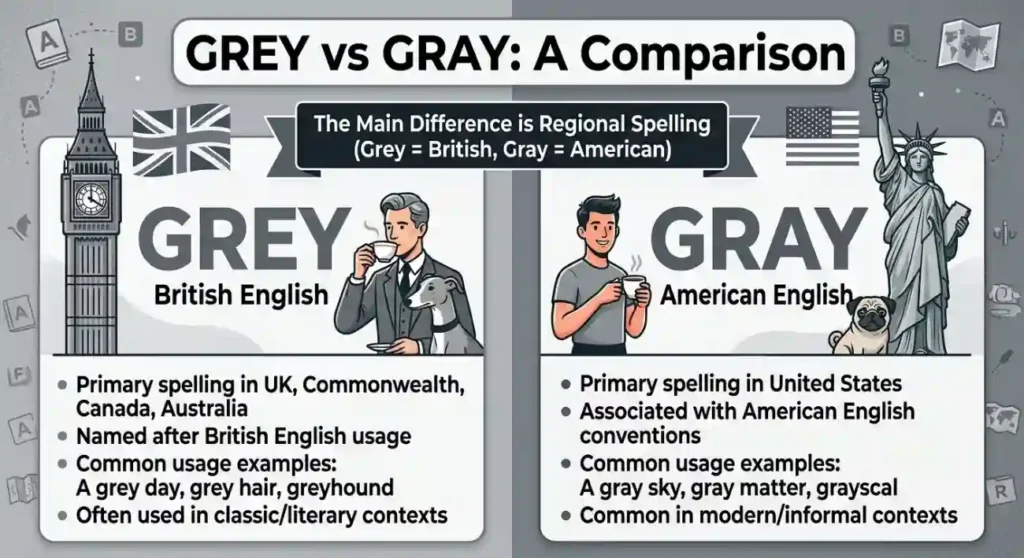
Grey and gray are both correct spellings of the same word. The main difference is regional: gray is the standard spelling in American English, while grey is more common in British English. Both words have the same basic meaning, pronunciation, and use for the color between black and white.
Key Takeaways
- Gray is the preferred spelling in American English.
- Grey is the preferred spelling in British English.
- Both spellings describe the same basic color and have the same pronunciation.
- Use the spelling that matches your audience and keep it consistent.
- Proper names and established terms may use either spelling regardless of location.
Grey vs Gray: What Is the Difference?
If you have ever typed grey and wondered whether it should be gray, you are not alone. Both forms are widely used, and neither is simply a spelling mistake.
The main difference is regional English usage. American English generally prefers gray, while British English generally prefers grey. Dictionaries such as Cambridge identify gray as the U.S. spelling of grey.
So, if you are writing for readers in the United States, gray is usually the best choice.
If you are writing for a British audience, grey will normally look more natural.
This is similar to other American and British spelling differences, such as color/colour, favorite/favourite, and center/centre.
Is Gray or Grey Correct?
Both are correct.
There is no general rule saying that grey is wrong or that gray is the only correct spelling. Instead, the preferred form depends largely on the variety of English being used.
For American readers:
The sky turned gray before the storm.
For British readers:
The sky turned grey before the storm.
The meaning stays exactly the same.
The words are also pronounced the same way, generally as /ɡreɪ/.
Therefore, the easiest rule is:
American English → gray
British English → grey
Gray vs Grey in American and British English
American English: Gray
In the United States, gray is the standard spelling.
You will commonly see it in phrases such as:
- gray hair
- gray shirt
- gray eyes
- gray clouds
- light gray
- dark gray
- gray paint
- gray area
- gray matter
For example:
She bought a light gray sweater.
His hair is starting to turn gray.
The sky looked gray all morning.
If your website, school assignment, business document, or other writing is intended for a U.S. audience, gray is normally the safer choice.
British English: Grey
In British English, grey is the more common spelling.
Examples include:
- grey hair
- grey shirt
- grey eyes
- grey clouds
- light grey
- dark grey
- grey paint
- grey area
- grey matter
For example:
She bought a light grey sweater.
His hair is starting to turn grey.
The sky looked grey all morning.
British dictionaries and English-language style resources generally recognize grey as the usual British form.
Do Gray and Grey Mean the Same Thing?
Yes. In ordinary modern English, gray and grey are spelling variants of the same word.
Both can refer to the neutral color between black and white. They can also be used as an adjective, noun, or verb depending on the sentence.
For example:
Adjective:
She wore a gray coat.
Noun:
Gray is one of my favorite neutral colors.
Verb:
His hair began to gray with age.
In British English, those sentences may use grey, grey, and grey instead.
The spelling changes, but the basic meaning does not.
Gray vs Grey Examples in Sentences
Seeing the two spellings side by side makes the difference easier to understand.
Gray/Grey as a Color
American English:
The walls are painted light gray.
British English:
The walls are painted light grey.
Both sentences describe the same color.
Gray/Grey Hair
American English:
My grandfather has gray hair.
British English:
My grandfather has grey hair.
Again, there is no difference in the person’s hair color simply because the spelling changes.
Gray/Grey as an Adjective
American English:
We had a gray afternoon with heavy clouds.
British English:
We had a grey afternoon with heavy clouds.
Here, the word describes the dull or cloudy appearance of the day.
Gray/Grey as a Verb
American English:
Her hair started graying in her thirties.
British English:
Her hair started greying in her thirties.
The same regional spelling pattern applies to related forms.
Are Gray and Grey Different Colors?
Generally, no.
There is no standard modern English rule that makes gray one particular shade and grey another. Both spellings normally refer to the same broad range of neutral colors between black and white. Dictionary sources treat the two as regional spelling variants rather than separate everyday colors.
You may sometimes see designers, artists, or individual writers use the terms to suggest slightly different shades. That can happen as a matter of personal or technical convention, but it is not the normal English spelling distinction.
So if someone asks, “Is grey darker than gray?”, the simple answer is no—not because of the spelling.
The color depends on the actual shade, not whether the word contains an a or an e.
What About Gray Area and Other Expressions?
The same spelling rule usually applies to common expressions.
In American English, you will normally see:
- gray area
- gray matter
- gray hair
- gray skies
- gray suit
- gray market
In British English, these generally become:
- grey area
- grey matter
- grey hair
- grey skies
- grey suit
- grey market
For example:
American: There is a gray area in the rules.
British: There is a grey area in the rules.
The figurative meaning also stays the same. A gray/grey area can describe something that is unclear, uncertain, or not easily classified as right or wrong.
When Should You Use Gray Instead of Grey?
If you are writing for an American audience, choose gray.
This is especially useful when writing:
- Blog posts
- School assignments
- Business documents
- Product descriptions
- Emails
- Social media posts
- Website content
- Marketing copy
For a U.S.-focused website, using gray consistently will match normal American spelling.
If your audience is primarily British, use grey instead.
The most important point is consistency. Switching randomly between gray and grey in the same piece can make your writing look inconsistent, even though both spellings are valid.
A useful memory trick is simple:
GrAy → America
GrEy → England
It is not a grammar rule, but it is an easy way to remember the preferred American and British spellings.
Are There Exceptions to the Rule?
Yes. Proper names and established names should keep their official spelling.
For example, a person’s name, company name, product name, title, or other proper noun may contain Grey or Gray regardless of the English variety being used.
You should not automatically change a proper name simply to match American spelling.
This matters because the spelling is part of the name itself.
There are also certain specialized uses where a particular spelling may be established by a technical system, organization, or proper term. When that happens, follow the official spelling rather than changing it based on the general U.S./UK rule.
In other words, the regional rule is a useful guide for ordinary writing, but official names always take priority.
Gray vs Grey: Quick Comparison Table
| Feature | Gray | Grey |
| Main usage | American English | British English |
| Correct spelling? | Yes | Yes |
| Basic meaning | Color between black and white | Color between black and white |
| Pronunciation | /ɡreɪ/ | /ɡreɪ/ |
| U.S. preference | Yes | Less common |
| UK preference | Less common | Yes |
| Gray/grey hair | Gray hair | Grey hair |
| Gray/grey area | Gray area | Grey area |
| Basic color difference | None | None |
The central difference is therefore spelling preference, not meaning.
Frequently Asked Questions
Is gray or grey correct?
Both gray and grey are correct. Gray is the standard U.S. spelling, while grey is more common in British English. They normally have the same meaning and pronunciation.
Is gray American or British?
Gray is the preferred spelling in American English. If you are writing for readers in the United States, use gray for ordinary words and phrases unless a proper name uses another spelling.
Is grey British or American?
Grey is the preferred spelling in British English. It is also used in other varieties of English, while gray is especially associated with American English.
Do gray and grey have the same meaning?
Yes. In normal usage, they are two spellings of the same word. Both refer to the neutral color between black and white and can also be used in related expressions such as gray/grey hair and gray/grey area.
Which spelling should I use in the USA?
Use gray in American English. For example, write gray shirt, gray hair, gray clouds, and gray paint. If you are reproducing an official name or title that uses grey, keep the original spelling.
Final Takeaway
When comparing grey vs gray, there is no complicated difference to memorize.
Gray is the preferred American English spelling, while grey is the preferred British English spelling. Both refer to the same basic color, have the same pronunciation, and work in the same grammatical contexts.
So, if you are writing for a U.S. audience, choose gray. If you are writing in British English, choose grey. Most importantly, pick the spelling that matches your variety of English and use it consistently.

I am Alexander, a passionate writer and language enthusiast at Synonyms. I specialize in creating clear, helpful content about synonyms, word meanings, and language differences to make English easier for everyone.