Most word lists built around “fox” repeat the same pattern fifty entries, each with a one-line meaning and a forgettable example sentence.
That format is easy to skim but hard to actually learn from, because it never tells you when to reach for one word over another.
This guide organizes the same fifty words into a real structure: five clear categories, each broken down further by tone and context, so you walk away knowing not just what a word means, but when it actually fits.
Why Word Choice Matters More Than Word Count
Before diving into the list, it helps to understand why “fox” produces so many synonyms in the first place. The word carries two separate identities in English. On one hand, it names a real, biologically distinct animal with its own vocabulary for gender, region, and species.
On the other hand, it has become a cultural shorthand for cleverness, quickness, and sometimes deception, borrowed from centuries of folklore where foxes consistently outwit larger, slower animals.
Because of this split identity, synonyms for fox fall into two very different families: words that describe the animal itself, and words that describe a personality trait the animal has come to represent.
Mixing these up is the single most common mistake language learners make, calling a person a “vixen” when they mean “clever,” for instance, sends a very different message than intended.
How to Choose the Right Word
A fast way to narrow down fifty options: ask what you’re actually describing.
If you’re referring to the literal animal, terms like vixen, tod, and dog fox apply. If you want to praise someone’s intelligence, words like sharp mind or strategist carry a positive, respectful tone.
If you’re pointing out sneakiness in a lighthearted way, sly one or crafty one works well. If you mean real dishonesty, harsher words like deceiver or swindler are more accurate and using them casually about a real person can come across as a serious accusation rather than a joke.
Tone is the variable most lists skip entirely, and it’s the difference between sounding natural and sounding like you pulled a word from a thesaurus without reading the fine print.
Category 1: Names for the Fox Itself
Terms Based on Gender
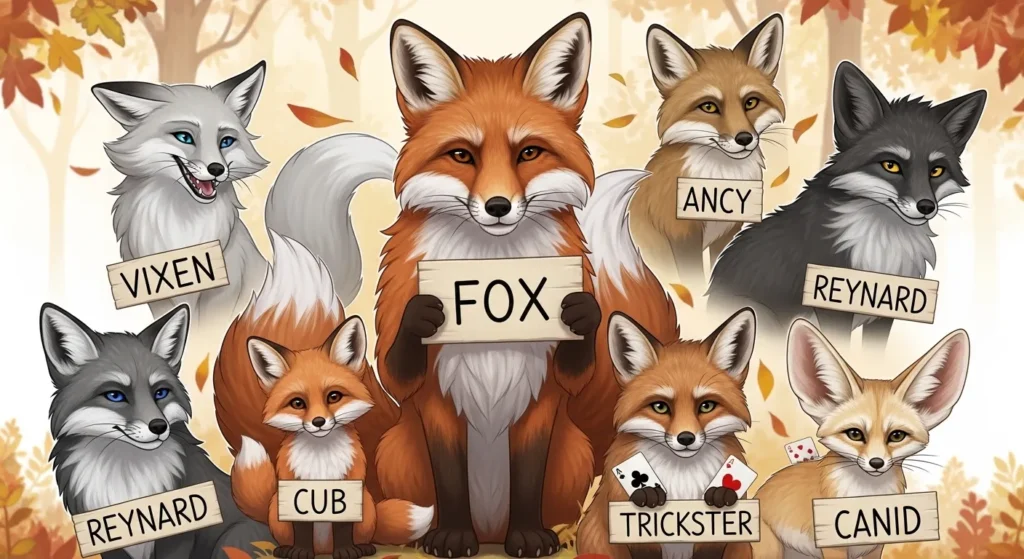
Vixen names a female fox specifically. A nature writer might say, “The vixen kept close watch over her cubs as the sun dropped behind the hills.” This word stays firmly in the animal world; it isn’t used to describe people the way “fox” sometimes is.
Tod refers to a male fox, though it’s a regional term most common in British nature writing. “A tod moved silently along the tree line before the farm dogs stirred.” Most readers outside the UK won’t recognize this word on sight, so it’s worth explaining if you use it.
Dog fox is the more universally understood term for a male fox. “The dog fox circled the field twice before settling near the hedge.”
Terms From Folklore
Reynard comes from a cycle of medieval European fables where a fox character named Reynard repeatedly tricked bigger, slower animals through wit rather than strength.
“Every version of the old tale ends the same way Reynard talks his way to freedom.” Outside of literature classes or fable retellings, this word rarely shows up in modern conversation.
Category 2: Words for a Clever or Sharp-Minded Person
Everyday Smart-Person Words
Clever one is a simple, widely used way to describe someone who picks things up quickly. “Everyone at the table knew better than to underestimate the clever one.”
Sharp mind works the same way but leans slightly more formal. “A sharp mind like hers noticed the error before anyone else even opened the file.”
Brainy one feels a touch more casual, often used among friends or in light conversation. “The brainy one of the group somehow always finishes the crossword first.”
Quick thinkers highlight speed under pressure rather than raw intelligence. “Being a quick thinker saved him when the presentation crashed mid-meeting.”
Smart animal applies specifically to animals rather than people, useful in wildlife writing. “Researchers describe the fox as a smart animal capable of solving multi-step problems to reach food.”
Words for Strategic Thinking
Strategist describes someone who thinks several moves ahead, and it carries a respectful, almost admiring tone. “The negotiator played the strategist, anticipating every objection before it was raised.”
It’s worth separating this from words in the next category that sound similar but carry very different weight. A strategist plans ahead for a fair outcome; a manipulator plans ahead to control or exploit someone else. The planning looks similar on the surface, the intent underneath is not.
Category 3: Words for Trickery, Sneakiness, and Cunning
Playful, Lighthearted Mischief
A sly one suggests someone who quietly gets their way, usually without malice. “That sly one somehow convinced the whole office to switch to a four-day week.”
Crafty one leans a bit more approving, praising resourcefulness over deception. “The crafty one found a loophole nobody else had thought to check.”
Sneaky one works especially well in casual, even affectionate contexts often used with children. “That sneaky one hid dessert behind the cereal boxes.”
Trickster is the classic folklore term, describing a character who lives for clever pranks rather than genuine harm. “In story after story, the trickster escapes danger through wit instead of strength.”
Rascal and scamp both describe harmless, often endearing mischief safe words for describing a playful child, pet, or friend. “That little rascal rearranged every book on the shelf just to see if anyone would notice.” “The scamp snuck one more cookie the moment the kitchen emptied out.”
Rogue sits in an interesting middle ground unpredictable and rule-breaking, but often with real charm attached, especially in fiction. “He played the rogue of the story, breaking every rule yet somehow earning the reader’s sympathy.”
Words That Signal Real Deception
Sneak, schemer, and plotter all describe secretive behavior with a more serious undertone than “sly” or “crafty.” “The sneak vanished from the meeting the moment questions turned toward him.”
Deceiver and manipulator go further, implying real harm rather than playful trickery. “The manipulator reshaped the entire conversation until the blame quietly shifted elsewhere.”
Swindlers and con artists describe deception involving money or serious loss, and they should never be used lightly about real people; the accusation carries legal and reputational weight. “The swindler disappeared the same afternoon the deposit cleared.”
Prowler stands apart from the rest of this category because it usually implies suspicious intent rather than clever mischief. “A prowler moved along the fence line long after the house had gone dark.” Unlike “rascal” or “scamp,” this word can sound genuinely unsettling; it’s used for burglars just as often as for wildlife.
Category 4: Words for Hunting Behavior
Stealth-Based Hunting Terms
Silent hunter and shadow hunter both emphasize how quietly an animal moves before striking. “As a silent hunter, the fox can close the distance on prey without a single warning sound.”
Night hunter simply marks an animal as most active after dark. “Being a night hunter, most of the fox’s activity happens well after the sun goes down.”
Stalker describes patient, quiet pursuit before an attack but outside of wildlife writing, this word almost always refers to a person following someone in a threatening way, so it needs careful handling in everyday contexts. “The stalker held completely still in the grass for nearly an hour before moving.”
Skill-Based Hunting Terms
Hunter and predator are broad, neutral terms that apply across almost any hunting animal. “Even a small predator like the fox plays a meaningful role in controlling rodent populations.”
Tracker highlights the ability to follow scent or footprints over distance. “A skilled tracker, the fox can follow a trail for miles without losing the scent.”
Fur hunter and small predator both describe scale and target smaller animals hunting other small, fur-bearing prey. “As a fur hunter, its usual targets are rabbits, voles, and other small mammals.”
Category 5: Habitat and Regional Fox Types
Fox Species by Climate
Red fox is the most common and recognizable species worldwide. “The bright orange coat of the red fox makes it one of the most photographed wild animals.”
Silver fox isn’t a separate species at all; it’s a striking dark color variation of the red fox. “A silver fox carries the same genetics as a red fox, just expressed through a different coat color.”
Arctic fox has adapted to some of the harshest cold climates on Earth. “The arctic fox’s coat shifts from white to brown as the seasons change, keeping it camouflaged year-round.”
Desert fox and fennec are both built for heat rather than cold. “The fennec’s oversized ears aren’t just for hearing, they also help release excess body heat in the desert sun.”
Habitat-Based Hunter Terms
Forest hunter and woodland hunter both describe foxes adapted to life among trees, relying on cover for their hunting style. “As a forest hunter, movement through dense brush comes almost silently.”
Field hunter applies to foxes that prefer open grassland instead of tree cover. “A field hunter relies on hearing alone to locate mice moving beneath tall grass.”
Bush runner and shade runner both emphasize speed and agility through dense, low vegetation. “The bush runner covered the distance across the thicket in seconds flat.”
Den dweller highlights a fox’s underground shelter rather than its hunting style. “As a den dweller, the fox digs and maintains burrows used to raise its young safely.”
Survivor and fast runner round out the list with broader traits, adaptability and raw speed. “Few animals adapt as well as the fox, thriving from remote deserts all the way into busy city parks.”
Three Mistakes to Avoid When Using These Words
The first mistake is treating negative words like “manipulator” or “stalker” as compliments. Both terms carry serious weight in everyday English, and using them casually can land far harsher than intended. If the goal is praising someone’s cleverness, “strategist” or “crafty one” is a much safer choice.
The second mistake is assuming “sly,” “cunning,” and “sneaky” all mean exactly the same thing. They sit close together, but each has its own shade of meaning: sneaky often sounds petty or childish, cunning sounds calculated and deliberate, and sly falls somewhere in between, often carrying a hint of humor.
The third mistake is ignoring how much context changes a word’s effect. “Rogue” might sound charming inside a novel, but the same word in a professional email can come across as careless or even insulting. Always weigh the setting as heavily as the dictionary definition.
Frequently Asked Questions
Can “fox” be used as a verb? Yes “to fox someone” is an informal way of saying to confuse or outsmart them, as in, “That last question on the exam really foxed me.”
What’s the safest everyday word for describing a clever person? “Sharp” or “sharp mind” sounds natural in casual conversation. Words like “cunning person” or “manipulator” read more like formal writing and can sound heavier than intended in everyday speech.
Which of these words should be used carefully around real people? “Swindler,” “deceiver,” and “con artist” all describe genuine wrongdoing, so they shouldn’t be applied lightly to someone in real life. The rest of the list is generally safe for casual or creative writing.
Putting It All Together
Think of these fifty words less as a list to memorize and more as a set of tools organized by job. When the job is naming the animal itself, the first category covers gender and folklore terms.
When the job is praising intelligence, the second category offers words that sound respectful rather than backhanded. When the job is describing mischief, the third category is really two categories in disguise: playful trickery on one side, real deception on the other and mixing them up is the fastest way to send the wrong message.
The fourth category exists almost entirely for nature and wildlife writing, where precision about hunting behavior matters more than it does in daily conversation. And the fifth category is purely descriptive, useful whenever accuracy about species or habitat is the actual goal.
Reading through a list like this once won’t make any of these words feel automatic. What tends to work better is picking a single word during a week of writing or conversation and deliberately using it a few times until the tone starts to feel natural rather than borrowed.
Over time, that kind of targeted practice builds real vocabulary, the sense of knowing, without pausing to think, that “crafty” fits a lighthearted story while “manipulator” belongs in a much more serious one.
Final Thought
Rather than trying to memorize all fifty words at once, pick two or three that fit a piece of writing you’re working on right now.
Paying attention to tone, not just definition is what actually makes vocabulary useful, and it’s the one habit that separates writing that sounds natural from writing that sounds like it came straight out of a word list.

James Parker is a writer who creates clear and helpful content for readers. I am James Parker, and I am a synonyms writer who focuses on explaining word meanings and differences in simple language to help students and learners understand concepts easily.