A student once asked me why her essay kept getting marked down for “repetitive language,” even though she thought she’d used a thesaurus correctly.
Her mistake was a common one: she’d replaced every instance of “represent” with “symbolize” even in a sentence where she meant “this graph represents our findings.” That sentence needed “shows” or “illustrates,” not “symbolizes.” Swapping words without understanding which represent you mean is how thesaurus-hunting backfires.
That’s the real problem with “represent.” It’s not one word, it’s at least eight different ideas wearing the same coat. Get the sense wrong, and your sentence reads oddly even if the word is technically a “synonym.” This guide sorts every major meaning out, gives you the right word for each one, and answers the specific questions people search for most: essay writing, sentence examples, research papers, and describing a person.
Quick Answer
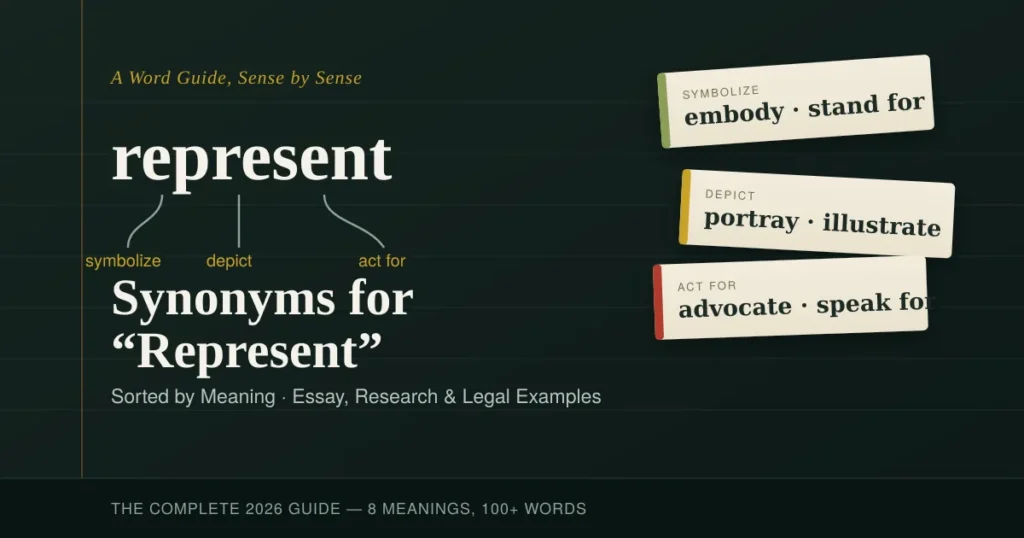
If you just need the fast version: for symbolizing something, use symbolize, embody, or stand for. For showing or depicting, use depict, portray, or illustrate. For acting on someone’s behalf, use act for, speak for, or advocate for. Keep reading for the full breakdown, examples, and the difference between each option.
What Does “Represent” Actually Mean?
“Represent” comes from the Latin repraesentare literally “to make present again,” from re- (again) and praesentare (to present).
That origin explains a lot. At its core, the word is about making something present to the mind that isn’t literally in front of you: a symbol makes an idea present, a lawyer makes an absent client present in court, a chart makes a set of numbers present to the eye.
Modern dictionaries split “represent” into distinct senses rather than treating it as one flat definition. Merriam-Webster, for instance, organizes its entry around three core ideas to characterize, to depict, and to symbolize while WordHippo’s thesaurus data goes even further, listing around 20 separate contexts. That’s the detail most quick synonym lists skip, and it’s exactly why a one-size-fits-all replacement rarely works.
The Main Senses of “Represent” (And the Best Word for Each)
1. To Symbolize or Embody
This is the sense people usually think of first one thing standing in for an idea, value, or concept.
Best synonyms: symbolize, embody, stand for, epitomize, typify, personify, exemplify
Think of a flag representing a nation, or a dove representing peace. In this sense, the “represent” isn’t literal, nothing is being drawn or shown, something is simply standing for a bigger idea.
“The white dove has long represented peace in Western art.” → “The white dove has long symbolized peace in Western art.”
2. To Depict or Show
Here, “represent” means to visually or descriptively present something: a painting, a diagram, a map.
Best synonyms: depict, portray, illustrate, show, render, sketch, picture
“The mural represents the city’s founding families.” → “The mural depicts the city’s founding families.”
Notice this is a completely different feel from Sense 1 nothing here is symbolic; it’s literal visual representation.
3. To Act on Someone’s Behalf
This is the legal, political, and professional sense of a lawyer, a diplomat, an elected official, or an agent standing in for another person or group.
Best synonyms: act for, speak for, advocate for, act on behalf of, appear for, stand in for
“Her attorney will represent her at the hearing.” → “Her attorney will advocate for her at the hearing.”
This is also the sense behind “representative” as a job title: a sales representative, a union representative, a member of Congress representing a district.
4. To Constitute or Amount To
Business and finance writing leans on this sense constantly when a number or event “represents” a change, growth, or proportion.
Best synonyms: constitute, account for, amount to, equal, comprise
“Coffee sales represent nearly 20% of the company’s revenue.” → “Coffee sales account for nearly 20% of the company’s revenue.”
You’ll see this exact pattern in financial journalism constantly. A recent Wall Street Journal piece noted that a particular deal would “represent an organic compound annual growth rate of 8%,” using the word in precisely this constitutive sense.
5. To Characterize or Describe
This sense frames or describes the essential quality of a person, group, or thing often in a way that implies judgment or interpretation.
Best synonyms: characterize, describe, portray, define, depict
“The article represented the team as disorganized and underprepared.” → “The article characterized the team as disorganized and underprepared.”
6. To Act as a Substitute or Stand-In
Slightly different from “acting on behalf of” this sense is about literally filling in for someone, often temporarily.
Best synonyms: stand in for, substitute for, deputize for, cover for, fill in for
“The vice president will represent the CEO at tomorrow’s meeting.” → “The vice president will stand in for the CEO at tomorrow’s meeting.”
7. To Be an Elected or Official Member
Specific to politics and formal organizations, someone chosen to speak for a group, district, or country.
Best synonyms: serve as the representative for, sit for, be elected by
“She has represented the district in Congress for three terms.”
Here, no single-word swap fits as cleanly this sense often works best left as “represent” or rephrased with “serves as [district]’s representative.”
8. To Imitate or Portray (Performance Context)
A lesser-known but legitimate sense is an actor “representing” a historical figure on stage, or someone imitating another’s mannerisms.
Best synonyms: portray, impersonate, play the part of, enact
“Kenneth Branagh represented Gilderoy Lockhart in the film adaptation.” → “Kenneth Branagh portrayed Gilderoy Lockhart in the film adaptation.”
Synonyms for Represent in an Essay
Academic writing tends to lean on senses 1, 2, and 5 the most symbolizing, depicting, and characterizing. When you’re analyzing literature, art, or historical events, these tend to be your strongest picks:
- symbolizes for thematic or symbolic analysis (“the storm symbolizes the protagonist’s inner turmoil”)
- illustrates for evidence-based points (“this example illustrates the author’s central argument”)
- embodies for character analysis (“the character embodies the era’s anxieties”)
- exemplifies for using a specific case to prove a broader claim
- conveys for tone, mood, or emotional meaning
A quick rule for essays: if you’re making an argument about meaning, reach for symbolize/embody/exemplify. If you’re pointing to evidence, reach for illustrates/demonstrates/shows.
Synonyms for Represent in a Sentence (Worked Examples)
Seeing the swap happen inside full sentences makes the distinction click faster than any list:
| Original Sentence | Better Word | Why |
| The color red represents danger in most cultures. | symbolizes | Symbolic meaning, not literal |
| This chart represents our Q3 sales figures. | shows / illustrates | Visual/data depiction |
| The senator represents a rural district. | serves | Elected role |
| Refreshers now represent about $2 billion in annual sales. | account for | Amounts to a proportion |
| The lawyer will represent the defendant. | advocate for | Legal representation |
| The painting represents a stormy sea. | depicts | Visual art |
| His actions represent everything wrong with the industry. | characterize / epitomize | Judgmental description |
Synonyms for Represent in Research (Academic & Scientific Writing)
Research writing has its own quirks. In methodology and results sections, “represent” is often used loosely to mean “correspond to” or “stand for a variable” and precision matters more here than almost anywhere else. Strong alternatives include:
- denotes for defining variables or symbols (“here, x denotes the sample size”)
- corresponds to for mapping data to categories
- indicates for what a result suggests
- reflects for what data reveals about an underlying pattern
- accounts for for statistical proportion (“this factor accounts for 40% of the variance”)
Avoid “symbolizes” and “embodies” in research writing entirely; those carry a literary, interpretive weight that doesn’t belong in a methods section.
Synonyms for Represent a Person
When “represent” refers to a person legally, politically, or professionally the right word depends on the relationship:
- Legal context: advocate for, act for, defend, appear on behalf of
- Political context: serve, speak for, act as delegate for
- Business/agency context: be the agent for, act as spokesperson for, be proxy for
- Performance context: portray, play, embody (an actor representing a real person)
“Representative”: The Related Word People Also Search For
Since “represent” and “representative” often get searched together, it’s worth separating them clearly. “Representative” functions as both a noun (a person who acts for others a sales representative, a legal representative) and an adjective (typical of a wider group “a representative sample”).
As a noun, synonyms include: agent, delegate, spokesperson, proxy, envoy, ambassador, deputy.
As an adjective, synonyms include: typical, characteristic, illustrative, indicative, exemplary.
Antonyms of “Represent”
Most thesaurus sites offer only a handful of weak antonyms here but the opposite of “represent” shifts depending on which sense you’re negating, just like the synonyms do.
| Sense | Antonym Options |
| Symbolize | contradict, obscure, conceal |
| Depict | hide, distort, misrepresent |
| Act for | abandon, disown, refuse to act for |
| Constitute/amount to | be irrelevant to, have no bearing on |
| Characterize (falsely) | misrepresent, distort, misconstrue |
Represent Synonym and Antonym: Quick Reference
For a fast side-by-side view:
Top 10 Synonyms: symbolize, depict, embody, portray, characterize, illustrate, constitute, advocate for, stand for, epitomize
Top 5 Antonyms: misrepresent, distort, conceal, contradict, obscure
Common Mistakes to Avoid
Over the years of helping people revise essays and professional writing, the same three mistakes show up again and again:
- Treating “represent” as one meaning. As shown above, it’s really eight or more to always identify which one you mean before swapping the word.
- Overcorrecting with “symbolize” everywhere. This is the single most common thesaurus mistake. Not everything that “represents” something is symbolic most of the time, in data, business, and factual writing, it’s simply “shows,” “equals,” or “accounts for.”
- Losing precision in legal or research contexts. “Represent” carries specific technical weight in law (acting as counsel) and statistics (a variable standing for a value). Swapping in a vague synonym can actually change the meaning of a sentence, not just its style.
Frequently Asked Questions
What is the best synonym for “represent”? There isn’t one universal answer it depends on the sense. For symbolic meaning, “symbolize” or “embody” work well. For legal or political representation, “advocate for” or “act on behalf of.”
What is a synonym for “represent” in English writing generally? For everyday writing, “show,” “depict,” and “stand for” cover most situations without sounding overly formal.
What is the opposite of “represent”? “Misrepresent” is the most direct antonym when talking about distorted or false representation. For other senses, “conceal,” “hide,” or “contradict” fit better.
Is “representative” a synonym for “represent”? Not exactly “representative” is a related word (a noun or adjective), not a direct synonym of the verb “represent.” A representative is a person who represents others.
Can “exemplify” always replace “represent”? Only in the symbolic/characterizing sense when something serves as a perfect example of a category. It doesn’t work for legal, political, or statistical uses of “represent.”
Conclusion
“Represent” survives in modern English because it’s genuinely useful and flexible enough to describe a flag, a lawyer, a chart, and a member of parliament with the same six letters plus a suffix.
But that flexibility is also a trap: the word that works perfectly in an essay about symbolism will sound off in a business report, and the word that fits a legal context will feel stiff in casual writing.
The fix isn’t memorizing a giant list, it’s asking one question before you reach for a synonym: am I talking about a symbol, a picture, a person acting for someone, a number, or a description? Once you know which “represent” you mean, the right word is usually obvious. That’s the difference between swapping words and actually writing well.

I am Alexander, a passionate writer and language enthusiast at Synonyms. I specialize in creating clear, helpful content about synonyms, word meanings, and language differences to make English easier for everyone.