Have you ever read a line of dialogue and immediately understood the character’s attitude from just one word? That’s often what happens with wryly. It’s a small word, but it can add a lot of meaning. It suggests dry humor, irony, and sometimes a little frustration or self-awareness.
The problem is that writers can easily overuse it. If you’ve written “she said wryly” several times in the same chapter, you may start looking for a different word that gives the sentence a fresher feel.
But finding a true replacement isn’t always easy.
Wryly doesn’t simply mean sarcastically or jokingly. It usually describes a particular kind of humor that is dry, understated, and aware of the irony in a situation. Depending on the context, it can also suggest resignation, mild annoyance, or self-mockery.
For example:
“Well, that went exactly as planned,” he said wryly.
The speaker obviously doesn’t believe that everything went according to plan. Instead, he’s pointing out the irony in a dry, controlled way. There’s humor in the comment, but it isn’t loud or exaggerated.
That’s what makes wryly difficult to replace with one perfect synonym. Different alternatives capture different parts of its meaning.
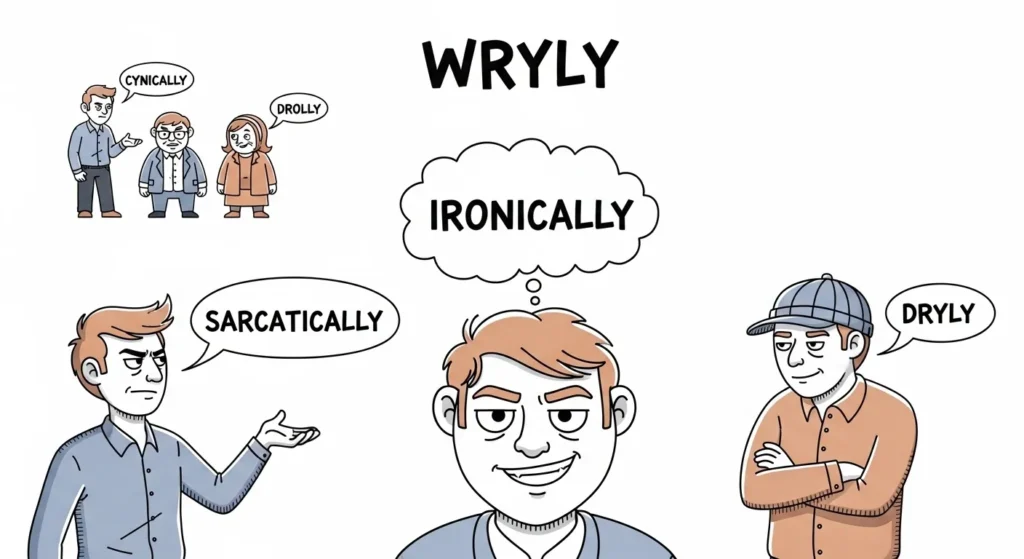
In this guide, you’ll find the closest synonyms for wryly, related alternatives grouped by tone, examples, common mistakes, and clear comparisons with words such as dryly, sarcastically, and ironically.
What Does Wryly Mean?
Wryly describes a way of speaking or reacting that combines dry humor with irony. It often appears when someone recognizes that a situation is disappointing, strange, ridiculous, or frustrating but responds with a clever, understated comment instead of an emotional reaction.
The word comes from wry, which originally referred to something twisted or crooked. Think of a wry smile: it’s not a wide, cheerful grin but a slightly crooked expression. Over time, the word developed a figurative meaning connected with irony and dry humor.
A wry comment usually has several qualities:
- It’s clever rather than loud or exaggerated.
- It contains some form of dry humor.
- It may include mild sarcasm.
- It often shows awareness of an ironic situation.
- It can carry frustration, resignation, or self-mockery.
Examples of Wryly in a Sentence
She smiled wryly when she saw the impossible deadline.
She isn’t happy about the deadline, but she sees something slightly amusing about the situation.
“Another meeting that could’ve been an email,” he said wryly.
He’s complaining, but he does it with dry humor rather than anger.
He wryly admitted that his “perfect plan” had fallen apart.
He’s embarrassed by what happened but can still see the funny side of it.
The important thing to remember is that wryly usually sits somewhere between humor and disappointment. It’s not necessarily cheerful, but it’s rarely completely bitter either.
The Closest Synonyms for Wryly
Not every word that appears in a thesaurus is a direct synonym for wryly. Some words are close matches, while others only overlap with one part of its meaning.
Here are some of the strongest alternatives.
1. Dryly
Dryly is probably the closest everyday alternative to wryly. It describes humor delivered in a calm, restrained, or almost emotionless way.
“Great, another problem to solve,” she said dryly.
The humor comes from how calmly she responds to an obviously frustrating situation.
Best for: subtle humor, deadpan delivery, and understated reactions.
2. Ironically
Ironically focuses more on the contradiction between what is expected and what actually happens. It can overlap with wryly, but it doesn’t always involve humor.
He ironically thanked the broken printer for “helping” him finish his work.
The situation is ironic because the printer is doing the opposite of helping.
Best for: situations involving clear contradiction or unexpected outcomes.
3. Sarcastically
Sarcastically is a common substitute for wryly, but the two aren’t identical. Sarcasm often involves saying something that means the opposite of the literal words, usually to criticize or mock someone.
“Excellent job,” she said sarcastically, staring at the mess.
The tone is sharper than it would normally be with wryly.
Best for: pointed criticism, mockery, or sharper humor.
4. Sardonically
Sardonically suggests humor with a darker, more cynical edge. It often carries disappointment, distrust, or bitterness.
He laughed sardonically at the idea that the company actually cared about its employees.
This isn’t light teasing. There’s clear cynicism underneath the humor.
Best for: dark humor, distrust, and bitter situations.
5. Cynically
Cynically expresses doubt about people’s motives, especially when someone assumes that others are acting out of self-interest.
“They’re only offering discounts because they want more customers,” he said cynically.
The speaker doesn’t simply find the situation amusing. He suspects that the company’s motives aren’t genuine.
Best for: suspicion, distrust, and negative assumptions.
6. Mockingly
Mockingly is stronger and more direct than wryly. It usually involves making fun of someone through imitation, exaggeration, or ridicule.
He repeated her excuse mockingly, drawing out every word.
Unlike wry humor, mockery often has the clear purpose of making another person look foolish.
Best for: ridicule, imitation, and deliberate teasing.
7. Wittingly
Wittingly isn’t a true synonym for wryly, but it can overlap in limited contexts. It means doing something knowingly or intentionally.
She wittingly pointed out the mistake everyone else had missed.
The word tells us that she was aware of what she was doing, but it doesn’t automatically suggest humor or irony.
Best for: deliberate or knowing actions, not general humor.
8. Playfully
Playfully removes much of the irony and edge associated with wryly. It suggests light, friendly teasing.
“You finally showed up,” he said playfully.
The speaker sounds warm and friendly rather than frustrated or cynical.
Best for: friendly teasing and light humor.
9. Witty
Witty describes someone or something that is clever and amusing. However, it doesn’t necessarily contain irony.
Her witty comeback had the whole room laughing.
A witty remark can be clever without being wry.
Best for: clever jokes, quick responses, and intelligent humor.
10. Amusedly
Amusedly suggests that someone is entertained or mildly pleased by what they’re seeing.
He watched the chaos unfold, amusedly.
It doesn’t carry the same ironic or self-aware quality as wryly.
Best for: genuine amusement without much bitterness or irony.
More Alternatives for Wryly, Grouped by Tone
Sometimes you don’t need an exact synonym. You simply need a word that creates the right mood in the sentence.
Humorous and Clever Alternatives
These words work when the character is being funny or clever without necessarily sounding bitter.
11. Humorously broadly describes something done in a funny way.
He humorously described his first cooking attempt as “a small disaster.”
12. Lightheartedly suggests cheerful, relaxed humor.
She lightheartedly joked about tripping on stage.
13. Jokingly a simple, everyday way to show that something was said as a joke.
“I guess I’m basically a professional now,” he said jokingly.
14. Teasingly works when the humor is directed toward another person in a friendly way.
“You actually cleaned your room?” she asked teasingly.
15. Cleverly emphasizes intelligence or skill rather than humor itself.
She cleverly pointed out the flaw nobody else had noticed.
Subtle and Understated Alternatives
These choices work when you want the reaction to feel restrained.
16. Subtly suggests something indirect or not immediately obvious.
He subtly criticized the decision during the interview.
17. Quietly shows restraint but doesn’t necessarily imply humor.
She quietly took in the chaos around her.
18. Understatedly suggests that something important is presented as if it were less significant than it really is.
He understatedly mentioned that the entire project had collapsed.
19. Deadpan describes a serious, emotionless delivery of something funny.
“I love waiting three hours for customer service,” he said with a deadpan expression.
A character can be both deadpan and wry, but the words describe slightly different things. Deadpan focuses on delivery, while wry focuses more on the underlying attitude.
Negative or Critical Alternatives
These words are useful when the humor has a darker or more serious edge.
20. Bitterly suggests anger, hurt, or resentment.
He laughed bitterly when he remembered the promise that was never kept.
21. Grimly suggests serious acceptance without much humor.
She grimly accepted that the plan had failed.
22. Resignedly shows acceptance of something unpleasant that cannot easily be changed.
“Well, that’s life,” he said resignedly.
23. Skeptically shows doubt rather than irony.
“That sounds like a great idea,” she said skeptically.
24. Doubtingly suggests uncertainty about whether something is true or reliable.
He looked at the results doubtingly, unsure whether to trust them.
Formal Alternatives
These words can work well in essays, articles, reports, and other formal contexts.
25. Pointedly suggests a deliberate comment that often carries criticism.
She pointedly mentioned the missed deadline in front of the whole team.
26. Dryness remains one of the most natural alternatives when the tone is restrained.
The report dryly noted that the “successful launch” still had several unresolved issues.
27. Ironically useful when the focus is on a contradiction or unexpected result.
Ironically, the technology designed to save time created even more delays.
28. Humorously works when the tone is simply funny and doesn’t need to sound critical.
The article humorously described the office kitchen as a battlefield.
Wryly vs. Similar Words: The Differences That Matter
Several words can look interchangeable with wryly, but small differences can change the tone of a sentence.
Wryly vs. Sarcastically
Wryly usually feels subtle, clever, and self-aware. It can contain criticism, but it doesn’t have to be hostile.
“Perfect timing,” she said wryly as the rain started the moment she stepped outside.
Sarcastically tends to be more pointed. It is often used to criticize, mock, or express annoyance.
“Amazing work,” he said sarcastically while looking at the mistake.
A simple way to remember the difference is this: wry humor is often understated, while sarcasm is usually more pointed.
Wryly vs. Dryly
Dryly focuses mainly on the way something is delivered. The speaker may sound calm, flat, or emotionally restrained.
Wryly focuses more on the attitude behind the words. There’s usually some irony, self-awareness, or mixed emotion involved.
Someone can speak dryly without being ironic. A genuinely wry remark, however, usually has some meaning beneath the surface.
Wryly vs. Ironically
Ironically often describes a contradiction between expectation and reality.
For example, if a fire station burns down, the situation itself is ironic.
If a firefighter jokes about needing a backup plan after the fire, that reaction can be described as wry.
In simple terms, irony can exist in a situation, while wryness often describes how a person responds to it.
Wryly vs. Cynically
Wryly doesn’t necessarily suggest distrust. A person can make a wry joke while still having a positive view of other people.
Cynically, on the other hand, suggests that someone expects selfish or dishonest motives.
“Sure, I’m sure they remembered my birthday,” she said wryly.
The speaker may simply be amused by the situation.
“They’re only pretending to care because they want something,” she said cynically.
Here, the speaker clearly distrusts the other person’s motives.
How Writers Use Wryly Effectively
Writers often use wryly because one small word can communicate several emotions at once.
Compare these two sentences:
John was sad, but he laughed anyway.
John laughed wryly.
The first sentence tells us directly that John is sad. The second suggests more. John understands that the situation is unpleasant, but he can still see something ironic or slightly amusing about it.
That said, wryly shouldn’t become a shortcut for every complicated emotional reaction. If you use it repeatedly, the writing can start to feel predictable.
Sometimes it’s better to show the reaction instead.
Instead of:
John smiled wryly.
You could write:
John looked at the ruined schedule and let out a short laugh.
The second version gives the reader something concrete to picture.
Common Mistakes When Using Wryly and Its Synonyms
Treating Every Sarcastic Comment as Wry
Not every sarcastic remark is wry. A blunt insult or cruel joke can be sarcastic without having the subtle humor associated with wry.
Before using wryly, ask whether the comment has some dry irony or self-awareness behind it.
Assuming Wry Always Means Funny
Wry humor doesn’t have to be genuinely funny. It can carry sadness, frustration, embarrassment, disappointment, or resignation.
That’s why a character can respond wryly to a situation that isn’t funny at all.
Using a Synonym Without Checking the Tone
Replacing wryly with mockingly, for example, can completely change the scene.
A wry comment may be clever and understated. A mocking comment can sound cruel or insulting.
Before choosing a replacement, ask:
- Is the character being clever?
- Are they teasing someone?
- Are they criticizing?
- Are they frustrated?
- Are they being cynical?
- Is the humor directed at themselves?
The answer will usually point you toward the right word.
Using a Related Word as an Exact Synonym
Words such as skeptically, quietly, and wittingly can sometimes work in a similar context, but they don’t carry the full meaning of wryly.
If you’re writing a synonym list, it’s better to label these as related alternatives rather than direct synonyms.
Frequently Asked Questions About Wryly
What are synonyms for wryly in English?
Some of the closest alternatives are dryly, ironically, sardonically, and sarcastically. Other related words include cynically, mockingly, humorously, playfully, and wittily, depending on the tone you want.
What does wryly mean?
Wryly means expressing something with dry humor, irony, or understated amusement. It often shows that someone recognizes the irony or disappointment in a situation without reacting strongly.
What is the antonym of wryly?
There isn’t one perfect antonym for wryly, but words such as sincerely, earnestly, seriously, and genuinely can express a more direct and straightforward tone.
How do you use wryly in a sentence?
Here are a few natural examples:
- “That went exactly as planned,” she said wryly, watching the project fall apart.
- He wryly admitted that his “genius idea” had failed within an hour.
- She smiled wryly at the irony of missing her own deadline.
What is the synonym and antonym of wryly?
Common synonyms include dryly, ironically, sardonically, sarcastically, and cynically. Depending on the context, possible opposites include sincerely, earnestly, genuinely, and seriously.
What is a synonym for wry?
Common synonyms for wry include ironic, dry, sardonic, sarcastic, and mocking. The best choice depends on whether you’re describing someone’s expression, attitude, humor, or words.
How do you pronounce wryly?
Wryly is pronounced “RY-lee.” It rhymes with words such as highly and shyly. The w is silent, just as it is in words such as write and wrong.
What are the synonyms and antonyms of wry?
Synonyms for wry include ironic, dry, sardonic, sarcastic, and mocking. Possible opposites include straightforward, sincere, genuine, earnest, and direct.
Final Thoughts
There isn’t one perfect replacement for wryly. The best choice depends on the emotion and attitude behind the sentence.
If you want subtle, understated humor, dryly is usually a strong choice. For sharper criticism, sarcastically may fit better. If the humor has a darker or more cynical edge, sardonically can work. For friendly teasing, playfully is often more natural.
The important thing is not to treat every related word as an exact synonym. Small differences in tone can change how a reader understands a character.
Sometimes the difference between wryly, dryly, sarcastically, and ironically is only a few shades of meaning. But those shades are exactly what make word choice matter.
Choose the word that matches the character’s attitude not simply the one that happens to appear next to wryly in a thesaurus.

I am Aiden, a passionate writer at Synonyms who specializes in vocabulary, synonyms, and word meanings. I create clear, helpful content that makes language easier to understand for readers worldwide.Aiden is an English language expert with over
5 years of experience in vocabulary and
linguistics. He specializes in helping
learners improve their writing skills through
simple and practical word guides.