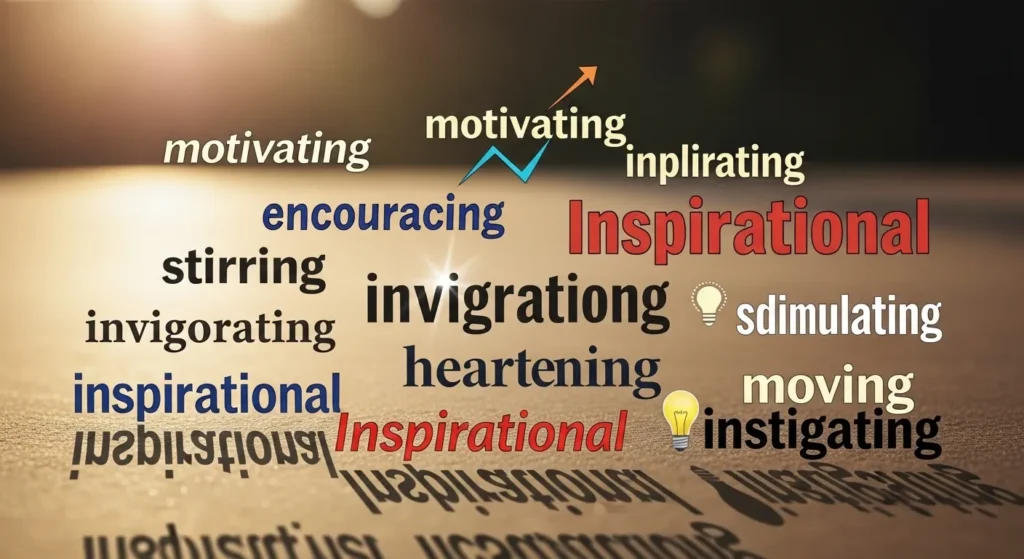
There’s a specific kind of writing problem that shows up the moment you’re describing something genuinely moving: a speech, a story, a person, a quote and you reach for “inspirational” because it’s the obvious word, and then you use it again two paragraphs later because nothing else quite fits the same feeling.
It’s a word that gets overused precisely because it works so well, which is exactly the problem.”Inspirational” describes something that motivates, uplifts, or stirs someone toward action, hope, or change. But it’s a broad word, and broad words tend to flatten nuance.
A speech that moves people to tears and a quote printed on a coffee mug can both technically be called “inspirational,” even though they’re doing very different emotional work. That’s where synonyms earn their keep; they let you be specific about what kind of inspiration you actually mean.
Here’s an example that shows the word doing real work:
Her story of overcoming homelessness to become a surgeon was deeply inspirational to everyone in the room.
That sentence carries weight because of the contrast hardship followed by triumph. But if you’re writing a whole article, book, or speech and “inspirational” is the only word you reach for, the emotional impact starts to wear thin. Readers stop feeling it and start just reading it.
This guide breaks down the closest synonyms for inspirational, groups the rest by the specific tone they carry motivating, uplifting, awe-inspiring, or reverent and clears up the confusion between inspirational and words like motivational and aspirational, which get mixed up constantly even though they mean genuinely different things.
What Does Inspirational Mean?
Inspirational describes something that instills a feeling of enthusiasm, hope, motivation, or emotional upliftment in someone else often by example, by story, or by words that stir a deeper response than simple encouragement. It typically implies an emotional or even spiritual dimension, not just a practical push to get something done.
The word comes from “inspire,” which originally meant to breathe life into a fitting origin, since something inspirational often feels like it gives people a renewed sense of purpose or energy they didn’t have moments before.
Something genuinely inspirational tends to have a few qualities:
- It stirs emotion, not just action
- It often involves overcoming difficulty, showing courage, or demonstrating meaning
- It leaves the audience feeling changed, hopeful, or moved, not just informed
- It can come from a person, a story, an object, or even a place
A few examples to get a feel for the word:
His recovery after the accident was truly inspirational to everyone who followed his journey. Focuses on emotional impact from a personal story of overcoming hardship.
The speaker gave an inspirational talk about turning failure into purpose. Suggests the audience left feeling moved, not just informed.
The mural was meant to be inspirational, reminding visitors of the community’s resilience. Shows the word applying to something beyond people art, places, symbols.
Notice that in each case, the emotional response is central. That’s the piece that separates inspirational from words that simply mean “encouraging” or “helpful.”
The Closest Synonyms for Inspirational
Some synonyms overlap almost completely with inspirational. Others only capture a slice of the meaning of practical motivation without the emotional depth, for instance. Here are the closest matches.
1. Motivational
Motivational is the word people confuse with inspirational most often, and for good reason they’re closely related. But there’s a real difference: motivation tends to focus on pushing someone toward action or achievement, while inspiration focuses more on emotional upliftment, meaning, or a shift in perspective.
The coach gave a motivational speech before the final match, focused entirely on effort and determination.
Use motivation when the goal is to spur someone into doing something specific, studying harder, training more, finishing a project rather than simply moving them emotionally.
2. Uplifting
Uplifting captures the emotional-lift side of inspirational without necessarily implying a call to action.
The documentary was uplifting, leaving the audience with a renewed sense of hope.
Difference: Uplifting is about mood and feeling. Inspiration often adds a layer of “this makes me want to be better” on top of that feeling.
3. Moving
Moving describes something that stirs deep emotion, though it doesn’t always carry the hopeful, forward-looking quality that inspirational usually implies.
Her acceptance speech was moving, touching on years of struggle before her success.
Use it when the emotional impact is strong but not necessarily tied to motivation or hope moving content can also be sad or bittersweet.
4. Encouraging
Encouraging is softer and more everyday than inspirational. It suggests support and reassurance rather than a profound emotional shift.
Her teacher’s encouraging words helped her believe she could pass the exam.
Difference: Inspirational often implies awe or admiration. Encouraging is simply a gentle nudge rather than a stirring emotional experience.
5. Stirring
Stirring implies something that provokes strong emotion, often with a sense of energy or passion behind it.
The stirring anthem brought the entire stadium to its feet.
Use stirring when you want to emphasize the intensity and energy of the emotional response, not just its uplifting quality.
6. Empowering
Empowering focuses specifically on giving someone a sense of confidence, strength, or control over their own life.
The workshop was empowering, helping participants recognize their own leadership potential.
Difference: Empowering is about giving someone strength or agency. Inspiration is broader; it can move someone without necessarily making them feel more capable or in control.
7. Heartening
Heartening describes something that gives comfort, reassurance, or renewed confidence, often after a difficult or uncertain period.
It was heartening to see the community come together after the storm.
Use it when the emotional shift is more about relief and reassurance than dramatic inspiration.
8. Aspirational
Aspirational relates to ambition and goals, often describing something people want to achieve or become, rather than something that moves them emotionally in the moment.
The brand’s aspirational marketing focused on the lifestyle customers wanted to have.
Key distinction: Aspirational points toward a future goal or identity. Inspirational points toward an emotional response happening right now.
9. Uplifted (as a descriptor, in context)
While “uplifted” is technically a past participle, it’s often used descriptively in similar contexts to inspirational, especially when describing how an audience feels.
The crowd left feeling uplifted after the ceremony.
10. Awe-inspiring
Awe-inspiring adds scale and grandeur to the mix; it suggests something so impressive it produces genuine wonder, not just motivation.
Standing at the edge of the canyon was an awe-inspiring experience.
Use it when the inspiration comes from scale, beauty, or magnitude rather than a personal story or call to action.
More Synonyms for Inspirational, Grouped by Tone
The right synonym depends heavily on what kind of inspiration you’re actually describing: quiet emotional resonance, loud motivational energy, or something closer to reverence and awe. Here’s the rest of the list, organized to make that easier.
Emotionally Uplifting Alternatives
Good for stories, speeches, or moments meant to comfort or uplift.
11. Heartwarming evokes warmth and tenderness rather than grand inspiration. The heartwarming reunion brought tears to everyone’s eyes.
12. Touching gentle emotional impact, often intimate rather than dramatic. His touching tribute to his late father moved the whole room.
13. Uplifting already covered above, but worth repeating as one of the most natural everyday substitutes.
14. Reassuring provides comfort and confidence, softer than inspirational. Her reassuring presence helped calm the nervous new employees.
15. Comforting focuses on emotional ease rather than motivation. The letter was comforting during a difficult time.
Motivating and Energizing Alternatives
Best for speeches, coaching, or content meant to spur action.
16. Motivating near-identical to motivational, often used interchangeably. His motivating leadership style pushed the team to exceed their targets.
17. Galvanizing implies sudden, energizing action, often collective. The announcement was galvanizing, uniting the entire office around a single goal.
18. Rousing energetic, often used for speeches meant to provoke enthusiasm or action. The rousing pep talk had the players ready to run through a wall.
19. Invigorating suggests renewed energy and vitality. The morning hike felt invigorating after weeks of feeling stuck.
20. Driving implies forward momentum and purpose. Her driving ambition inspired everyone around her to work harder.
Awe and Reverence-Based Alternatives
For grand, larger-than-life inspiration, nature, achievement, scale.
21. Awe-inspiring already covered above, one of the strongest words for describing scale and wonder.
22. Breathtaking is often used for visual or experiential inspiration. The breathtaking view from the summit made the entire climb worth it.
23. Sublime a more literary word implying beauty mixed with a sense of grandeur or even overwhelm. The symphony’s final movement was nothing short of sublime.
24. Majestic grandeur and dignity, often used for landscapes or large-scale achievements. The majestic mountain range left the hikers speechless.
25. Transcendent implies something beyond the ordinary, almost spiritual. The performance felt transcendent, as though the whole audience shared a single emotion.
Formal and Professional Alternatives
Useful for essays, corporate writing, or formal speeches where “inspirational” might sound a little too casual or overused.
26. Uplifting, safe, professional, still emotionally resonant.
27. Motivational standard in workplace or coaching contexts.
28. Empowering is increasingly common in professional and educational writing.
29. Encouraging appropriately modest for formal feedback or reviews.
30. Edifying a more formal, somewhat old-fashioned word implying moral or intellectual improvement. The lecture was edifying, offering new ways to think about civic responsibility.
Inspirational vs. Similar Words: The Differences That Actually Matter
These words overlap heavily in casual use, but the distinctions genuinely change what a sentence communicates.
Inspirational vs. Motivational
Inspirational:
- Focused on emotional impact and meaning
- Often tied to a story of overcoming hardship or demonstrating character
- Leaves the audience feeling moved, not necessarily told what to do next
Motivational:
- Focused on pushing someone toward specific action
- Often practical, goal-oriented, energizing
- Leaves the audience feeling ready to act
Example to see the difference: A motivational speaker might say, “Get up an hour earlier and you’ll outwork everyone else.” An inspirational speaker might share a personal story of loss and resilience that leaves the audience quietly reflecting on their own lives.
Inspirational vs. Aspirational
Aspirational points toward a future goal, identity, or lifestyle someone wants to achieve. Inspirational points toward an emotional response happening in the present moment.
An aspirational brand sells the life you want to have. An inspirational story moves you right now, regardless of whether it changes your goals.
Inspirational vs. Uplifting
Uplifting is softer and more focused purely on mood; it doesn’t necessarily involve admiration or a “I want to be like that” reaction the way inspirational often does.
A funny, feel-good movie can be uplifting without being inspirational. A story about someone overcoming enormous odds is usually both.
How Writers Use Inspirational Effectively
The word earns its place because it signals emotional weight quickly. Compare these two versions:
She told a story about her career.
She told an inspirational story about overcoming setbacks to build her career from nothing.
The second version tells the reader exactly what kind of emotional response to expect, not just information, but something meant to move them. That’s precisely why the word shows up so often in speeches, marketing, and storytelling, and exactly why it starts to lose its punch if it’s repeated without variation throughout a longer piece.
Common Mistakes When Using Inspirational (or Its Synonyms)
Mistake 1: Using it for anything mildly positive. Not everything upbeat qualifies as inspirational. A cheerful comment is encouraging; inspirational usually implies something deeper: struggle, meaning, or transformation.
Mistake 2: Confusing inspirational with motivational. They’re related, but not identical. Inspirational leans emotional and reflective; motivational leans practical and action-oriented. Mixing them up can make a speech or piece of writing feel tonally off.
Mistake 3: Overusing it without specifics. Simply calling something “an inspirational story” without describing what actually happened weakens the word’s impact. It’s far stronger to describe the struggle and the outcome, and let the word “inspirational” be earned by the details rather than doing all the emotional work alone.
Frequently Asked Questions About Inspirational
What is another word for inspirational? Common alternatives include motivational, uplifting, moving, empowering, and stirring. The right choice depends on whether you want to emphasize emotional impact, forward action, or awe and scale.
What does inspirational mean? Inspirational describes something that stirs enthusiasm, hope, or emotional upliftment in someone else, often through a story of overcoming hardship, an act of courage, or something that demonstrates deeper meaning or purpose.
What is the difference between inspirational and motivational? Inspirational focuses on emotional impact and meaning, often through personal stories or examples. Motivational focuses on pushing someone toward specific action or achievement. A speech can be one, the other, or both.
What is the antonym of inspirational? Words like discouraging, dispiriting, uninspiring, or demoralizing capture the opposite of inspirational describing something that drains hope or motivation rather than building it.
How do you use inspirational in a sentence? A few examples:
- Her journey from refugee to award-winning scientist was truly inspirational.
- The coach’s inspirational message reminded the team why they started playing in the first place.
- The mural was designed to be inspirational, celebrating the neighborhood’s history of resilience.
What is a formal synonym for inspirational? Uplifting, empowering, motivational, and edifying all work well in formal or professional writing, since they carry the same emotional weight without sounding overly casual.
Is inspirational the same as aspirational? Not quite. Aspirational refers to a future goal, identity, or lifestyle someone wants to achieve, while inspirational refers to an emotional response happening in the present moment, often triggered by a story or example.
What is a synonym for inspirational person? Words like role model, trailblazer, visionary, or motivator are often used to describe an inspirational person, depending on whether the focus is on their achievements, leadership, or influence on others.
Final Thoughts
The right synonym for inspirational depends entirely on the specific feeling you’re trying to create. If you want quiet emotional resonance, reach for moving, touching, or heartwarming.
You want energy and forward motion, motivational, rousing, or galvanizing will serve you better. If the moment calls for scale and wonder, awe-inspiring, sublime, or majestic capture that far more precisely than inspirational ever could on its own.
Recognizing these small differences doesn’t just help you avoid repeating the same word, it helps you communicate exactly what kind of impact you’re describing, which is usually the entire point of choosing a more precise word in the first place.

I am Aiden, a passionate writer at Synonyms who specializes in vocabulary, synonyms, and word meanings. I create clear, helpful content that makes language easier to understand for readers worldwide.Aiden is an English language expert with over
5 years of experience in vocabulary and
linguistics. He specializes in helping
learners improve their writing skills through
simple and practical word guides.