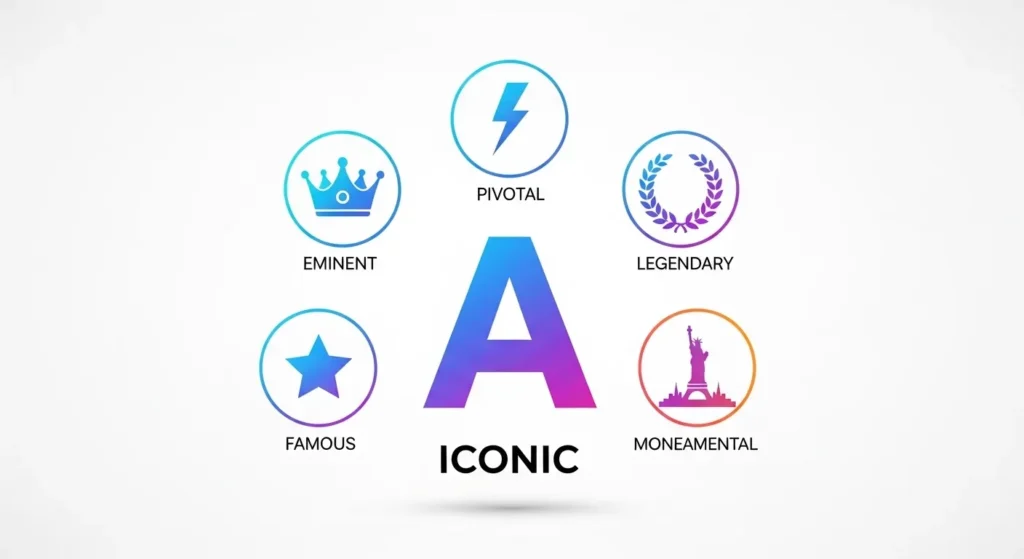
The word iconic is used everywhere these days. We see it in product descriptions, travel articles, entertainment news, social media posts, and everyday conversation.
But iconic does not simply mean “famous.” It usually describes something that is widely recognized and strongly connected with a person, place, period, style, or idea.
That difference matters when you are looking for a synonym. Legendary can work when you want to emphasize lasting fame, while emblematic is better when something represents a larger idea. If you simply mean that something is widely known, renowned or well-known may be a better choice.
Below, you’ll find the closest synonyms for iconic, followed by related alternatives grouped and context. You’ll also see examples, common mistakes, word comparisons, and answers to common questions about using “iconic.”
Quick Answer: What Is Another Word for Iconic?
Common synonyms and close alternatives for iconic include legendary, emblematic, renowned, celebrated, famed, and recognizable. The best choice depends on the context. Use emblematic for symbolism, legendary for lasting fame, and renowned when reputation and recognition are the main focus.
What Does “Iconic” Actually Mean?
Iconic describes something that is highly recognizable and has become strongly associated with a particular person, place, idea, style, or period.
For example, the Eiffel Tower is iconic because people around the world recognize it and associate it with Paris. A musician can also be iconic when their image, music, or influence becomes strongly connected with a particular era or culture.
The word comes from icon, which originally referred to an image or representation. That idea of representation still matters today.
Something can be famous without being iconic. Famous mainly means that many people know about it. Iconic music usually adds a sense of symbolism, recognition, or lasting cultural importance.
What Does “Iconic” Mean?
“Iconic” means very famous, memorable, and easily recognized. It describes a person, place, thing, image, or idea that has become a strong and lasting symbol of something.
Example: The Eiffel Tower is an iconic symbol of Paris.
What Makes Something Iconic?
Something described as iconic often has one or more of these qualities:
- It is easy to recognize.
- It represents something larger than itself.
- It has made a lasting cultural or historical impression.
- It is strongly associated with a particular person, place, style, or period.
Examples of Iconic
The Eiffel Tower is an iconic symbol of Paris.
Her red-carpet dress became iconic and influenced fashion for years.
The band’s final performance became an iconic moment in music history.
Iconic – Meaning, Definition & Synonyms
Meaning: Iconic means very famous, memorable, and easily recognized as a symbol of a person, place, thing, or idea.
Definition: Iconic describes someone or something that is widely recognized and strongly associated with a particular person, place, style, or idea.
Example: The Statue of Liberty is an iconic symbol of New York City.
Synonyms: famous, legendary, renowned, celebrated, influential, memorable, classic.
Iconic in a Sentence
Iconic is used to describe a person, place, thing, or moment that is very famous, memorable, and easily recognized.
Example: The Eiffel Tower is an iconic landmark in Paris.
Closest Synonyms
Not every word below has exactly the same meaning as iconic. Some are close synonyms, while others work better in specific contexts.
1. Legendary
Legendary describes someone or something known for exceptional or lasting fame. It can suggest that a reputation has grown over time.
The guitarist’s final concert became legendary among music fans.
Best for: lasting fame, remarkable achievements, or almost mythical reputations.
2. Renowned
Renowned means widely known and respected, especially because of achievement or quality.
The architect is renowned for her minimalist designs.
Best for: professional reputation, achievement, and respect.
3. Emblematic
Emblematic is one of the closest alternatives when iconic means symbolic. It describes something that represents a larger idea, group, or identity.
The skyline has become emblematic of the city’s growth.
Best for: symbolism and representation.
4. Quintessential
Quintessential means the clearest or most typical example of something.
That diner is the quintessential American roadside restaurant.
It does not necessarily mean famous or widely recognized.
Best for: describing something as a perfect example of its type.
5. Celebrated
Celebrated describes someone or something that has received public praise or recognition.
She is a celebrated author of modern fiction.
Best for: public recognition, praise, and achievement.
6. Famed
Famed means widely known or famous. It has a slightly more literary feel than “famous.”
The town is famed for its annual harvest festival.
Best for: established fame, especially in formal or descriptive writing.
7. Storied
Storied describes something with a long, notable, or interesting history.
The university has a storied athletic program.
Best for: places, organizations, careers, and traditions with an important history.
8. Recognizable
Recognizable means easy to identify because of appearance, sound, style, or other familiar features.
Her voice is instantly recognizable on the radio.
Best for: appearance, sound, branding, and familiar features.
Related Alternatives for Iconic
Some words are connected to the meaning of iconic but should not be treated as direct synonym. They can be useful when they express the specific quality you want to emphasize.
Fame and Recognition
9. Well-known
Well-known simply means recognized by many people. It is one of the easiest and most natural alternatives to “iconic” when symbolism is not important.
She is a well-known journalist in the city.
10. Famous
Famous means known by many people. Unlike “iconic,” it does not necessarily suggest cultural or symbolic importance.
The restaurant is famous for its homemade pasta.
11. Prominent
Prominent describes someone or something that is important, noticeable, or influential within a particular field or group.
She is a prominent figure in local journalism.
12. World-famous
World-famous emphasizes recognition across countries and cultures.
The museum houses a world-famous painting.
13. Popular
Popular means liked, accepted, or enjoyed by many people. It is related to fame but is not a direct synonym for iconic.
The café became popular within a year of opening.
Historical and Cultural Importance
14. Monumental
Monumental describes something extremely important, large in scale, or significant enough to have a lasting effect.
The treaty was a monumental moment in the country’s history.
15. Classic
Classic describes something that remains valued, respected, or relevant over time.
That film is now considered a classic.
A classic can be iconic, but the two words are not interchangeable.
16. Historic
Historic means important or significant in history.
The old courthouse is a historic building.
It differs from “historical,” which simply means related to the past.
17. Cultural touchstone
A cultural touchstone is a person, work, event, or idea that has become an important reference point for a particular group or culture.
The film became a cultural touchstone for a generation.
Symbolic Meaning
18. Symbolic
Symbolic describes something that represents a larger idea or meaning.
The dove is symbolic of peace.
It can describe the symbolic side of something iconic, but it does not necessarily imply fame.
19. Representative
Representative means typical of a particular group, period, style, or idea.
The painting is representative of her early work.
20. Signature
A signature can describe something strongly associated with a person, brand, place, or style.
The bold color scheme became the designer’s signature style.
21. Hallmark
Hallmark refers to a distinctive feature that helps identify a person, place, product, or style.
Fast service is a hallmark of the company.
22. Archetypal
Archetypal describes something that represents a classic or widely recognized example of a particular type.
The story follows an archetypal hero’s journey.
23. Trademark
Trademark can describe a feature, phrase, behavior, or style that is strongly associated with a person or brand.
The singer’s dramatic costumes became her trademark style.
Excellence and Distinction
24. Distinguished
Distinguished describes someone or something recognized for excellence or achievement.
He had a distinguished career in medicine.
25. Outstanding
Outstanding means exceptionally good or impressive.
The team delivered an outstanding final performance.
26. Eminent
Eminent means highly respected and important within a particular field.
She is an eminent scholar in linguistics.
27. Illustrious
Illustrious describes someone or something famous and respected because of notable achievements.
He comes from an illustrious family of scientists.
28. Esteemed
Esteemed means highly respected or admired.
She is an esteemed professor at the university.
29. Revered
Revered means deeply respected or admired.
She is revered as a pioneer in her field.
Impact and Visual Appeal
30. Striking
Striking describes something that immediately attracts attention because it is unusual, impressive, or visually strong.
The building has a striking glass facade.
31. Influential
Influential describes someone or something that has a strong effect on people’s ideas, behavior, or work.
He remains an influential voice in modern art.
32. Seminal
Seminal describes work that has a major influence on later developments in a particular field.
The paper became seminal in the field of linguistics.
33. Majestic
Majestic describes something grand, impressive, and dignified.
The mountains looked majestic at sunrise.
34. Groundbreaking
Groundbreaking describes something new and important that changes how people approach a subject or activity.
The invention was groundbreaking for its time.
35. Epic
Epic describes something grand, dramatic, or unusually large in scale. It can sometimes describe an iconic moment, but it is not a direct synonym for iconic.
The film ends with an epic battle scene.
Formal vs. Casual Alternatives for Iconic
The best synonym also depends on the tone of your writing.
Casual and Everyday
These words sound natural in conversation or informal writing:
- famous
- well-known
- popular
- classic
- big name
She’s a famous singer with fans around the world.
Formal or Academic
These options work better in formal writing:
- renowned
- eminent
- illustrious
- quintessential
- archetypal
- seminal
- emblematic
The building is an emblematic example of the city’s architectural style.
The important thing is to match the word to the tone of the sentence. A casual phrase can sound awkward in an academic paragraph, while an overly formal word can feel unnatural in everyday conversation.
Iconic vs. Similar Words
Iconic vs. Famous
Famous means widely known. Iconic music usually goes further by suggesting symbolism, strong recognition, or lasting cultural importance.
The actor is famous.
The actor became an iconic figure of the 1990s.
The second sentence suggests that the person represents something beyond simple fame.
Iconic vs. Legendary
Iconic emphasizes recognition and symbolism. Legendary focuses more on lasting fame and an exceptional reputation.
A person can become iconic because of their image or cultural influence, while someone becomes legendary because of extraordinary achievements or a reputation built over time.
Iconic vs. Classic
Classic describes something that continues to be valued over time. Iconic focuses more on recognition and symbolic importance.
A movie can be a classic without being especially iconic.
Likewise, something can become iconic relatively quickly before it has existed long enough to be called a classic.
Iconic vs. Historic
Historic means important in history. Iconic does not require historical importance.
A newly designed building can become iconic because of its appearance or cultural influence, even though it has no long history.
Where These Alternatives Work Best
In Marketing
Marketing often uses words such as iconic, signature, famous, and legendary to make a product or brand sound memorable.
The brand’s signature design has remained popular for decades.
In Journalism
Journalists may use historic, landmark, monumental, or iconic when describing an event, person, or place with major public significance.
The agreement marked a historic moment for both countries.
In Academic Writing
Academic and professional writing may favor words such as emblematic, eminent, seminal, representative, or quintessential, depending on the subject.
The study became seminal in the field.
In Everyday Conversation
In casual conversation, famous, well-known, popular, and classic usually sound more natural.
That restaurant is pretty famous around here.
Common Mistakes When Using Iconic
Mistake 1: Treating “Famous” and “Iconic” as the Same
Something can be famous without becoming iconic.
Famous focuses on how widely known something is. Iconic music often adds symbolism or cultural importance.
Mistake 2: Calling Everything “Legendary”
“Legendary” suggests an unusually strong or lasting reputation.
That was a legendary performance.
may sound natural for a truly exceptional event, but using it for every small success weakens the word.
Mistake 3: Mixing Formal and Casual Words
Using big names and illustrations in the same formal paragraph can create an uneven tone.
Choose words that fit the rest of your writing.
Mistake 4: Confusing “Historic” and “Historical”
Historic means important in history.
Historical simply means related to history or the past.
A historic event changed the country.
A historical document was found in the archive.
Mistake 5: Using Too Many Synonyms at Once
A sentence such as:
The iconic, legendary, world-famous landmark attracted millions of visitors.
can feel exaggerated.
Usually, one precise word is enough.
Mistake 6: Choosing a Synonym Without Checking Its Meaning
Words such as popular, timeless, epic, traditional, and age-old may relate to something iconic, but they do not mean exactly the same thing.
Before replacing “iconic,” decide what quality you want to emphasize: fame, recognition, symbolism, history, influence, or excellence.
Related words
Iconic Synonyms in English
In English, iconic usually describes something that is widely recognized and strongly associated with a person, place, style, or idea. Depending on the context, words like legendary, emblematic, renowned, famous, and recognizable may work.
Example: The Eiffel Tower is an iconic landmark and a famous symbol of Paris.
Iconic Meaning Synonym and Antonyms
Synonyms for iconic include legendary, emblematic, renowned, celebrated, famous, and recognizable. Possible opposites include ordinary, obscure, forgettable, unremarkable, and unknown, depending on the context.
Example: The actor became an iconic figure, while the lesser-known performer remained relatively obscure.
Iconic Synonym Slang
In casual or slangy English, people may use words such as legendary, epic, badass, unforgettable, or goated to describe something that feels extremely impressive or memorable. These are informal and should be used carefully.
Example: That outfit is iconic! can casually become That outfit is legendary!
Another Word for Iconic Person
When describing an iconic person, you can use legendary, influential, celebrated, renowned, distinguished, or notable, depending on what you want to emphasize. “Legendary” works well for someone with an exceptional and lasting reputation.
Example: She is an iconic singer who influenced several generations of musicians.
Iconic Antonyms
There is no single perfect antonym for iconic. Words such as ordinary, obscure, forgettable, unremarkable, and unknown can work when you want to describe something that lacks strong recognition or cultural importance.
Example: The building was functional but ordinary, with none of the features that made the city’s iconic landmarks memorable.
Iconic Synonym Formal
For formal or academic writing, emblematic, renowned, distinguished, eminent, quintessential, and representative can work depending on the intended meaning. These words sound more precise than using “iconic” repeatedly.
Example: The monument is an emblematic example of the country’s architectural heritage.
Synonyms for Icon
The noun icon can refer to a widely admired person, symbol, image, or representation. Depending on the context, alternatives include symbol, figure, emblem, representation, and idol.
Example: The athlete became an icon of the sport after years of outstanding performances.
Another Word for Iconic Building
An iconic building can be described as landmark, distinctive, renowned, celebrated, emblematic, or architecturally significant. The best choice depends on whether you want to emphasize its appearance, reputation, or cultural importance.
Example: The Sydney Opera House is an iconic building and a landmark of Australian architecture.
Frequently Asked Questions About Iconic
What is a simple synonym for iconic?
Famous or well-known can work in everyday writing when you only mean that many people recognize something. They do not always carry the symbolic meaning of “iconic.”
What is the difference between iconic and legendary?
Iconic emphasizes recognition and symbolism, while legendary focuses more on lasting fame, extraordinary achievements, or an almost mythical reputation.
Can “iconic” describe a person?
Yes. A person can be called iconic when their image, work, style, or influence becomes strongly associated with a particular era, culture, or idea.
What is a formal synonym for iconic?
Depending on the context, emblematic, renowned, eminent, illustrious, quintessential, or archetypal may work in formal writing.
Is “iconic” overused?
It can be, especially in marketing, entertainment writing, and social media. The word is sometimes used for things that are simply popular or attractive. A more precise alternative can make the writing stronger.
What is the opposite of iconic?
There is no single perfect antonym. Unremarkable, obscure, forgettable, and ordinary can work depending on what you want to contrast with “iconic.”
Is “classic” the same as “iconic”?
No. Classic emphasizes lasting value or relevance, while iconic emphasizes recognition and symbolic importance. Something can be one without necessarily being the other.
What word works best for describing a brand or logo?
Emblematic, recognizable, signature, or distinctive may work depending on the sentence. If the logo represents the identity of a brand, emblematic is often a strong choice.
What is a synonym for “iconic moment”?
Possible alternatives include defining moment, landmark moment, historic moment, and pivotal moment. Choose the one that best matches the type of importance you want to express.
How Do You Call Someone “Iconic”?
You call someone iconic when they are very famous, memorable, or admired, and their personality, style, work, or achievements make them stand out.
Example: Taylor Swift is an iconic singer known for her music and influence.
Final Thoughts
Iconic is a stronger and more specific word than simply famous. It often suggests recognition, symbolism, cultural importance, or lasting influence.
If you mean lasting fame, try legendary. For symbolism, emblematic may be better. For professional recognition, use renowned. If something is a strong example of its type, quintessential may fit.
For simple recognition, famous, well-known, or recognizable are often clearer.The best synonym is not necessarily the fanciest one. Choose the word that matches the exact idea you want to express.
What Does “Iconic” Mean in Simple Terms?
Iconic means very famous, memorable, or easily recognized. It is used for a person, place, thing, or image that has become well known and represents something important or special.
Example: The Eiffel Tower is an iconic landmark of Paris.
Haan, is H3 ko direct-answer style mein rakhna better hoga, taake Google ko clear definition mile.
Is “Iconic” a Positive or Negative Word?
“Iconic” is generally a positive word. It describes someone or something that is widely recognized, memorable, and admired for being especially important or influential. For example, calling a singer an iconic artist is usually a compliment.
Note: “Iconic” can sometimes be used humorously or ironically, depending on the context, but its standard meaning is positive.
How Do You Call Someone “Iconic”?
You call someone iconic when they are widely recognized, memorable, and admired for their personality, style, work, or achievements. Calling someone iconic is usually a strong compliment that shows they have made a lasting impression.
Example: She is an iconic actress whose performances have inspired generations.
What Is a Better Word for “Iconic”?
A better word for “iconic” depends on the context. Common alternatives include legendary, famous, celebrated, renowned, influential, memorable, and classic.
For example, you can use “legendary” for someone or something highly admired, while “renowned” works well when emphasizing fame or reputation.

James Parker is a writer who creates clear and helpful content for readers. I am James Parker, and I am a synonyms writer who focuses on explaining word meanings and differences in simple language to help students and learners understand concepts easily.