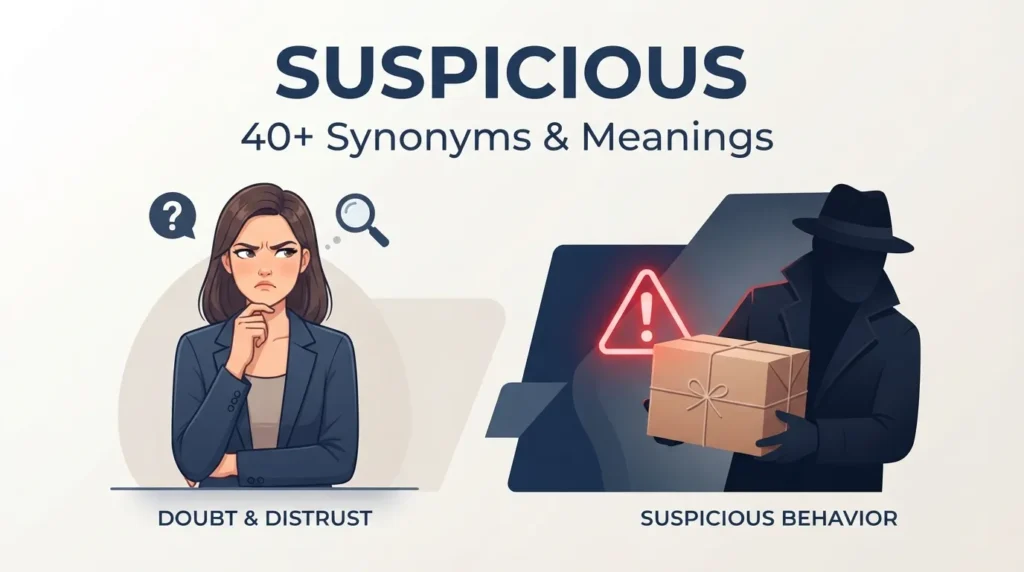
“Suspicious” does two jobs in English: it describes what you feel (distrust, doubt, wariness) and what something looks like to other people (shady, dubious, fishy). Most lists throw both into one alphabetized pile, and worse, mix true synonyms with words that only apply in specific contexts. This one separates all three.
A common problem I see when editing reports is “suspicious” getting used eleven times across two pages, when half those instances actually mean “unverified” and the other half mean “acting shady.” Same word, two different jobs and neither job is served well by a flat, undifferentiated list.
So here’s the split: direct synonyms, context-specific alternatives, and related words that describe suspicion without technically meaning it.
A Quick Note on Accuracy
Not every word on a “suspicious” list is actually a synonym. Some words like conspicuous, anomalous, or nervous can describe a suspicious situation without meaning “suspicious” themselves. This article keeps those separate:
- Direct synonyms can usually swap in for “suspicious” itself
- Context-specific alternatives fit a particular register or use case (slang, legal, security)
- Related words often appear near suspicion but carry their own distinct meaning
First, What Is “Suspicious” Actually Doing in Your Sentence?
Before grabbing a word, figure out which job it’s doing. There are really two:
- Feeling suspicious this is internal, it’s about you doubting something (“I’m suspicious of his motives”)
- Looking suspicious this is external, it’s about how something appears to others (“the package looked suspicious”)
Grab the wrong one and the sentence tilts oddly “he felt shady about the deal” doesn’t mean what you want it to mean. Shady describes him, not his internal state.
Suspicious: The Feeling of Doubt
Direct synonyms: skeptical, distrustful, mistrustful, doubtful, wary, leery, dubious
Related words (describe a nearby feeling, not exact swaps): apprehensive, uneasy, guarded
In a sentence: “I was leery of the deal from the moment he avoided eye contact.”
Picking between them:
- Skeptical → a logical demand for proof, not necessarily an assumption of malice (“scientists are skeptical of the new study”)
- Wary / leery → cautious alertness rooted in a realistic instinct
- Distrustful / mistrustful → a settled lack of trust, usually built over time
- Apprehensive → closer to anxiety about an outcome than distrust of a person a related feeling, not a direct swap
- Uneasy → general discomfort that may or may not involve distrust
More examples: “Regulators remain skeptical about the startup’s ambitious timeline.” “Years of broken promises made the community deeply distrustful.”
Being Suspicious of Someone
wary of · distrustful of · leery of · suspicious of · guarded around · skeptical of · doubtful of
In a sentence: “She stayed guarded around him after the second missed meeting.”
Note that “guarded” describes caution and reserve, not suspicion specifically someone can be guarded without necessarily suspecting anything. It fits here because it’s commonly used alongside suspicion, not because it’s an exact synonym.
The preposition matters: “wary of him,” “distrustful of his intentions,” “skeptical of what he says.” Drop the “of” and most of these read incomplete.
Looking Suspicious Behavior & Appearance
Context-specific alternatives (informal/slang register): shady, dodgy (UK), sketchy (US), fishy, sus, shifty, furtive, sneaky
Direct/formal synonyms: dubious, questionable, suspect, untrustworthy
In a sentence: “There’s something fishy about why the store closed without notice.”
Picking between them:
- Fishy → mild, everyday doubt, common in both US and UK English
- Shady → dishonesty with a slight edge of danger, US-leaning but understood everywhere
- Dodgy → the UK/Australian equivalent of shady
- Sketchy → US slang, usually about a place or situation feeling unsafe
- Sus → informal internet slang, especially associated with online and gaming culture
- Furtive / shifty → specifically about body language glances, posture, evasiveness
Where people mix these up: “dubious” and “questionable” sound formal enough to feel interchangeable with “shady,” but they’re softer; they cast doubt on a claim or decision, not necessarily on a person’s character. “The report’s methodology was dubious” reads fine; “the man looked dubious” reads a little off; you’d want shady or shifty there instead.
Words for a Suspicious Person
Context-specific: shady character, shifty person, sketchy guy/person (US), dodgy character (UK)
Direct/formal: untrustworthy individual, dubious character, questionable figure, deceitful, dishonest
In a sentence: “The bouncer kept an eye on the shifty character near the coat check.”
When describing a person specifically, English tends to pull toward character, figure, or individual rather than the bare adjective on its own.
Words for Suspicious Behavior / Suspicious Activity
These aren’t always direct synonyms; many are descriptors that accompany suspicion rather than mean it outright.
Suspicious behavior (how someone is acting): furtive, evasive, secretive, shifty, deceptive plus related but non-synonymous descriptors like nervous, erratic, unusual, which can suggest suspicion without meaning it directly
Suspicious activity (what’s happening, often in a security/report context): unusual, unexplained, irregular, potentially improper these are context-specific to legal, security, and financial writing rather than general-purpose synonyms
In a sentence: “Security flagged unusual activity near the loading dock at 2 a.m.”
Behavior describes a person’s manner; activity describes an event or pattern. “He behaved erratically” works; “he performed erratic activity” doesn’t match the word to whether you’re describing a person or an event.
Words for Excessive Suspicion
defensive· hypervigilant · overcautious · distrustful to a fault · overly wary
In a sentence: “After the break-in, he became almost defensive about locking every window twice.”
Suspicious is the most common word here, but it’s stronger and more negative than ordinary “suspicious” ; it implies suspicion that’s excessive or unreasonable, not just heightened caution. Use it deliberately, not as a casual stand-in for “very suspicious.”
Suspicious vs. Skeptical vs. Dubious
Suspicious → distrust or danger (“I think he’s up to no good.”)
Skeptical → doubt, lack of proof (“I need evidence before I believe this.”)
Dubious → doubtful or questionable, often implying something isn’t
true, reliable, or valid (“The claim is dubious.”)
Words for a Suspicious Look or Behavior
- Furtive a sneaky, guilty-looking glance. “He threw a furtive glance over his shoulder before opening the safe.”
- Shifty, evasive, dishonest-looking. “He gave a shifty look before pocketing the wallet.”
- Clandestine done in secrecy, often illicit. “Detectives uncovered a clandestine meeting.”
- Guarded cautious, reserved (a related word, not a direct synonym). “Her expression stayed guarded through the interrogation.”
Note: conspicuous means “easy to notice” or “standing out” ; it’s the opposite of secretive, and is not a synonym for suspicious, even though a conspicuous action can sometimes draw suspicion.
Idioms and Phrases for Expressing Suspicion
- To smell a rat sense something dishonest is going on. “When he insisted on cash-only, the auditor began to smell a rat.”
- To raise red flags trigger warning signs. “The five-year employment gap raised red flags for the hiring manager.”
- Something doesn’t add up, the explanation lacks logic. “His alibi didn’t add up.”
- To look askance at a formal/literary expression meaning to view something with doubt or disapproval. “Bankers look askance at unregulated crypto markets.”
- Under a cloud of suspicion in a situation where someone is widely suspected of wrongdoing. “He left the firm under a cloud of suspicion following the audit.”
- To keep someone at arm’s length avoid trusting or getting close. “She kept her new neighbor at arm’s length.”
Industry-Specific Words Related to Suspicion
These are context-specific words used in professional writing not direct synonyms, but the terms each field reaches for.
| Field | Words |
| Legal | questionable, suspect, irregular, inconsistent, unexplained, potentially improper |
| Corporate / Finance | unusual, irregular, questionable, potentially fraudulent |
| Cybersecurity | anomalous, flagged, unauthorized |
| Fiction / Noir | shifty, clandestine, covert |
In a sentence: “The firewall flagged anomalous traffic from an unknown IP.”
A few of these need care: fraudulent specifically means involving fraud or deception. It’s a much stronger claim than “suspicious,” so use “potentially fraudulent” or “suspected of fraud” unless deception is actually confirmed.
Anomalous and irregular aren’t interchangeable either; anomalous implies a deviation worth investigating, while irregular just means it broke from standard procedure. A late invoice is irregular; a login from three countries in one hour is anomalous.
US vs. UK: Where the Slang Splits
| Word | Region | Example |
| Sketchy | US | “That alley looks pretty sketchy at night.” |
| Dodgy | UK / Australian | “I wouldn’t buy a car from him, he seems dodgy.” |
| Bent | UK (corrupt officials specifically) | “The detective exposed bent politicians.” |
| Shady | US-leaning, understood everywhere | “Avoid buying electronics from that shady site.” |
| Fishy / Shifty | Common in both US and UK English | “He gave a shifty look before slipping the wallet away.” |
Formal vs. Casual: Matching Tone
| Formal / Academic | Neutral / Everyday | Casual / Slang |
| dubious, questionable, suspect | suspicious, doubtful, wary | shady, fishy, sketchy |
| untrustworthy | skeptical, distrustful | dodgy, sus |
If you’re writing a legal brief, “suspect” or “questionable” earns its place. If you’re texting a friend about a Craigslist listing, it’ll sound like you’re cross-examining them to reach for “sketchy” instead.
Synonyms for “Suspiciously” (The Adverb)
warily · doubtfully · distrustfully · guardedly · furtively · shiftily · skeptically · with suspicion
In a sentence: “He glanced around furtively before slipping the note under the door.”
Picking between them:
- Warily / guardedly → a cautious manner, general-purpose
- Furtively / shiftily → sneaky, guilty-looking manner, tied to body language
- Distrustfully / skeptically → the manner reflects doubt in what’s being said or shown, not necessarily secrecy
Antonyms of Suspicious
| Word | Opposite |
| suspicious | trusting, unsuspecting |
| skeptical | trusting, convinced |
| dubious | certain, credible |
| untrustworthy | trustworthy, reliable |
| fishy / shady | legitimate, trustworthy, above-board |
| wary / leery | unwary, trusting |
Noun Forms
- Suspicion of the general feeling. “He acted with an air of suspicion.”
- Wariness cautious alertness. “There was a wariness in her voice.”
- Distrust a settled lack of trust. “Years of lies bred distrust between them.”
A-Z Quick Index (Direct & Contextual Words Combined)
| Letter | Words |
| D | dubious, distrustful, dodgy, doubtful |
| F | fishy, furtive |
| G | guarded |
| L | leery |
| M | mistrustful |
| P | paranoid |
| Q | questionable |
| S | skeptical, shady, sketchy, shifty, sus, suspect |
| U | untrustworthy, uneasy |
| W | wary |
Etymology, Briefly
“Suspicious” derives from Latin suspicio/suspicere, combining sub (“under”) and specere (“to look at”). The word passed through Old French (suspecious) into Middle English with a meaning close to today’s regarding something with doubt or distrust. (Worth verifying against a primary dictionary source if using for a formal or academic publication.)
Quick Hits (Common Questions, Answered Fast)
What’s the most common synonym for suspicious? There isn’t one best synonym for every context. “Skeptical,” “doubtful,” “wary,” “fishy,” and “shady” are all common choices, depending on the tone and situation.
What’s a synonym for a suspicious person? Depending on context shady, shifty, or dodgy describe how someone comes across; untrustworthy, deceitful, or dishonest describe their character more directly.
What’s the opposite of suspicious? Trusting, credible, or reliable, depending on whether you’re negating a feeling, a claim, or a person’s character.
Is “sus” a real word? Yes it’s been added to several major dictionaries as informal slang for “suspicious” or “suspect,” driven largely by online and gaming culture.
What’s the difference between suspicious and suspect? “Suspicious” usually describes something that causes doubt or appears untrustworthy. “Suspect” can mean much the same thing but is more formal, and can apply to people, evidence, explanations, or circumstances depending on context.
The Method: How to Pick the Right One in 10 Seconds
- Ask: is this my feeling, or their behavior? That’s your category.
- Ask: is this word a direct synonym, or just a word that often appears near suspicion?
- Read the sentence back. If it still means “suspicious” but sharper and actually means it, not just implies it you’ve got it.
Conclusion
“Suspicious” carries more range than most synonym lists give it credit for; it can sit inside your head as doubt, or show up on someone else’s face as a glance they can’t quite hide. Treating those as the same job is where most word swaps go wrong.
The fastest way to get it right isn’t memorizing all 40-plus words above. It’s asking one question first: is this about what I feel, or what they’re doing? Once that’s settled, picking between skeptical and leery, or shady and dubious, stops being a guess and starts being a choice one that actually matches what you meant to say.
Bookmark this if you need it again. But the more you notice the difference between a feeling-word and a behavior-word in what you read day to day, the less you’ll need to.

I am Aiden, a passionate writer at Synonyms who specializes in vocabulary, synonyms, and word meanings. I create clear, helpful content that makes language easier to understand for readers worldwide.Aiden is an English language expert with over
5 years of experience in vocabulary and
linguistics. He specializes in helping
learners improve their writing skills through
simple and practical word guides.