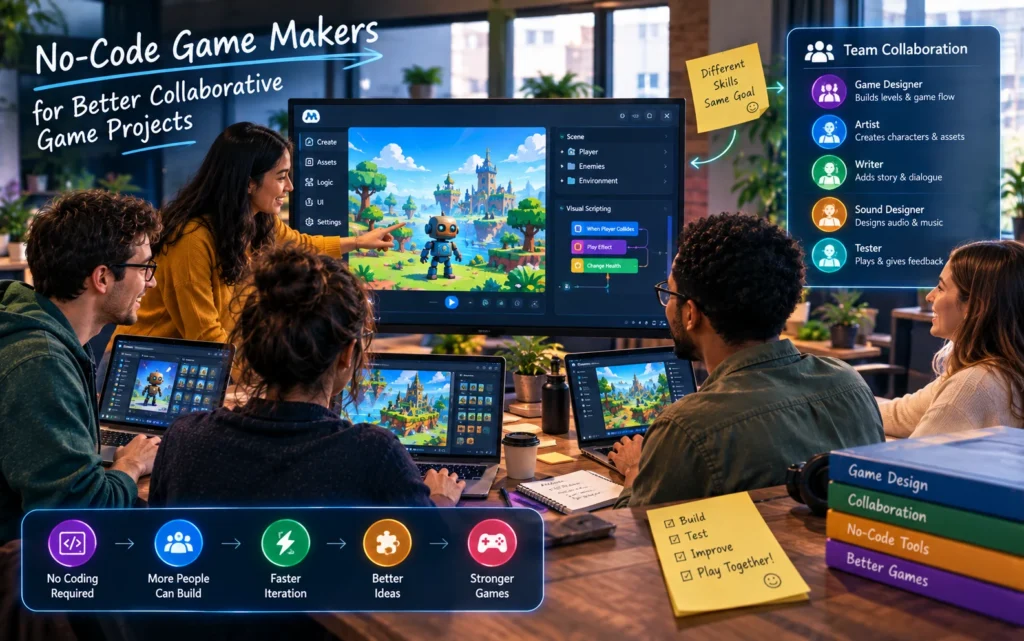

Collaborative game projects tend to run into a specific kind of friction that solo projects never have to deal with. A team might have someone with a strong creative vision, someone with a great sense of level design, and someone with a knack for tone and dialogue, but if only one person on that team can actually write code, everything eventually has to pass through them. No-code game makers are starting to change that dynamic, letting more members of a team contribute directly rather than funneling every idea through a single technical bottleneck.
Why Collaborative Projects Often Struggle
One Technical Bottleneck Slows Everyone Down
When only one or two people on a team can actually implement ideas, every contribution from everyone else has to wait its turn. This creates a queue where good ideas sit unimplemented simply because the person capable of building them is already working on something else.
Non-Technical Contributors Feel Disconnected From the Build
Team members who can describe exactly what they want but can’t build it themselves often end up feeling like passengers on a project rather than active contributors. Their input gets filtered through someone else’s interpretation, which can dilute the original idea before it ever becomes playable.
Miscommunication Multiplies With Team Size
The more people involved in describing an idea to the person who implements it, the more chances there are for something to get lost or slightly misunderstood along the way. A detail that seemed obvious to the person describing it can come out differently once translated into someone else’s implementation.
How No-Code Tools Change Team Collaboration
More Team Members Can Build Directly
No-code tools let people without a programming background implement their own ideas rather than relying entirely on a technical teammate to translate everything for them. This spreads the actual building work across more of the team instead of concentrating it in one or two people.
Faster Feedback Between Collaborators
When a team member can quickly turn their own idea into something playable, other collaborators can react to it almost immediately rather than waiting for it to work its way through a development queue. This keeps the overall pace of a collaborative project moving much faster.
Reduced Risk of Ideas Getting Lost in Translation
When the person with the original idea is also the one building it, there’s no intermediary step where the concept might shift slightly from what was originally intended. What ends up in the game is much closer to what the contributor actually pictured.
What Effective Collaboration Looks Like With No-Code Tools
Dividing Work by Idea Rather Than by Technical Skill
Instead of splitting a project along traditional lines like programmer, artist, and writer, teams using no-code tools can divide work by feature or section, letting whoever has the clearest vision for a particular part build it directly, regardless of their technical background.
Reviewing Playable Builds Instead of Descriptions
Collaboration becomes more concrete when team members can review an actual playable version of an idea rather than a written description or a verbal pitch. Feedback tends to be more accurate and useful when everyone is reacting to the same tangible thing.
Keeping a Shared Sense of the Overall Vision
Even with more people building independently, a collaborative project still benefits from regular check-ins to make sure individual contributions are staying aligned with the game’s overall direction, since faster individual progress doesn’t automatically guarantee everyone is moving toward the same destination.
Building Collaborative Projects on a No-Code Platform
Having more team members capable of building directly is only useful if there’s a shared platform that supports this kind of distributed contribution in practice.
A Platform Suited to Team-Based Creation
Astrocade is a good example of a no-code game maker that lets multiple contributors work on different aspects of a game without requiring everyone involved to have a programming background. This kind of accessibility matters especially for teams where creative talent and technical skill aren’t evenly distributed across every member.
Seeing a Collaborative-Style Project in Practice
Minecraft Robot Mode is a good example of the kind of layered concept that often benefits from multiple contributors bringing different ideas to a shared foundation. Games built on a familiar base like this can accommodate a range of creative additions from different team members without everyone needing to touch the same underlying systems.
What Still Requires Strong Team Coordination
Someone Still Needs to Own the Overall Vision
Distributing building work across more people doesn’t remove the need for a clear creative direction. Without someone keeping an eye on the whole project, individually strong contributions can end up feeling disconnected from each other rather than part of a cohesive experience.
Conflicting Ideas Still Need to Be Resolved
Faster individual building doesn’t eliminate creative disagreements, it just means those disagreements surface sooner, once multiple playable versions already exist. Teams still need a clear process for deciding which direction to take when contributors have different visions for the same part of a game.
Consistency Across Contributions Takes Deliberate Effort
When multiple people are building different parts of a game independently, maintaining a consistent tone, difficulty, and style across all of it requires ongoing attention. This coordination doesn’t happen automatically just because building itself became easier.
Common Mistakes in Collaborative No-Code Projects
Letting Everyone Build in Isolation Without Check-Ins
Faster individual progress can create a false sense that a project is coming together well, when in reality separate contributions may not fit together as smoothly as expected. Regular check-ins help catch this before too much work has gone in separate directions.
Assuming Speed Replaces the Need for Planning
Because no-code tools make building fast, it’s tempting to skip upfront planning entirely. Teams that jump straight into building without any shared sense of direction often end up with a collection of disconnected ideas rather than a coherent game.
Not Assigning Clear Ownership Over Final Decisions
When multiple people can build and suggest changes, disagreements are inevitable. Projects benefit from having a clear process, or a specific person, responsible for making final calls when contributors don’t agree on a direction.
A Practical Approach to Collaborative No-Code Projects
A reasonable process looks like this. Establish a shared understanding of the game’s core vision and tone before dividing up work, so individual contributions have something consistent to build toward. Divide responsibilities by feature or section rather than strictly by technical skill, letting whoever has the clearest idea for a part take the lead on building it. Check in regularly with playable versions rather than descriptions, and keep a clear process in place for resolving disagreements when contributors have different ideas about the same part of the game.
Final Thoughts
No-code game makers remove one of the biggest structural problems in collaborative projects, the bottleneck created when only one person on a team can actually build. What they don’t remove is the need for a shared vision and clear coordination, but for teams that get those fundamentals right, no-code tools make it realistic for far more contributors to shape a game directly rather than working through someone else’s interpretation of their ideas.