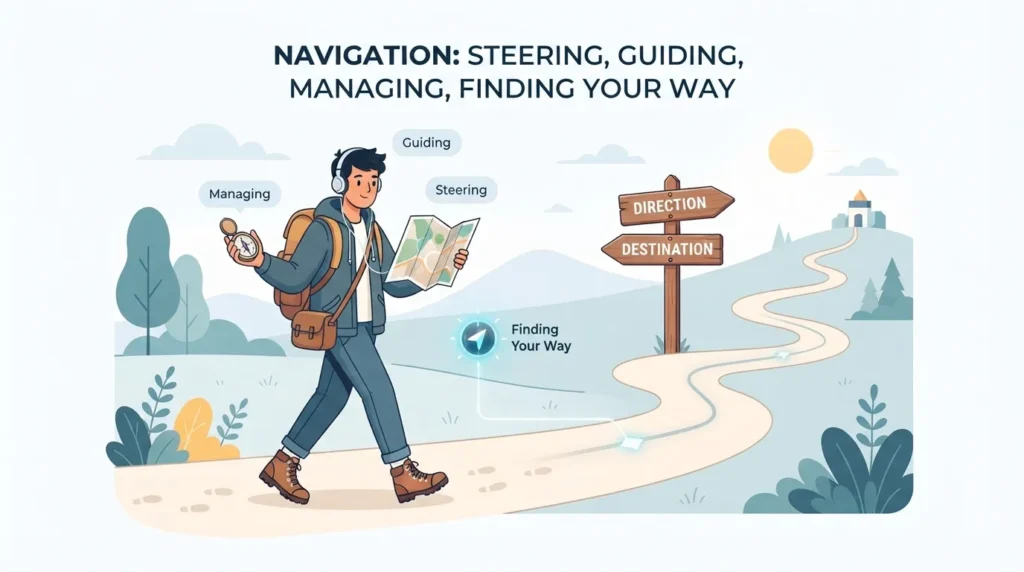
Quick Answer: The best synonyms for navigating are steering, piloting, maneuvering, guiding, directing, traversing, finding your way, handling, managing, and working through. Which one fits depends on the situation.
For physical movement a ship, a car, a route use words like steering or piloting. For a hard situation, life, or work, words like handling, managing, or working through usually sound more natural.
If you’ve typed “navigating” into a document for the third time in one paragraph, you’re not alone. It’s a useful word. But when it shows up three or four times in the same piece, it stops sounding smart and starts sounding repetitive, a pattern that shows up a lot in essays, LinkedIn posts, and anything drafted with AI help.
This guide breaks “navigating” down by the situation you’re actually writing about, not just a flat dictionary list. You’ll find words for physical navigation (ships, roads, maps), digital navigation (websites and apps), and figurative navigation (life, work, relationships, research) plus antonyms, close-but-different words, and the specific mistakes AI tools tend to make with this word.
What Does “Navigating” Mean? (Meaning at a Glance)
At its core, navigate means to find, follow, or direct a path through a place, a system, or a difficult situation. It covers three main uses:
- Physical: to steer or find a route, a ship navigating a strait, a driver navigating traffic.
- Figurative: to work your way through something complicated or uncertain navigating grief, navigating a career change.
- Digital: to move around a website, app, or document “the site is easy to navigate.”
Most people searching for a synonym are thinking of the second meaning, but all three matter, so this guide covers each one separately.
Synonyms for Navigating (Literal, Physical Movement)
Use these when a person, vehicle, or ship is physically moving through space.
- Steering controlling the direction of a vehicle or vessel
- Piloting controlling and guiding a vehicle, especially a plane or ship
- Maneuvering moving carefully through a tight or tricky space
- Guiding showing or leading the way
- Directing controlling the course of something
- Traversing traveling across or through an area
- Charting a course planning a route ahead of time
- Plotting a route deciding the exact path to take
- Finding your way successfully discovering a route
- Making your way moving toward or through a place, often with some effort
Example: The captain spent an hour steering the ferry around the sandbanks before the tide came in.
Synonyms for Navigating Through (Something)
“Navigating through” usually points to obstacles: a crowd, a forest, a pile of paperwork. Good replacements keep that sense of resistance:
- Working through
- Making your way through
- Finding your way through
- Wading through sounds tedious or difficult
- Threading your way through sounds careful, like moving through a crowded space
- Weaving through sounds like dodging obstacles
- Getting through
- Cutting through
Example: Instead of “She was navigating through the paperwork,” try “She was wading through the paperwork.” It keeps the sense of difficulty without repeating the same verb every paragraph.
Synonyms for Navigating a Situation
This is where most people actually get stuck not with ships, but with tricky, real-life circumstances. Here, “navigating” really means dealing with something carefully:
- Handling
- Managing
- Dealing with
- Coping with
- Working through
- Getting through
- Grappling with struggling to understand or deal with something hard
- Sorting out
- Negotiating dealing carefully with a tense situation or relationship
- Addressing taking direct action on a problem
Example: He was managing a difficult team dynamic without anyone realizing how much work it took.
Another Word for Navigating in an Essay
Academic and essay writing overuses “navigate” because it sounds formal without much effort. A more specific verb usually sharpens the sentence:
- Examining
- Addressing
- Analyzing
- Exploring
- Investigating
- Considering
- Untangling
- Grappling with
Before and after:
- Overused: “This essay navigates the complex relationship between memory and identity.”
- Better: “This essay examines the complex relationship between memory and identity.”
- Also good: “This essay untangles the relationship between memory and identity.”
A small tip: save “navigate” for the one moment in your essay where the idea of finding a path through complexity actually matters. It lands harder when it isn’t competing with itself for attention.
Another Word for Navigate Through Life (Navigating Life)
“Navigating life” shows up constantly in personal essays and journaling. Because it’s abstract and personal, softer phrases tend to fit better than technical ones:
- Making your way through life
- Finding your footing
- Finding your bearings
- Working your way through
- Figuring things out
- Getting by
- Muddling through
- Taking life as it comes
Example: After the move, she spent months just finding her footing new city, new job, no routine at all.
Another Word for Navigate Challenges (Navigating Challenges)
When the subject is obstacles or setbacks, these carry more weight than a plain “navigate”:
- Handling challenges
- Managing challenges
- Tackling challenges
- Facing challenges
- Working through difficulties
- Weathering setbacks
- Pushing through
- Wrestling with
Example: The company spent two quarters weathering supply chain problems before things stabilized.
A quick note: “Overcome” is related but not identical. Navigate means finding a way through something ongoing; overcome means it’s finished and you succeeded. You navigate a difficult year; you overcome an illness.
Another Word for Navigate in Research
In academic and scientific writing, “navigate” often describes moving through data, literature, or a complicated process. More precise verbs usually make research writing stronger:
- Reviewing
- Analyzing
- Synthesizing
- Interpreting
- Evaluating
- Sorting through
- Mapping out
- Working through
Example: Rather than “the researchers navigated a large dataset,” a paper reads more cleanly as “the researchers analyzed a large dataset.” The second version tells the reader exactly what happened. Precision beats a fancy verb almost every time in research writing.
Navigate Synonym in Business
Business writing leans on “navigate” for change, uncertainty, and market conditions. These sound just as professional without the cliché:
- Managing (change, growth, risk)
- Steering (the company, the team)
- Guiding (a project, a team)
- Directing (strategy)
- Adapting to
- Responding to
- Handling (a transition)
- Leading through
Example: The new CEO is steering the company through its biggest restructuring in a decade. “Steering” works well here because it keeps the sense of actively directing something through a hard stretch.
Another Word for Navigate Relationship (Navigating a Relationship)
For friendships, romantic relationships, and family dynamics, softer and more human phrasing usually beats a formal synonym:
- Working through
- Finding your way (together)
- Figuring things out
- Managing the dynamic
- Balancing expectations
- Sorting things out
- Building understanding
- Mending things
Example: They spent the first year figuring things out different schedules, different families, different expectations.
Synonyms for Navigating a Website or App
This is a real, distinct sense of “navigate” moving around a website, app, or document and it’s one most synonym lists skip entirely. If you’re writing product copy or a how-to guide, these fit better than anything nautical:
- Browsing
- Moving around
- Getting around
- Finding your way around
- Moving between pages
- Clicking through
- Exploring the layout
- Skimming through
Example: The redesigned menu makes it much easier to browse the site on mobile.
Navigating vs. Scrolling
These two get mixed up, but they’re not the same thing. Scrolling just means moving the content up, down, or sideways on a screen. Navigating means moving through the site or app to find something or reach a different page. You scroll down to read the next section; you navigate to the pricing page. So “scrolling” isn’t really a direct synonym for “navigating” it’s one small action inside the larger one.
“Easy to navigate” is one of the most common phrases in app store reviews and software descriptions, and swapping in “easy to get around” or “simple to browse” keeps that kind of copy from sounding identical to everyone else’s listing.
Navigate Synonym and Antonym
Synonyms (Quick Recap)
Steer, pilot, maneuver, guide, direct, traverse, handle, manage, cope with, work through, find your way.
Antonyms of Navigate
There’s no single perfect antonym, because “navigate” carries more than one meaning but the strongest, most direct opposites are neglect and forget, both describing a failure to plan or account for a course at all. A softer, everyday antonym is get lost.
Beyond those three, opposites shift depending on which sense of “navigate” is in play:
- Opposite of steering/directing: to drift, to lose control, to wander aimlessly
- Opposite of handling something well: to flounder, to struggle, to fail to cope, to be overwhelmed, to mismanage
- Opposite of finding a path: to stray, to veer off course, to go astray, to lose your way
Example: Without a plan, the team just floundered instead of navigating the crisis.
Navigating Synonym (Simple Version)
If you just need one easy, everyday word instead of “navigating,” pick based on the situation:
- Handling (it) good for most everyday problems
- Getting through (it) good for personal or emotional situations
- Steering (it) good for anything with a clear direction or goal
- Finding your way good for uncertain, open-ended situations
- Managing (it) good for tasks and responsibilities
No single word works in every sentence context decides more than formality does.
Opposite of Navigate
Beyond the antonym list above, here are single-word opposites depending on tone:
- Drift
- Wander
- Stray
- Flounder
- Mismanage
- Lose your way
Example: Without a map, the hikers could easily lose their way.
Words to Use Instead of “Journey”
“Journey” often shows up right next to “navigate” in the same overused-word category. If you’re trying to avoid both in one piece, here are alternatives for “journey” specifically:
- Path
- Process
- Experience
- Progress
- Passage
- Route
- Voyage (for literal travel)
- Chapter (for a life stage)
What’s Another Word for Divert?
“Divert” is sometimes confused with “navigate,” but it means something different to redirect or turn something away from its original path, rather than to steer through it. Good synonyms include:
- Redirect
- Reroute
- Deflect
- Sidetrack
- Distract
- Turn aside
- Rechannel
Example: The detour diverted traffic away from downtown for the entire weekend.
Approaching (in Other Words)
“Approaching” is another word people search for alongside “navigating” because both describe how you deal with a task. Alternatives for approaching:
- Tackling
- Addressing
- Dealing with
- Taking on
- Handling
- Considering
- Engaging with
Why “Navigating” Gets Overused And What AI Writing Tools Get Wrong With It
If you’ve used ChatGPT or another AI tool to draft an essay, email, or LinkedIn post recently, there’s a good chance “navigate” or “navigating” showed up more than once, often in places where it doesn’t quite fit. A few patterns are worth knowing so you can catch them yourself:
- Using it as a filler verb. AI tools default to “navigate” for almost any situation involving difficulty or change, even when a simpler word says more. “Navigating the challenges of remote work” could just be “adjusting to remote work.”
- Reaching for it instead of a simpler verb. Often “handling,” “managing,” “examining,” or “dealing with” says the same thing more clearly.
- Being vague instead of specific. “Navigating this situation” tells the reader very little. Human writers tend to name the actual action negotiating, apologizing, rescheduling where AI text often stays abstract.
- Repeating the same metaphor. If “navigate,” “landscape,” “journey,” and “path” all show up in one piece, the writing starts to feel formulaic and machine-generated.
- Using it identically across unrelated contexts. AI drafts often use “navigate” the same way for physical movement, business problems, and personal relationships, without adjusting to fit each one.
- Pairing it with “landscape,” “realm,” or “tapestry.” These words tend to cluster together in AI-written text (“navigating the ever-changing landscape of…”). Spotting this combination is usually a sign to rewrite the sentence entirely, not just swap one word.
The fix isn’t to replace every instance of “navigate” it’s to ask what the sentence is actually describing, and pick the verb that names it.
If you’re checking your own writing, tools like Grammarly can catch some repetition and tone issues, and an AI detector can flag text that reads as machine-generated but neither replaces reading your work aloud and asking whether a real person would talk that way.
How to Pick the Right Synonym for Navigating
A quick way to choose:
- Is it physical movement? Use steer, pilot, guide, or traverse.
- Is it an emotional or personal situation? Use cope with, work through, or find your footing.
- Is it professional or business-related? Use manage, steer, or adapt to.
- Is it academic or research-based? Use examine, analyze, or synthesize.
- Is it a website or app? Use browse, get around, or click through.
- Do you just want something simple? Use handle or get through.
Matching the synonym to the type of navigating physical, emotional, professional, academic, or digital does more for your writing than memorizing a long list ever will.
Frequently Asked Questions
What is the simplest synonym for navigating? “Handling,” “managing,” or “getting through” work in almost any everyday context.
What is a formal synonym for navigate? For physical movement, “traverse” or “pilot” reads as more formal. For difficult situations, “manage,” “address,” or “work through” usually fits better.
What’s the difference between navigate and manage? “Navigate” suggests finding a path through something uncertain or complicated. “Manage” suggests taking control of it. You can manage a budget, but you’d more naturally navigate a crisis the two overlap but aren’t identical.
Is “navigate” the same as “overcome”? Not quite. “Navigate” implies working your way through something ongoing; “overcome” implies it’s finished and you succeeded. You navigate a difficult year; you overcome an illness.
What is another word for navigating a website? Browsing, getting around, clicking through, or finding your way around the right pick depends on exactly what the user is doing on the site.
Conclusion
“Navigating” is a genuinely useful word, but it works best as one choice among many, not the default for every situation involving change, difficulty, or direction. The trick isn’t memorizing a long list, it’s noticing what the sentence is actually describing.
A ship needs steering. A hard year needs getting through. A messy app needs to be easy to browse. A tangled research topic needs examining, not just “navigating.”
Once you start matching the word to the moment instead of reaching for the same safe verb every time, your writing naturally sounds more specific and less like it was generated on autopilot.

I am Alexander, a passionate writer and language enthusiast at Synonyms. I specialize in creating clear, helpful content about synonyms, word meanings, and language differences to make English easier for everyone.