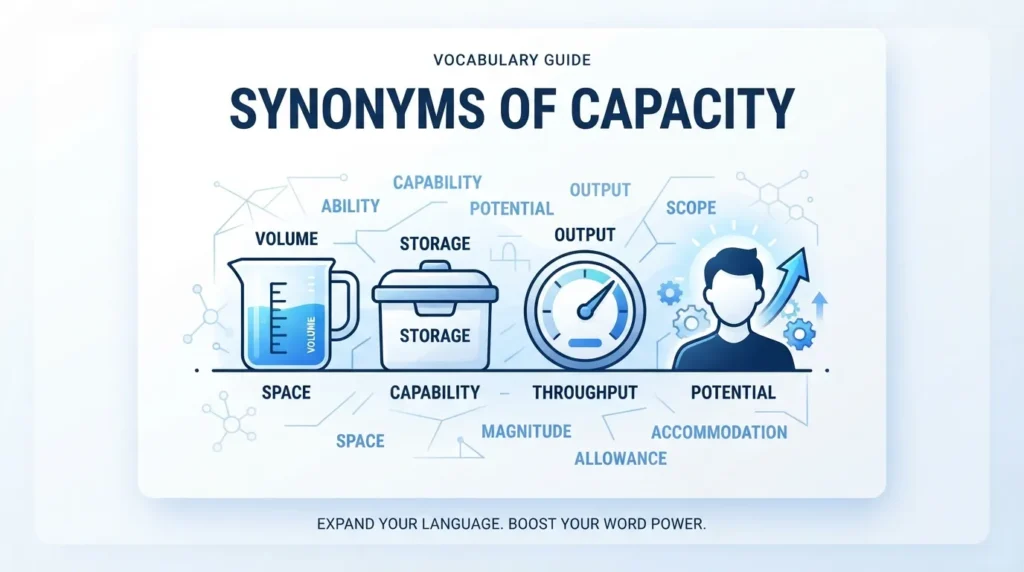
The best synonym for capacity depends on the meaning. For ability or potential, use ability, capability, potential, aptitude, or competence. In physical space, go with volume, room, or space. For a person’s role, choose role, position, or function. And for production, output, throughput, or production capability work best.
There is no single synonym that fits every situation and ultimately determines which word sounds most accurate and natural.
Introduction
“Capacity” is a common word that appears in resumes, business reports, legal documents, school essays, and everyday conversation. However, it isn’t one word with one meaning it’s four or five different ideas wearing the same outfit. Depending on the sentence, it can refer to how much something can hold, what someone is able or potentially able to do, the role in which someone acts, or how much a system can produce.
I’ve spent years editing copy where writers reach for “capacity” out of habit, then wonder why the sentence still feels vague. In most cases, the fix isn’t a thesaurus dump it’s identifying which of the four meanings you actually intend, and then choosing the one word built for that job.
Rather than handing you a long list of loosely related words, this guide separates useful alternatives into clear categories: direct synonyms, context-specific alternatives, and related words, each with examples showing exactly when it works best.
By the end, you’ll know what capacity means in simple words, how it differs from ability and capability, which words express a lack of capacity, and how to choose the right alternative for essays, resumes, business writing, and everyday English.
Capacity Meaning and Definition
In simple words, capacity means the maximum amount something can hold, the amount it can do or produce, or the potential someone or something has. If you check a capacity dictionary or thesaurus entry, you’ll typically find four core uses:
- Physical limit how much a container, room, vehicle, or building can hold
- Ability or potential what a person or system is able or potentially able to do
- Role or function the position in which someone acts
- Production limit how much a machine, factory, or system can produce
This is exactly why a generic list of “words that mean capacity” can mislead you. Since the right alternative depends entirely on which meaning you intend, using the wrong one can leave a sentence sounding technically fine but subtly off.
Synonyms of Capacity
Direct / Close Synonyms
These words can closely replace capacity, especially when it refers to ability, potential, or competence:
ability, capability, potential, aptitude, competence, proficiency, skill, talent, competency
If you’re specifically looking for synonyms of ability on their own, the closest matches are aptitude, competence, skill, and faculty. Meanwhile, if it’s synonyms of capability you need, narrow the field to competence, proficiency, and power capability leans toward “can do right now,” while capacity leans toward “has the potential to.”
Example:
“She has the capacity to learn quickly.”
Depending on intended meaning, this becomes:
“She has the ability to learn quickly.” (present skill) “She has strong potential to learn quickly.” (future possibility) “She has an aptitude for learning.” (natural talent)
Although these words overlap with capacity, each carries a slightly different emphasis and that’s the part most thesaurus sites skip past.
Context-Specific Alternatives
These words work as alternatives to capacity only when the surrounding context narrows the meaning:
volume, space, room, output, throughput, role, position, function, production capability, holding capacity, accommodation
For physical space:
“The stadium has a seating capacity of 40,000.” → “The stadium can accommodate 40,000 people.” “The tank has a capacity of 500 liters.” → “The tank can hold 500 liters.”
For storage:
“The device has a storage capacity of 1 TB.” → “The device has 1 TB of storage space.”
For a role or position: consider “He spoke in his capacity as director,” which becomes “He spoke in his role as director.” This register is especially common in formal, professional, and legal writing.
For legal standing a narrower but important use: another word for legal capacity includes legal competence, legal standing, legal fitness, and legal eligibility. Instance, “He lacks the legal capacity to sign a contract” becomes “He lacks the legal standing to sign a contract.”
For production: a sentence like “The plant is running at full capacity” can become “The plant is operating at full production” or “producing at its maximum output.”
Additionally, for capacity utilization, alternatives include operating rate or capacity utilization rate. For engine capacity, the technical term is often engine displacement, which refers to the volume of an engine’s cylinders.
Related Words
These words are closely associated with capacity but aren’t direct synonyms in every context:
bandwidth, scalability, headroom, skill, talent, availability, limit, potential
Scalability is worth flagging on its own. In tech and business writing, it specifically describes a system’s capacity to grow under increased demand, which makes it a useful, more specific alternative in that narrow context.
Example:
“We don’t have the capacity to take on another project.” → “We don’t have the bandwidth to take on another project.” (Bandwidth is a related business expression, not a universal synonym.)
Capacity vs. Capability vs. Ability Untangling the Confusion
If you take one thing from this article, make it this table. It’s the distinction almost nobody explains clearly, and it’s the reason “capacity” gets misused so often in professional writing.
| Word | Typical Meaning | Example |
| Capacity | Potential, available ability, or an upper limit | “She has the capacity to lead a large team.” |
| Capability | The power or ability to perform a task | “The system has the capability to process large files.” |
| Ability | General power or skill to do something | “She has the ability to speak three languages.” |
| Competence | Skill or knowledge sufficient to perform a task effectively | “She has the competence to handle the role.” |
A simple way to remember it: capacity is potential, capability is proof. In other words, you can have the capacity for something and never use it, but you can’t have the capability for something without already demonstrating it.
That said, these words genuinely overlap. In many sentences, capacity and capability are both grammatically correct, and the choice comes down to the writer’s intended emphasis rather than a strict rule. So when someone asks whether capacity is the same as capability, the honest answer is: not exactly, but close enough that context not grammar usually settles it.
Words That Express a Lack of Capacity
There’s no single opposite of capacity for every meaning; instead, the right word depends on context.
| Word | Best Context | Example |
| Incapacity | legal, medical, formal | “The document addressed his legal incapacity.” |
| Inability | everyday, general use | “His inability to focus affected his work.” |
| Incompetence | professional, skill-based judgment | “The audit revealed managerial incompetence.” |
| Limitation | space, resource, or scope | “Budget limitations restricted the project.” |
| Shortage | staffing or supply | “A staffing shortage reduced production.” |
| Deficiency | lack or insufficient amount | “The system has a capacity deficiency.” |
| Insufficiency | formal term for an inadequate amount | “The available resources were insufficient.” |
| Ineptitude | strong criticism of skill | “His ineptitude cost the team the contract.” |
Quick rule: legal or medical writing calls for incapacity, everyday conversation calls for inability, judging job performance calls for incompetence, and space, budget, or resource shortfalls call for limitation or shortage.
More broadly, lack of capacity synonyms include shortfall, deficiency, and insufficiency, while out of capacity synonyms include fully booked, at maximum, and overloaded. For a capacity limit specifically, reach for maximum, cap, ceiling, upper limit, or threshold instead.
Capacity Parts of Speech in Use
Understanding the word family helps you use capacity-related vocabulary more precisely.
| Word | Part of Speech | Example |
| Capacity | Noun | “The tank’s capacity is 500 liters.” |
| Capacious | Adjective | “The house has a capacious living room.” |
| Capaciously | Adverb | “The house was designed for large families.” |
| Capacitate | Verb | “Training helps to capacitate new employees.” |
| Capacitation | Noun (process) | “The program focuses on staff capacitation.” |
| Incapacitate | Verb | “The injury incapacitated him for several months.” |
| Incapacitated | Adjective | “He was temporarily incapacitated by the injury.” |
Notably, capacious means having a lot of space more formal than “spacious,” and commonly used for rooms, buildings, bags, and vehicles. It’s also worth noting that there’s no commonly used everyday verb formed directly from “capacity” itself; when you need a verb expressing the act of giving someone ability, enable, equip, empower, or prepare are usually more natural choices.
Common Phrases and Collocations With Capacity
| Phrase | Meaning | Alternative |
| filled to capacity | completely full | packed, full house |
| working capacity | ability or level at which something operates | operating capacity |
| carrying capacity | maximum load or sustainable population | maximum load, sustainable limit |
| capacity crowd | audience filling a venue to its limit | full house, sold-out crowd |
| in the capacity of | acting in a particular role | in the role of |
| capacity building | developing skills, systems, or organizational ability | skill development |
| lack of capacity | insufficient ability, space, or resources | shortage, deficiency |
| to capacity | fully or to the maximum available level | fully, at full load |
As for carrying capacity specifically, useful alternatives depend on context: maximum load or load limit for vehicles and equipment, holding capacity for containers, or sustainable limit in environmental writing.
Synonyms of Capacity in Business
In workplace and business writing, the best alternative depends on which type of capacity you mean:
- Workforce and staffing: availability, staffing capacity, workforce capacity, headcount
- Workload: bandwidth, available time, workload capacity
- Production: output, throughput, operating capacity
- Strategic planning: capability, potential, scalability
For example, “We don’t have the capacity to take on more clients” often becomes “We don’t have the bandwidth to take on more clients” in informal workplace English, the more modern, commonly used version in business today.
Synonyms of Capacity in Life
Outside business and formal writing, simpler alternatives usually sound more natural.
Emotional capacity: emotional energy, ability to cope, emotional bandwidth. For instance, “I don’t have the emotional capacity for another difficult conversation” becomes “I don’t have the emotional energy for another difficult conversation.”
Physical capacity: physical ability, stamina, endurance, strength. Similarly, “His physical capacity has improved with training” becomes “His physical endurance has improved with training.”
General potential: potential, ability, capability, room to grow. In the same way, “The student has the capacity to improve” becomes “The student has strong potential to improve.”
Synonyms of Capacity Building
“Capacity building” is a fixed phrase common in nonprofit work, international development, education, and organizational development, and the right alternative depends on whether you’re talking about a person or an organization.
For an individual: skill development, competency development, capability development
For an organization: institutional development, organizational development, strengthening capabilities
Choosing the Right Word by Writing Context
Different writing situations call for different vocabulary. Rather than picking a synonym simply because it appeared in a thesaurus list, consider the exact meaning you need.
| Writing Context | Useful Alternatives |
| Essay writing | ability, potential, aptitude |
| Academic writing | capability, competence, potential |
| Resume | skills, proficiency, competencies |
| Formal letter | capability, competence, role |
| Cover letter | skills, qualifications, competencies |
| Writing for children | ability, room, space |
| Simple everyday English | ability, room, space |
| Fancy/formal register | capaciousness (for space), puissance (rare, for power) |
In an essay specifically, another word for capacity is almost always potential, capability, or aptitude. All three sound more precise than repeating “capacity,” and they read as more deliberate word choice to an academic reader.
Complete Synonyms and Antonyms of Capacity Quick Reference
If you just want to write the synonyms of capacity in one place, here’s the consolidated master list:
Direct/Close Synonyms: ability, capability, potential, aptitude, competence, proficiency
Context-Specific Alternatives: volume, space, room, output, throughput, role, position, function, production capability
Related Words (also called capacity related words or words associated with capacity): bandwidth, scalability, headroom, skill, talent, availability, limit
Words That Express a Lack of Capacity: incapacity, inability, limitation, shortage, deficiency, insufficiency
Keep in mind that these words aren’t all interchangeable; the safest choice always depends on the exact meaning of capacity in your sentence. For synonyms of capacity in English generally, the safest everyday replacements remain ability, capability, and room.
Frequently Asked Questions
What are other words for capacity? It depends on the meaning: ability and capability for personal ability, volume and space for physical limits, role and position for a person’s function, and output for production.
Have a capacity for synonyms? Yes, “have a capacity for” can become “have an ability to,” “have an aptitude for,” “have a talent for,” or “have the potential to.” For example, “She has a capacity for languages” becomes “She has an aptitude for languages.”
What is capacity in simple words? It’s the maximum amount something can hold, do, or produce, or the potential someone has to do something. So “The hall has a capacity of 500 people” simply means the hall can hold up to 500 people.
What is a synonym for carrying capacity? Common alternatives include maximum load, load limit, holding capacity, and sustainable limit, and the best choice depends on whether you’re discussing equipment, vehicles, or environmental systems.
What is the opposite of capacity? There’s no single opposite for every meaning. Incapacity and inability describe a lack of ability, while limitation or shortage describe a lack of space or resources.
Is capacity the same as capability? Not exactly. The words overlap heavily, but capacity often emphasizes potential or an upper limit, while capability emphasizes the demonstrated power to perform something right now.
What is the synonym of capacity? Common alternatives include ability, capability, potential, volume, room, space, and output, though the correct choice depends on the meaning of capacity in your sentence.
How do you say capacity in other words? You can say ability, capability, potential, room, space, output, or role, depending on what you mean.
What does capacity mean in a sentence? It usually refers to a limit, ability, potential, or role. For instance, “The hall’s capacity is 500 people” means the maximum number of people the hall can hold.
What is a one-word synonym for capacity? There’s no single synonym that works everywhere. Instead, ability, capability, volume, room, potential, and output each fit a different sense of the word.
Conclusion
“Capacity” is a genuinely useful word precisely because it can describe physical space, personal ability, potential, professional roles, and production limits all at once.
However, that same flexibility is what makes it vague when used without thought: a sentence built around “capacity” is often technically correct but rarely as sharp as it could be.
Ultimately, the fix isn’t memorizing a long thesaurus list. It’s asking one question every time you reach for the word: do I mean ability, volume, role, or output? Once you identify which of the four senses you’re actually using, the right synonym stops being a guess and starts being obvious and that one habit will do more for your writing than any list of alternatives ever could.

James Parker is a writer who creates clear and helpful content for readers. I am James Parker, and I am a synonyms writer who focuses on explaining word meanings and differences in simple language to help students and learners understand concepts easily.