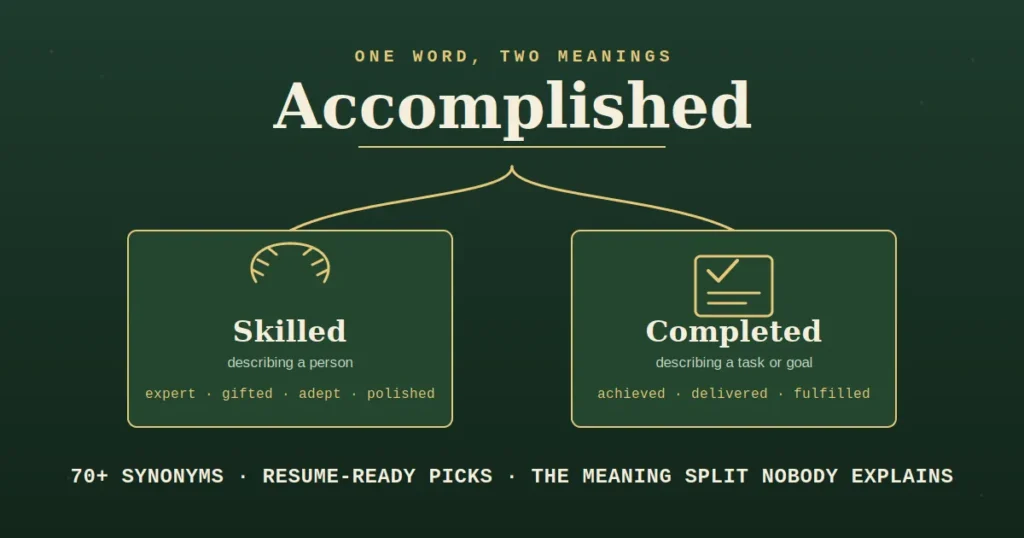
“Accomplished” actually carries two different meanings, and that’s exactly where most people get stuck. First, as an adjective describing a person, strong synonyms include skilled, expert, gifted, polished, masterly, and adept.
Second, as a way to describe a finished task or goal, better options include achieved, completed, executed, fulfilled, and realized. Because these two uses look identical on the page, writers constantly mix them up so below, we’ll untangle both, plus give you resume-ready alternatives and real sentence examples.
Why This Word Trips People Up
Here’s the thing nobody tells you upfront: “accomplished” isn’t one word with one job. It’s actually two.
For instance, you can say “an accomplished violinist” and mean she’s skilled. Alternatively, you can say “the team accomplished the task” and mean they finished it. Same spelling, same word, yet two completely different jobs in the sentence.
Most thesaurus pages simply dump a list of 60-something synonyms without separating these uses, so you end up with “expert” and “completed” sitting side by side as if they’re interchangeable. In reality, they’re not. If you swap them by mistake, your sentence stops making sense. For example, “the task was expert” reads like a translation error.
This guide fixes that problem. First, we’ll split synonyms by meaning; then, we’ll sort them by tone (formal, casual, resume), so you always grab the right word for the right job.
“Accomplished” as Skilled or Talented
Use this group whenever you’re describing a person who is good at something.
| Word | Feel | Example |
| Skilled | Neutral, widely usable | Because she’s a skilled negotiator, she closes deals others walk away from. |
| Expert | Strong, implies deep knowledge | She’s an expert baker who has won three regional contests. |
| Gifted | Suggests natural talent | Even without formal training, he tells stories like a gifted natural. |
| Adept | Slightly formal, precise | The team handled last-minute changes with adept ease. |
| Masterly | Elevated, almost literary | From start to finish, it was a masterly performance. |
| Polished | Implies refinement through practice | After years on stage, her delivery became remarkably polished. |
| Talented | Everyday, warm | He never went to art school, yet he’s a genuinely talented photographer. |
| Proficient | Slightly technical/measured | She’s proficient in three programming languages. |
| Consummate | Very formal, top-tier | In every meeting, he came across as a consummate professional. |
| Cultured | Describes refinement, not just skill | Thanks to years abroad, she grew cultured and well-read. |
“Accomplished” as Completed or Achieved
Use this group whenever you’re describing a task, goal, or action that got finished.
| Word | Feel | Example |
| Achieved | Neutral, most common swap | She achieved her sales target two months early. |
| Completed | Simple, factual | The crew completed the renovation ahead of schedule. |
| Fulfilled | Suggests meeting a promise or need | He fulfilled every requirement on the checklist. |
| Executed | Implies a plan carried out precisely | The team executed the launch without a single delay. |
| Realized | Slightly formal, goal-focused | She finally realized her childhood dream. |
| Delivered | Business/project tone | Even under budget, the team delivered the project on time. |
| Attained | Formal, goal-oriented | After months of study, he attained the certification. |
| Finalized | Administrative tone | They finalized the contract last Friday. |
| Concluded | Neutral, process-ending | Negotiations concluded with both sides satisfied. |
| Secured | Implies effort to obtain something | After weeks of talks, the company secured the deal. |
Search Intent: Why Are You Actually Here?
Generally, people land on “synonyms for accomplished” for a handful of different reasons, and the right answer depends on which one applies to you:
- Job seekers who need to rewrite a resume that overuses “accomplished” in every bullet point
- Students and writers trying to describe a skilled person without repeating themselves
- ESL learners confused about why “accomplished” sometimes means skilled and sometimes means done
- Editors and proofreaders who want to double-check word choice for tone and precision
Because of that, we’ve structured this article so all four groups can find what they need quickly, without wading through irrelevant sections.
The Resume Problem: “Accomplished” Is Now Overused
Here’s a gap most vocabulary articles don’t mention: career sites now flag “accomplished” as one of the most overused resume words, right alongside “responsible for” and “team player.” Since recruiters read hundreds of resumes, and since every candidate tends to open a bullet with the same word, none of them actually stand out.
So, instead of leading every bullet with “accomplished,” try pairing a more specific verb with a real number:
- Weak: Accomplished sales goals for three consecutive quarters.
- Stronger: Exceeded sales targets by 18% for three consecutive quarters.
- Weak: Accomplished a major website redesign.
- Stronger: Delivered a website redesign that cut load time by 40%.
In short, swap “accomplished” for a verb that shows how the result happened for example, exceeded, streamlined, delivered, launched, or generated then back it up with a number whenever possible.
Formal vs. Casual: Quick Comparison
| Context | Best Choice | Avoid |
| Resume/cover letter | Achieved, delivered, exceeded, executed | Accomplished (overused), “did” |
| Academic writing | Attained, realized, fulfilled | Nailed, pulled off |
| Casual conversation | Pulled off, nailed it, got it done | Consummate, masterly |
| Describing a skilled person formally | Accomplished, adept, proficient | Good at, pretty great |
| Describing a skilled person casually | Talented, gifted, a natural | Consummate, cultured |
Common Mistakes
- Using a “skilled” synonym where a “completed” synonym belongs. For instance, “she expert the marathon” doesn’t work, since “expert” describes a person, not an action. Instead, you’d say “she completed the marathon.”
- Treating “accomplished” and “talented” as identical. Because “talented” suggests natural ability, while “accomplished” suggests skill built through achievement and experience, a talented teenager might not yet be an accomplished one.
- Repeating “accomplished” across every resume bullet. If a recruiter sees it three times in one resume, it quickly stops meaning anything so vary it with achieved, delivered, exceeded, and led.
- Using “consummate” too casually. Since it’s a strong, formal word, “a consummate professional” works well in a reference letter, but sounds odd in a text message.
- Forgetting that “accomplished” can also be a straightforward past-tense verb, not just an adjective. In other words, “I accomplished my goal” (verb) differs from “an accomplished pianist” (adjective) both are correct, but they perform different grammatical jobs.
Pro Tips
- First, ask yourself: am I describing a person or a result? That single question sorts you into the right half of this article every time.
- For resumes, always pair the verb with a number. While “achieved” alone works fine, “achieved 120% of quota” actually gets interviews.
- Don’t stack synonyms in the same paragraph just to avoid repetition. Instead, one well-chosen word beats three near-misses.
- Match formality to the room. Use “nailed it” in a team Slack message, but choose “executed flawlessly” for a client report.
- When in doubt, read the sentence out loud. If a synonym sounds like it’s trying too hard, it probably is, so go simpler instead.
Frequently Asked Questions
What is a stronger word than “accomplished” for a resume? It depends on the achievement. For numbers you beat, use “exceeded”; for projects you finished, use “delivered”; and for anything you managed, use “led.” Overall, each option reads as more specific and less overused than “accomplished.”
Is “accomplished” formal or casual? It leans from formal to neutral. Consequently, it works well in resumes, reports, and reference letters, while “pulled off” or “nailed it” fit better in casual speech.
What’s the difference between “accomplished” and “achieved”? “Accomplished” often describes a person’s skill level (“an accomplished chef”) or a completed action. Meanwhile, “achieved” almost always refers to reaching a specific goal or result, which makes it the safer, more precise choice for resumes.
What is a one-word synonym for “highly accomplished”? Both “consummate” and “masterly” compress “highly accomplished” into a single formal word, although they suit writing more than everyday speech.
What is the opposite of “accomplished”? Common antonyms include inexperienced, unskilled, and inept; meanwhile, for the “completed” sense, you’d use unfinished or abandoned instead.
Conclusion
Overall, “accomplished” isn’t wrong to use, it’s just doing double duty, and most writers never notice which job it’s doing in their own sentence. Once you split it into two lanes (skilled person vs. completed task), picking a synonym stops being guesswork: reach for expert, gifted, or polished when you mean skilled, and choose achieved, delivered, or executed when you mean done.
On a resume especially, swap it out entirely wherever you can, because a number paired with a specific verb will always outperform a word every other applicant already used.

I am Alexander, a passionate writer and language enthusiast at Synonyms. I specialize in creating clear, helpful content about synonyms, word meanings, and language differences to make English easier for everyone.