Words are powerful tools that help us communicate our thoughts, feelings, and ideas. However, using the same word repeatedly can make writing sound boring and repetitive. This is where synonyms become useful.
Synonyms are an important part of the English language. They help us express ourselves in different ways while keeping the same basic meaning. Whether you are writing an essay, speaking in class, creating blog content, or learning English, understanding synonyms can improve your vocabulary and communication skills.
In this guide, you will learn what a synonym is, why synonyms are important, different types of synonyms, examples of synonyms, and how they are used in everyday life.
What Is a Synonym?
A synonym is a word that has the same or nearly the same meaning as another word.
In simple terms, synonyms are different words that can often be used to express the same idea.
For example:
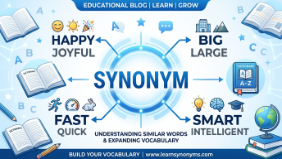
- Happy = Joyful
- Big = Large
- Fast = Quick
- Smart = Intelligent
- Begin = Start
When people use synonyms, they can make their writing more interesting and avoid repeating the same words over and over again.
Simple Definition
A synonym is a word that means the same thing or almost the same thing as another word.
For example, if someone says, “The movie was good,” they could also say, “The movie was excellent.” In many situations, “good” and “excellent” have similar meanings.
Where Does the Word Synonym Come From?
The word “synonym” comes from the Greek language. It is made from two Greek words:
- Syn = together or same
- Onoma = name
Together, these words mean “same name.” Over time, the term came to describe words that share similar meanings.
Examples of Synonyms
The best way to understand synonyms is by looking at examples.
| Word | Synonym |
| Happy | Joyful |
| Big | Large |
| Small | Tiny |
| Fast | Quick |
| Smart | Intelligent |
| Easy | Simple |
| Strong | Powerful |
| Beautiful | Attractive |
| Begin | Start |
| End | Finish |
| Angry | Mad |
| Brave | Courageous |
| Quiet | Silent |
| Rich | Wealthy |
| Friendly | Kind |
These words have similar meanings and can often replace one another in sentences.
Example Sentences
Happy:
- Sarah felt happy after winning the competition.
- Sarah felt joyful after winning the competition.
Big:
- They live in a big house.
- They live in a large house.
Fast:
- The car is very fast.
- The car is very quick.
The meaning remains nearly the same even though different words are used.
Why Are Synonyms Important?
Synonyms play a major role in speaking and writing.
1. They Improve Writing
Imagine reading a paragraph that repeats the same word again and again.
Example:
“The book was good. The story was good. The characters were good.”
This sounds repetitive.
Using synonyms makes the writing more interesting:
“The book was excellent. The story was engaging. The characters were impressive.”
The second version sounds much better.
2. They Help Build Vocabulary
Learning synonyms introduces you to new words.
For example, instead of always using “happy,” you can learn:
- Joyful
- Cheerful
- Delighted
- Pleased
- Glad
The more synonyms you know, the stronger your vocabulary becomes.
3. They Improve Communication
Different situations require different words.
For example:
- “Kid” is informal.
- “Child” is more formal.
Both words have similar meanings, but choosing the right synonym helps you communicate more effectively.
4. They Make Reading More Interesting
Authors, journalists, and bloggers use synonyms to keep readers engaged.
Without synonyms, writing would become repetitive and dull.
Types of Synonyms
Not all synonyms are exactly the same. There are different types.
Absolute Synonyms
Absolute synonyms have exactly the same meaning.
Examples:
- Sofa = Couch
- Autumn = Fall
These words can usually replace each other without changing the meaning.
However, true absolute synonyms are rare in English.
Near Synonyms
Near synonyms have similar meanings but are not exactly identical.
Examples:
- Happy = Content
- Angry = Furious
These words are related, but they express different levels of emotion.
Someone who is furious is usually much angrier than someone who is simply angry.
Synonyms in Everyday Life
You probably use synonyms every day without realizing it.
For example:
Instead of saying “good” all the time, people may say:
- Great
- Excellent
- Wonderful
- Fantastic
- Amazing
Instead of saying “bad,” they may say:
- Poor
- Terrible
- Awful
- Unpleasant
- Negative
Using different words helps conversations sound more natural.
Synonyms in School
Students often use synonyms when writing essays and reports.
Teachers encourage students to avoid repeating the same words too often.
Example:
Instead of writing:
“The scientist made an important discovery. The important discovery changed science.”
A student could write:
“The scientist made an important discovery. The significant finding changed science.”
This makes the writing stronger and more professional.
Synonyms in Books and Stories
Writers use synonyms to create variety and make their stories enjoyable.
Imagine a story that says:
“The giant dragon was big. Its wings were big. Its tail was big.”
A writer might improve it by saying:
“The giant dragon was enormous. Its wings were massive. Its tail was gigantic.”
The description becomes much more vivid and exciting.
Synonyms in SEO and Online Content
Today, websites and blogs often use synonyms to improve content quality.
Search engines can understand related words.
For example, an article about cars might also include:
- Vehicles
- Automobiles
- Motorcars
This helps cover the topic more naturally and improves readability.
However, writers should use synonyms naturally rather than forcing them into content.
Synonyms vs Antonyms
Many people confuse synonyms and antonyms.
What Are Synonyms?
Synonyms are words with similar meanings.
Examples:
- Happy = Joyful
- Fast = Quick
- Big = Large
What Are Antonyms?
Antonyms are words with opposite meanings.
Examples:
- Happy = Sad
- Fast = Slow
- Big = Small
Comparison Table
| Synonyms | Antonyms |
| Similar meanings | Opposite meanings |
| Happy = Joyful | Happy = Sad |
| Big = Large | Big = Small |
| Fast = Quick | Fast = Slow |
Remember:
- Synonym = Similar
- Antonym = Opposite
Common Mistakes When Using Synonyms
Using the Wrong Word
Some synonyms seem similar but cannot always replace each other.
For example:
- Slim
- Skinny
Both describe a thin person, but “skinny” may sometimes sound negative.
Ignoring Context
Words change meaning depending on the sentence.
Example:
The word “bright” can mean:
- Intelligent
- Full of light
Always consider the context before choosing a synonym.
Using Too Many Synonyms
Adding too many fancy words can make writing difficult to understand.
Good writing focuses on clarity, not complexity.
Tips for Learning Synonyms
Here are some easy ways to learn new synonyms:
Read More
Books, articles, and blogs introduce you to new vocabulary.
Use a Dictionary and Thesaurus
A dictionary explains meanings, while a thesaurus provides synonyms.
Practice Writing
Try replacing common words with synonyms in your daily writing.
Learn Word Lists
Create lists of common words and their synonyms.
Example:
Happy:
- Glad
- Cheerful
- Delighted
- Joyful
Big:
- Large
- Huge
- Massive
- Enormous
Frequently Asked Questions
What is a synonym in simple words?
A synonym is a word that has the same or nearly the same meaning as another word.
What is an example of a synonym?
“Big” and “large” are synonyms because they have similar meanings.
Why do we use synonyms?
We use synonyms to improve writing, avoid repetition, and expand vocabulary.
Are all synonyms exactly the same?
No. Many synonyms have slight differences in meaning, tone, or usage.
What is the opposite of a synonym?
The opposite of a synonym is an antonym, which is a word with the opposite meaning.
Can synonyms improve writing?
Yes. Synonyms make writing more engaging, clear, and professional.
Conclusion
A synonym is a word that has the same or nearly the same meaning as another word. Examples include happy and joyful, big and large, and fast and quick.
Synonyms are important because they improve vocabulary, make writing more interesting, and help people communicate effectively.
Whether you are a student, writer, teacher, or English learner, understanding synonyms can strengthen your language skills. By learning and using synonyms regularly, you can become a more confident speaker and writer while making your communication clearer and more engaging.
read more articles
- synonyms for fox
- synonyms for powered
- synonyms of nation
- synonyms of dependent
- hidden treasure synonyms

I am Alexander, a passionate writer and language enthusiast at Synonyms. I specialize in creating clear, helpful content about synonyms, word meanings, and language differences to make English easier for everyone.